Advancing Your Karate Practice
Hip Rotation Mechanics
The Engine of Power
In Shotokan karate, power doesn't come from the arms or legs. It originates from the body's centre, specifically from the rotation of the hips. This principle is called '' (腰), and mastering it is the difference between a superficial technique and one with devastating impact. It's about treating your body not as a collection of separate limbs, but as a single, connected unit.
The power generated by the hips is transmitted through the body in a wave of motion. This concept, known as the , is fundamental. Force starts at the floor, travels up through your legs, is amplified by the explosive snap of your hips, and is finally channelled through your torso, shoulder, and arm into your fist or foot. A punch isn't just an arm movement; it's the culmination of a full-body action.
For example, a Kung Fu practitioner may use their hips and core muscles to generate torque, which is transferred through the limbs to create powerful strikes.
Two Sides of Rotation
Hip rotation in Shotokan primarily manifests in two ways: regular rotation (順回転, Jun-kaiten) and reverse rotation (逆回転, Gyaku-kaiten). Understanding the mechanics of both is crucial for a versatile practice.
| Rotation Type | Description | Primary Use |
|---|---|---|
| Jun-kaiten | The hip rotates in the same direction as the striking limb. For a right-hand punch (gyaku-zuki), the right hip drives forward. | Maximises power for linear, forward-moving techniques like straight punches and front kicks. |
| Gyaku-kaiten | The hip rotates in the opposite direction of the striking limb. As one hip pulls back, the other snaps forward. Think of the recoil motion in a punch (choku-zuki) or the hip action in an age-uke (rising block). | Generates speed and sharp, snapping power. Essential for blocks and techniques where recoil is part of the movement. |
In Jun-kaiten, you are throwing your body's momentum behind the strike, creating immense forward pressure. In Gyaku-kaiten, the power comes from the sharp, whip-like action created by the counter-rotation. One isn't better than the other; they are simply different tools for different situations. A powerful strike often involves a blend of both, starting with a reverse rotation to load the hips, followed by a regular rotation to deliver the blow.
Stability and Subtlety
Generating this rotational power is useless without a stable core. To transfer force effectively, your trunk must be rigid. This is achieved by engaging the pelvic floor and lower abdominal muscles. Imagine creating a solid cylinder from your hips to your ribs. This bracing prevents energy from leaking out and ensures the full force of your hip rotation is channelled into the technique.
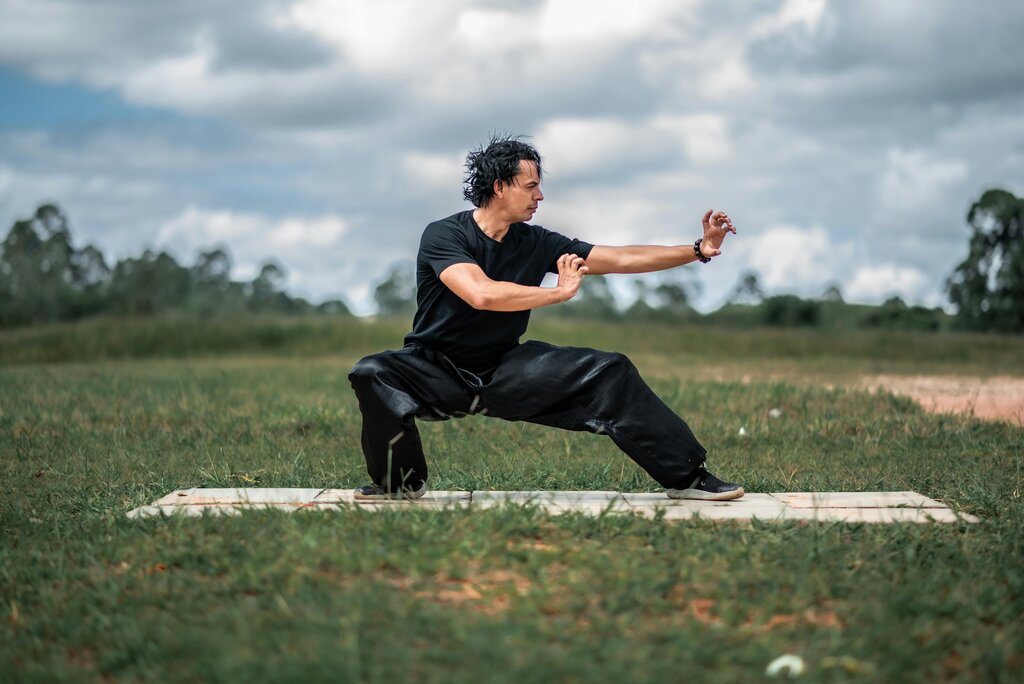
There's a trade-off between power and speed. A fully squared hip position, where your hips are perfectly aligned with your target, delivers maximum impact. However, it takes longer to achieve and can be easier for an opponent to read. A partially turned hip allows for quicker strikes with better reach but sacrifices some power. The choice depends on the situation: a finishing blow might demand a full rotation, while a quick jab requires less commitment.
Finally, a critical detail for intermediate practitioners is maintaining a level hip height throughout the rotation. Any bouncing or dipping motion is wasted energy. More importantly, it's a form of —a clear signal to your opponent that an attack is coming. A smooth, level rotation is not only more efficient but also far more deceptive.
Smooth, level hip rotation is the hallmark of an efficient and deceptive martial artist. Power without control is wasted.
Time to review the key concepts we've covered.
Let's check your understanding of these principles.
What is the primary source of power in a Shotokan karate technique, referred to as 'Koshi'?
The concept of force travelling from the floor, up through the legs, being amplified by the hips, and channelled into a strike is known as the:
Practising these concepts—focusing on the type of rotation, core stability, and level hip movement—will transform your techniques.