Advancing Your Karate Practice
Dynamic Stance Transitions
The Art of the In-Between
You've mastered the foundational stances: Zenkutsu-dachi, Kokutsu-dachi, and Kiba-dachi. You can hold them with stability and precision. But in a real confrontation, you don't hold a stance—you move through it. The true art isn't in the pose, but in the seamless, powerful transition between them.
The goal is to move without wasted energy. A common mistake is “bobbing,” where the head moves up and down between stances. This telegraphs your intention, drains your stamina, and momentarily breaks your connection to the ground. True mastery is keeping your head on a level plane, gliding from one technique to the next as if on a rail.
Generating Force from the Floor
Your power doesn't come from your arms or shoulders; it comes from the ground. Think of the floor not as something you stand on, but as something you push off of. To transition, you don’t just lift a foot and step. Instead, you apply pressure into the floor with one foot to propel your body in the desired direction. This creates a stable, driven movement.
This propulsion is what allows you to maintain your during the transition. Instead of your weight crashing from one position to the next, it flows. Your body remains a single, connected unit, always ready to absorb or deliver force. This constant connection is the key to both stability and explosive speed.
The point of our stance training and the stances in our forms is to learn how to move, not merely how to stand.
To achieve this grounded propulsion, you need to cultivate shime—a state of focused muscular tension, particularly in the legs and core. It’s not about being rigid or stiff. is a dynamic tension, a feeling of being coiled and ready, like a compressed spring. It keeps your structure intact during the chaos of movement, ensuring your stance doesn’t collapse the moment you shift your weight. Without shime, your transitions will be sloppy and weak.
Sliding into Position
Two key footwork methods enable this smooth, level movement: Suri-ashi and Yori-ashi.
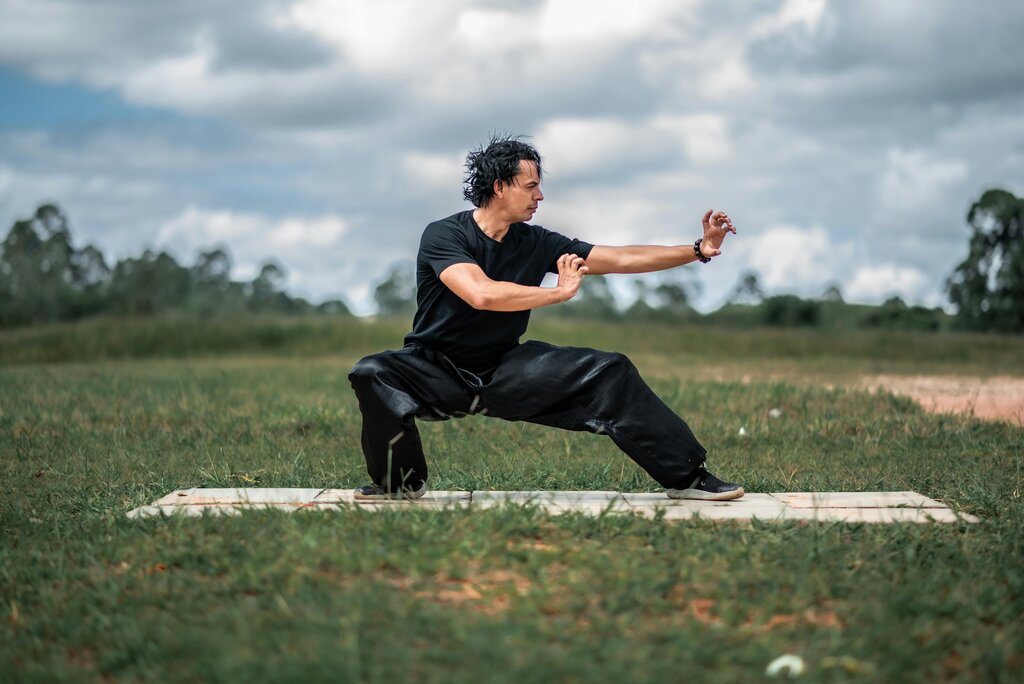
(sliding foot) is the primary method. You glide your feet across the floor rather than lifting them. The ball of the foot maintains light contact with the surface, acting like a sensor. This keeps you grounded and ready to change direction instantly. Think of it as skimming the surface of water—you're moving quickly but remain connected.
Yori-ashi (dragging step) is a variation used for adjusting distance without changing your facing. To move forward, the front foot slides forward, and then the rear foot follows, or “drags,” to re-establish the stance. To move back, the rear foot slides back first, followed by the front. In both cases, the feet never cross, and your center of gravity remains between them.
Fluid, adaptable movement and mastery of distance are essential skills for any martial artist or self-defence practitioner.
By combining floor pressure for propulsion, shime for stability, and suri-ashi for smooth footwork, your stances stop being static positions. They become fluid, powerful, and deceptive. Your opponent won't see you step; they'll simply see you arrive.
Ready to test your understanding of these dynamic principles?
What is the primary problem with "bobbing" (moving your head up and down) when transitioning between stances?
According to the principles described, where does true power in movement originate?
Drill these transitions slowly at first. Focus on the feeling of pushing the floor away and keeping your head level. With practice, the movement will become second nature, and your karate will become far more effective.