Advancing Your Karate Practice
Koshi Power Generation
The Hips Don't Lie
In Karate, true power isn't about the size of your muscles. It's about mechanics. A powerful strike or block isn't pushed from the shoulder; it's launched from the ground, channelled through the body, and amplified by the hips. This concept is called Koshi, and it's the engine behind every effective technique.
Koshi
noun
The Japanese term for the hips, waist, and lumbar region. In martial arts, it refers to the body's centre of gravity and the core engine for generating power through rotation and vibration.
Think of it as a kinetic chain. The force starts when you push off the floor, travels up your legs, and is then aggressively redirected by your hips. This transfer of energy from the ground is called Ground Reaction Force (GRF). Your legs collect this energy, and your hips act like a gearbox, converting that raw upward force into forward, rotational power that accelerates your limbs. Without proper hip action, you're just arm-punching, leaving most of your potential power untapped.
Two key elements of hip mechanics are pelvic alignment (Shinto) and body alignment (Gamae). A common mistake is to arch the lower back, which leaks power and creates instability. Instead, the pelvis should be tilted slightly upwards at the front, engaging the core and creating a solid connection between the upper and lower body. This alignment, Gamae, ensures that the power generated by the hips is transferred efficiently without being lost along the way.
Rotation vs Vibration
Koshi isn't a one-size-fits-all movement. We can apply hip power in two distinct ways: rotation and vibration.
Hip Rotation is a large, deliberate turning of the hips. Think of throwing a gyaku-zuki from a deep stance. Your back foot pivots, your hips turn almost 90 degrees, and your entire body mass drives behind the punch. This method generates maximum power and is ideal for decisive, committed techniques.
Hip Vibration, on the other hand, is a short, sharp, explosive snap. It's a much smaller, faster movement, almost like a shudder. This is used for quick, repeated techniques like a jab (kizami-zuki) or for finishing a technique with a final burst of energy (kime). It's less about full-body rotation and more about a sudden, percussive contraction and relaxation of the core muscles.
| Feature | Hip Rotation | Hip Vibration |
|---|---|---|
| Movement | Large, full turn | Short, sharp snap |
| Speed | Slower to initiate | Extremely fast |
| Power | Maximum force generation | High-speed impact, kime |
| Range | Best for long-range techniques | Ideal for short to mid-range |
| Example | Gyaku-zuki (reverse punch) | Kizami-zuki (jab), finishing a block |
Mastering both is crucial. Rotation provides the knockout power, while vibration provides the speed and sharpness needed for effective combinations and defence.
The Double Hip Action
The transition between stances is where these concepts truly come to life. Let's analyse the movement from a back stance (kokutsu-dachi) to a front stance (zenkutsu-dachi) while executing a strike. This isn't just a simple step forward; it's a powerful
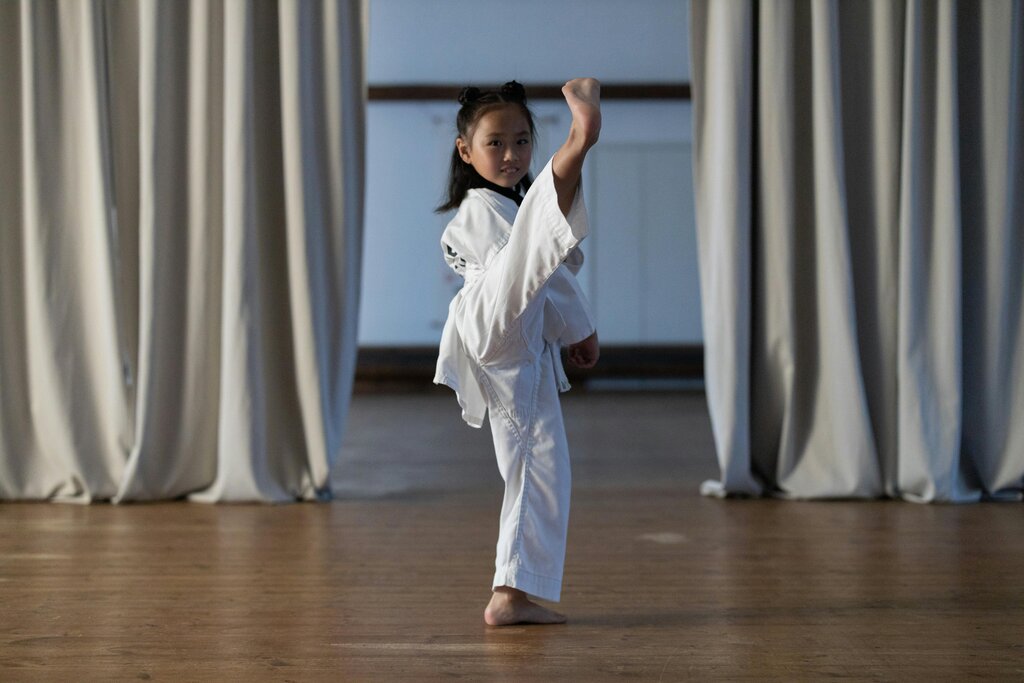
whip-like motion often called the double hip action .
-
First Hip Action (Loading): As you begin to move from kokutsu-dachi, your hips initially rotate backwards slightly. This movement is subtle but critical. It's like pulling back a slingshot; you are loading the hips with potential energy.
-
Second Hip Action (Firing): As your front foot lands in zenkutsu-dachi, your hips explosively reverse direction and fire forward. This rapid reversal unleashes the stored energy, whipping your torso and striking limb towards the target with immense speed and power.
This double action transforms a simple step into a devastating power-generation technique. It ensures your body weight is moving with the strike, not just your arm.
By rotating the hips and engaging the core, a fighter can amplify their power significantly.
When you practice, focus on this sequence. Feel the initial backward coil, then the explosive release forward. The goal is to make the transition seamless and fluid, turning your entire body into a single, coordinated weapon. This is the essence of moving beyond basic stances and into the dynamic application of Koshi.
Ready to test your understanding of these power principles?
According to the principle of Koshi, what is the primary engine for a powerful Karate technique?
What is the term for the force that travels from the floor, up the legs, and is redirected by the hips to power a technique?
Understanding these mechanics is the first step. The next is feeling them in your own body through thousands of repetitions.