Advancing Your Karate Mastery
Biomechanical Power Generation
The Body as a Whip
A powerful strike isn't born in the fist or the foot. It begins with the floor. Think of your body as a whip. The handle is your connection to the ground, and the tip is your hand or foot. To make the tip crack, you don't just flick your wrist; you initiate a wave of energy that starts from your core and travels the entire length.
In Karate, this sequence of movement is called the and it is the foundation of all power generation. The force for a punch starts when your feet push against the ground. This energy travels up through your legs, is amplified by the rotation of your hips, funnels through your torso and shoulders, and finally explodes out of your striking limb. Each link in the chain adds momentum and velocity, culminating in a focused impact far greater than any single muscle group could produce on its own.
Power flows from the ground up. Your connection to the floor is the first and most critical link.
This process relies on Ground Reaction Force. For every action, there is an equal and opposite reaction. When you push down and away on the floor with your feet, the floor pushes back with equal force. This is the energy you harvest. Even your non-punching hand, the hikite, plays a role. Pulling it back sharply to your hip does more than just prepare for the next block or strike; it acts as a counterbalance, helping to anchor your body and drive the rotation that channels this ground force.
The Engine of Power
If the feet connect you to the ground, the hips are the engine that multiplies the force. Proper hip rotation, or koshi no kaiten, is what separates a weak push from a devastating strike. By powerfully twisting your hips toward the target, you convert the linear force from your legs into rotational torque, dramatically increasing the speed and mass behind your technique.
There are two main types of hip action. For techniques that travel a longer distance, like a reverse punch (gyaku-zuki), you use full rotation. The back hip drives forward, turning over completely. For shorter, faster techniques, like those in a kata, you might use hip vibration. This is a much smaller, sharper snapping motion, like quickly slamming a door, that generates rapid power over a minimal distance.
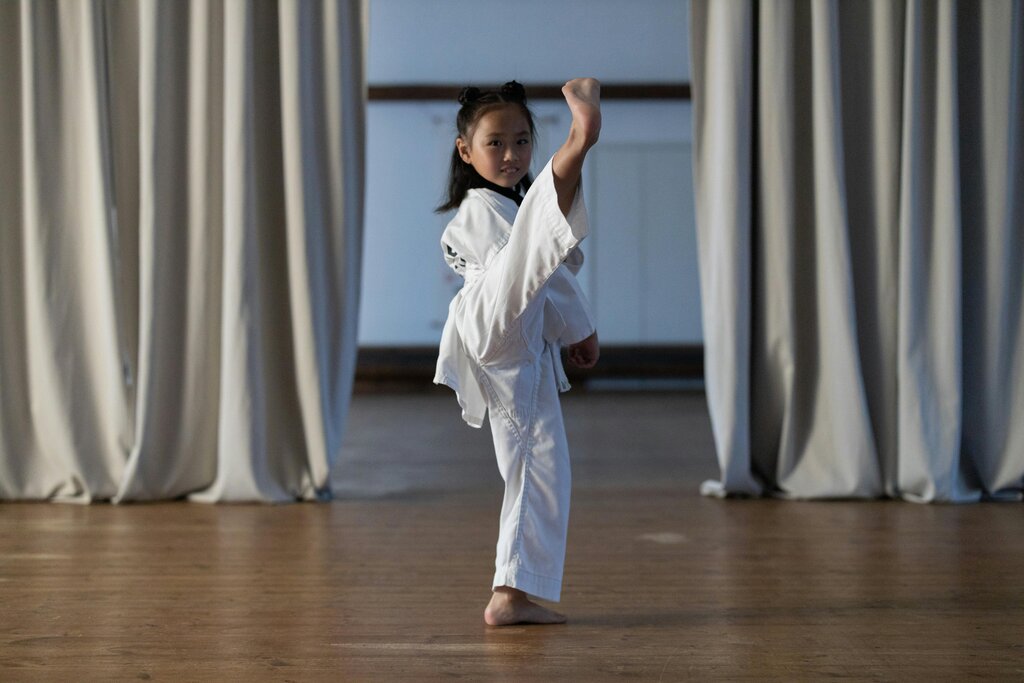
No matter the technique, your center of gravity, or , must remain stable and controlled. It's the axle around which your body rotates. A stable hara allows for a smooth transfer of power, while an unstable one causes energy to leak out, weakening your strike and compromising your balance.
Relax to Win
It seems contradictory, but the secret to maximum speed is relaxation. Tense muscles are slow muscles. They fight against each other and create drag. To achieve a truly fast punch or kick, your body must remain loose and fluid throughout the motion, allowing the kinetic chain to work without resistance.
Only at the precise moment of impact do you tense everything. This is the concept of —the focus or decisive moment. It's a full-body contraction that lasts for only an instant. This sudden tension transfers all the accumulated kinetic energy into the target and ensures your body's structure is solid upon impact, preventing your joints from buckling and focusing the force into a single point.
Flow like water until the moment of impact, then become stone.
This principle also ties into structural alignment. For force to be transmitted effectively, your bones need to be properly aligned from the ground to the target. In a punch, this means the wrist is straight, and the knuckles of the index and middle finger are aligned with the bones of the forearm. Any bend or misalignment creates a weak point where energy escapes and injuries can occur. Proper kime locks this structure in place, making your arm feel like a solid steel rod at the moment of impact.
Ready to test your understanding of how these principles come together?
According to the principles of Karate power generation, where does the force for a powerful strike originate?
The concept of ________ is the full-body contraction at the precise moment of impact to transfer accumulated energy into the target.
Mastering these concepts is a lifelong journey. It transforms your techniques from simple movements into an efficient, powerful expression of biomechanics.