Advancing Your Guitar Technique
Mastering Barre Chords
Beyond Open Chords
You've already mastered the foundational open chords. You know how to form a G, a C, and a D without looking. That's a huge step. But you've probably noticed a limitation: those shapes are stuck in one place. To play in a key like B-flat, you need a capo. Barre chords are the solution. They are moveable shapes that turn your index finger into a human capo, unlocking the entire fretboard.
The core idea is simple: take a familiar open chord shape, move it up the neck, and use your index finger to fret the open strings.
The E Shape
The most common barre chord comes from the open E major shape. To get a feel for it, form an open E major chord, but use your middle, ring, and pinky fingers instead of your usual first, second, and third. Your index finger should be free, hovering over the nut.
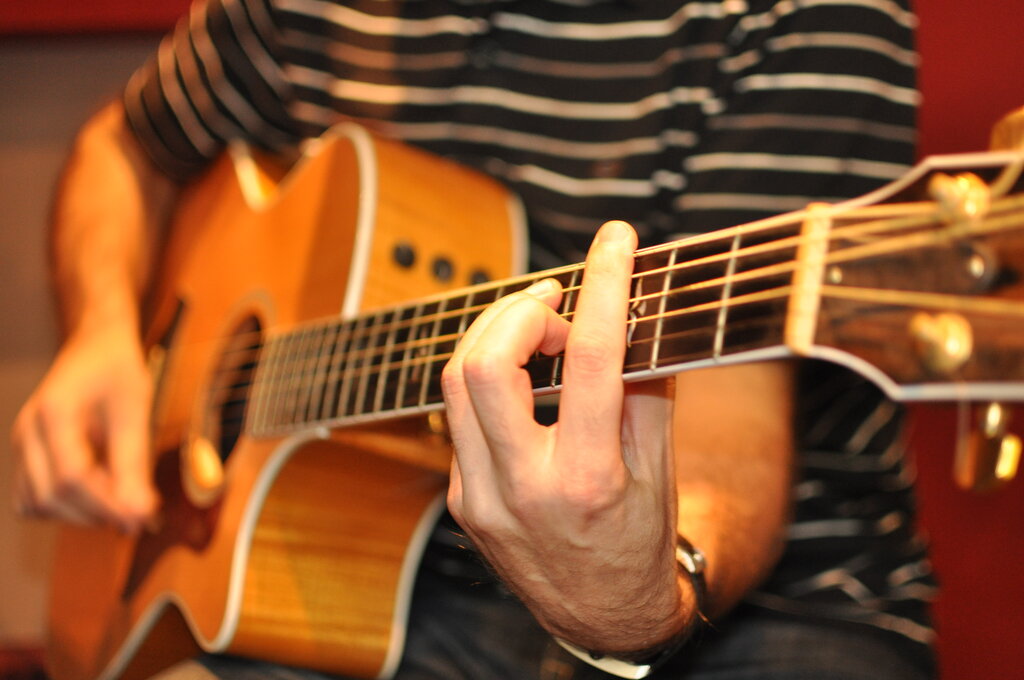
Now, slide that entire shape up three frets. The notes your middle, ring, and pinky are fretting are now at the 5th and 4th frets. Finally, press your index finger down flat across all six strings at the 3rd fret. This action is the barre. You are now playing a G major chord.
The root note of the chord—the note that gives the chord its name—is found on the thickest (low E) string. Since your index finger is pressing on the 3rd fret of the low E string, which is a G note, you're playing a G major chord. If you slide the whole shape up to the 5th fret, you're playing an A major. Move it to the 1st fret, and it's an F major.
| Fret | Note on Low E String | E-Shape Chord |
|---|---|---|
| 1 | F | F Major |
| 2 | F# | F# Major |
| 3 | G | G Major |
| 4 | G# | G# Major |
| 5 | A | A Major |
What about minor chords? It's an easy switch. Just like changing an open E major to an E minor, you simply lift your middle finger off the G string. That's it. With the barre at the 3rd fret and your middle finger lifted, you're now playing a G minor chord.
The A Shape
The second essential barre chord shape comes from the open A major chord. Again, start by forming an open A major chord with different fingers. The easiest way is to use your ring finger to press down on the D, G, and B strings at the 2nd fret. This frees up your index and middle fingers.
Now, slide that shape up the neck. Let's move it to the 5th fret, so your ring finger is barring the 7th fret. Place your index finger across the top five strings at the 5th fret. It's important to mute the low E string with the tip of your index finger or by not strumming it. You're now playing a D major chord.
For A-shape barre chords, the is on the A string (the second thickest string). Since your index finger is on the 5th fret of the A string, which is a D note, you're playing D major. Slide it down to the 3rd fret, and you have a C major.
| Fret | Note on A String | A-Shape Chord |
|---|---|---|
| 1 | A# / Bb | Bb Major |
| 2 | B | B Major |
| 3 | C | C Major |
| 4 | C# | C# Major |
| 5 | D | D Major |
To make the A-shape minor, you need to alter the shape slightly. Instead of barring with your ring finger, you'll need to fret the notes individually to make an A minor shape. Place your index finger for the barre, then use your ring finger on the A string (two frets higher) and your pinky on the D string (two frets higher). Your middle finger goes on the B string (one fret higher than the barre). It's a bit more of a stretch, but it follows the same logic as the open A minor chord.
Making It Musical
Knowing the shapes is one thing; using them smoothly is another. The biggest challenge is transitioning cleanly between open chords and barre chords. Practice moving from an open G to an F major barre chord (E-shape at 1st fret). Then try going from an open C to a D minor barre chord (A-shape minor at 5th fret).
Start slowly. Don't worry about speed. Focus on getting every note to ring out clearly. Often, a buzzing sound means you're not applying even pressure or your finger isn't close enough to the fret.
Don't press harder than you need to. Good technique is about efficiency, not a death grip. Roll your index finger slightly onto its side to use the bonier part, which helps apply pressure more effectively.
Now, let's test your understanding of these new shapes.
What is the primary function of your index finger when playing a barre chord?
If you play an E-shape barre chord with your index finger barred at the 5th fret, what chord are you playing?
With the E-shape and A-shape barre chords, you can now play any major or minor chord you need, all without reaching for a capo. It takes practice, but it's the gateway to true freedom on the guitar.