Advancing Your Guitar Technique
Barre Chord Foundations
Beyond Open Chords
You've mastered the basic open chords like G, C, and D. They sound great, but they're stuck in one place on the neck. To unlock the entire fretboard, you need a way to move these familiar shapes around. This is where barre chords come in.
The core idea is simple: your index finger becomes a movable nut. By pressing it firmly across all the strings at a certain fret, you can transpose any chord shape up and down the neck, allowing you to play in any key. This technique is built on the principles of the CAGED system, which maps out the fretboard using five fundamental open chord shapes.
The E Shape
Let's start with the open E major chord. You know this one well. To turn it into a movable barre chord, you'll use your index finger to press down on all six strings at a chosen fret. This acts as the new 'open' position. Then, you'll form the rest of the E major shape with your other three fingers, just one fret higher than your barre.
For example, to play an F major chord, you place your index finger barre across the first fret. Then, your middle, ring, and pinky fingers form the E major shape at the second and third frets. The crucial thing to remember is that the root note of an E-shape barre chord is always the note your index finger is pressing on the 6th (low E) string.
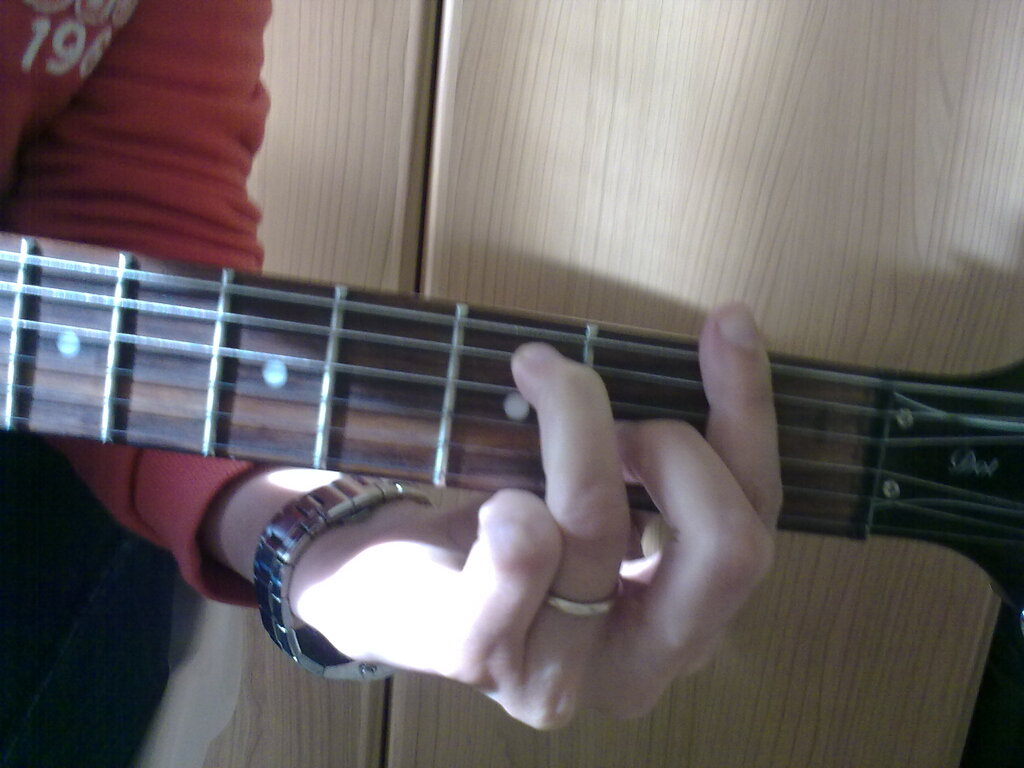
Once you have the major shape down, changing it to minor is straightforward. Just like changing an open E major to an E minor, you lift your middle finger. This flattens the third of the chord, giving it the minor quality. Everything else stays the same. An F minor barre chord is the same as the F major, but without your middle finger on the G string.
This single shape unlocks every major and minor chord up the neck. An E shape barre at the 3rd fret is a G chord. At the 5th fret, it's an A chord. At the 8th fret, it's a C chord.
The A Shape
The next essential movable shape comes from the open A major chord. The principle is the same, but the mechanics are slightly different. For this shape, your index finger barres the top five strings, from the A string down. The 6th (low E) string is not played.
The [{
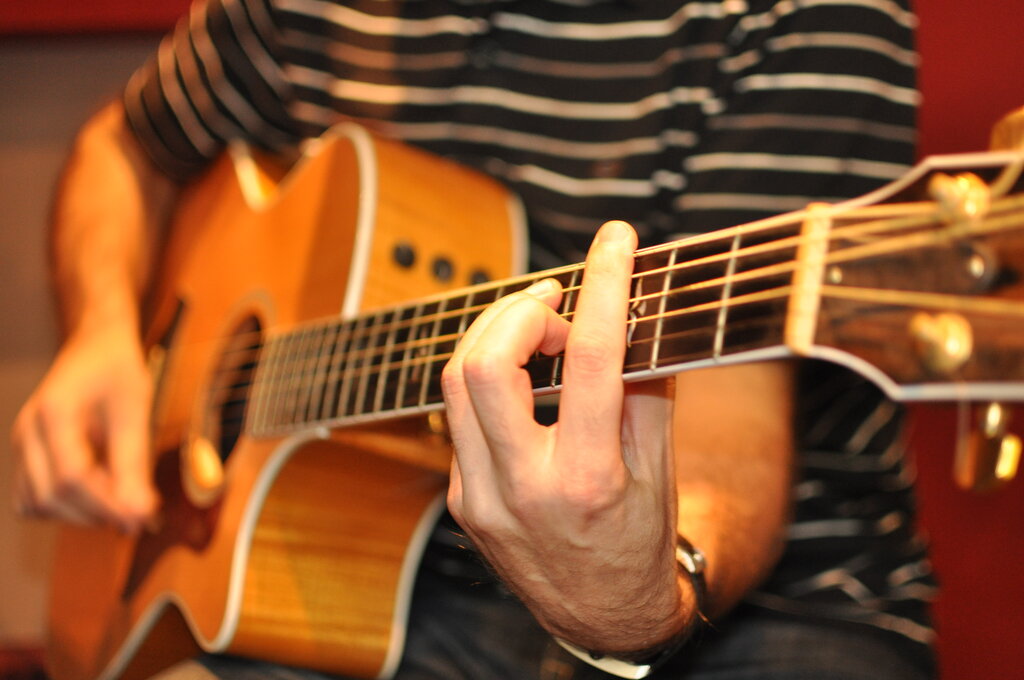
To create the A-shape minor barre chord, you adjust the fingering from the A minor open shape. After your index finger barre, your ring finger frets the D string, your pinky finger frets the G string, and your middle finger frets the B string. It follows the logic of the open A minor shape, just moved up the neck.
With the A shape, you can now reach chords whose root notes are on the 5th string. A barre at the 2nd fret gives you a B chord. At the 5th fret, a D chord. At the 7th fret, an E chord. Combining the E and A shapes gives you access to any major or minor chord you'll ever need.
Making it Clean
Barre chords are a physical challenge at first. Don't worry if your hand gets tired or some notes buzz. Building the necessary finger strength and muscle memory takes consistent practice.
Here are a few tips to get a clear sound:
- Use the side of your index finger. Roll your index finger slightly onto its bony side, closer to your thumb. This part of your finger can apply more consistent pressure than the fleshy underside.
- Keep your thumb centered. Place your thumb on the back of the neck, roughly behind your middle finger. This creates a clamp-like pressure that supports your barre.
- Stay close to the fret. Position your barring finger as close to the fret wire (the metal bar) as possible without being on top of it. This requires less pressure to get a clean note.
- Start higher up the neck. The frets are closer together higher up the neck (e.g., at the 5th or 7th fret), making the stretch easier for your fingers. Practice your shapes here before moving closer to the nut.
Start by practicing transitions between an open chord and a barre chord, like G major to the A-shape B minor (2nd fret), or C major to the E-shape F major (1st fret). This will build the fluidity you need for playing songs.
Ready to test your knowledge?
What is the primary function of your index finger when playing a barre chord?
If you are playing an E-shape barre chord and your index finger is on the 3rd fret, which chord are you playing?
Mastering these two shapes is a huge leap forward in your playing. It's the bridge between playing chords in one position and owning the entire fretboard.