Advancing with Generative AI
Transformer Architecture
The Transformer Revolution
In 2017, a paper titled "Attention Is All You Need" introduced an architecture that changed everything: the Transformer. Before this, models like Recurrent Neural Networks (RNNs) and LSTMs processed text sequentially, word by word, like a person reading a book. This worked, but it was slow and struggled to connect words that were far apart in a long sentence.
The Transformer model broke this sequential barrier. It processes all the words in a sentence at the same time, using a mechanism called attention to weigh the relationships between them. This parallel processing not only made training much faster but also proved incredibly effective at understanding context and long-range dependencies.
Encoders and Decoders
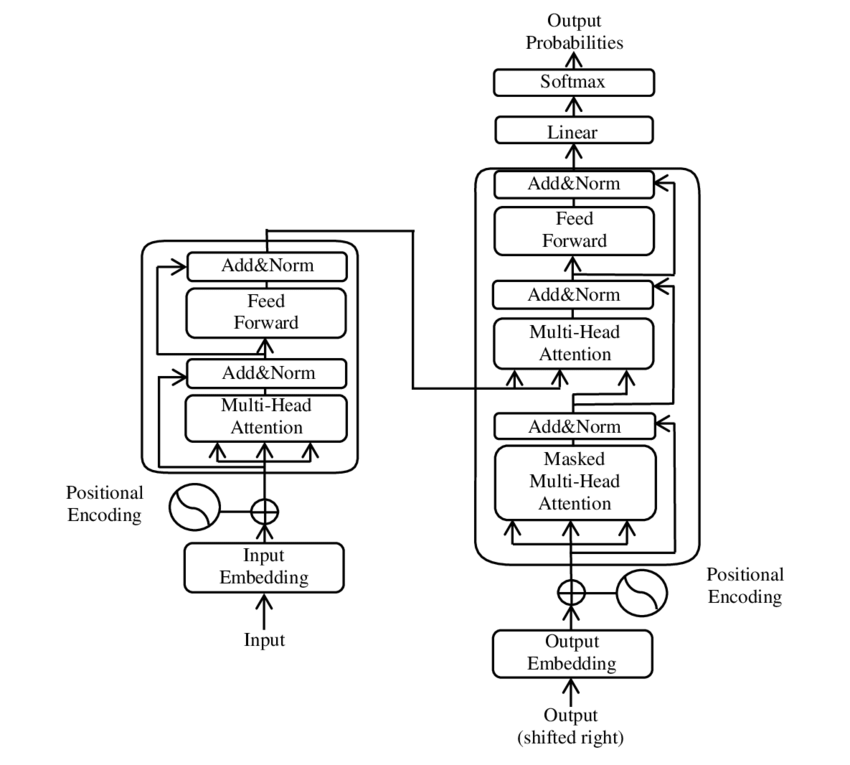
The original Transformer had two main parts: an encoder and a decoder. The encoder's job is to read and understand the input text. It builds a rich numerical representation of the input, capturing the meaning and context of every word. Think of it as the 'comprehension' part of the system.
The decoder's job is to take that understanding and generate an output. For a translation task, it would take the encoder's representation of an English sentence and generate the equivalent French sentence, word by word. Each part is a stack of identical layers.
However, many modern Large Language Models (LLMs), like the GPT series, use a decoder-only architecture. They essentially discard the encoder stack. This design is optimized purely for generation. It excels at tasks where the goal is to continue a sequence, like writing an essay based on a prompt, answering a question, or completing a line of code. It learns context and generates output within a single, unified structure.
The Magic of Attention
The core innovation of the Transformer is self-attention This mechanism allows a word to look at all other words in the input sequence to get clues about its own meaning. Consider the sentence: "The bank of the river is steep."
To understand the word "bank," the model needs context. Is it a financial institution or a riverside? Self-attention allows "bank" to assess its relationship with every other word. It will notice the strong link to "river" and assign it a high attention score, effectively clarifying its meaning.
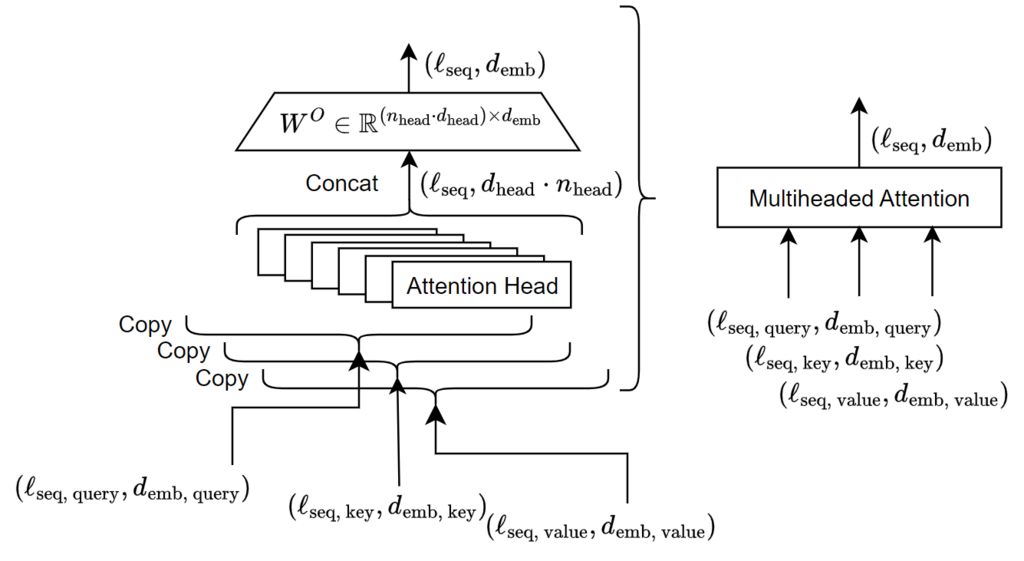
To do this, the model creates three vectors for each input word: a Query (Q), a Key (K), and a Value (V). The Query is like a question the word asks: "What am I in this context?" The Key is like a label on every other word, saying "This is what I am." The model compares the Query of one word to the Key of all other words to find the best matches. The Value contains the actual substance or meaning of each word. The attention scores determine how much of each word's Value gets passed along.
But what if a word has multiple contextual meanings? That's where comes in. Instead of calculating attention just once, this mechanism runs the self-attention process multiple times in parallel. Each parallel process is called an "attention head."
Each head can learn to focus on different types of relationships. One head might focus on grammatical links (subject-verb), another on semantic relationships (synonyms), and another on positional closeness. By combining the outputs of all these heads, the model gets a much richer and more nuanced understanding of the input text than it could with a single attention mechanism.
Completing the Picture
Since the Transformer processes all words in parallel, it has no inherent sense of word order. To fix this, we add Positional Encoding to the input embeddings. This is a vector that gives the model information about the position of each word in the sequence. These encodings use a clever combination of sine and cosine functions of different frequencies, allowing the model to easily learn about the relative positions of words.
Finally, each layer in both the encoder and decoder contains a simple, fully connected Feed-Forward Network (FFN). This network is applied independently to each position's representation after the attention mechanism has done its work. Its role is to further process the output from the attention layer, adding more computational depth and allowing the model to learn more complex transformations. It consists of two linear transformations with a ReLU activation in between.
Ready to test your knowledge?
What is the primary advantage of the Transformer architecture compared to older models like Recurrent Neural Networks (RNNs)?
In the self-attention mechanism, what are the three vectors created for each input word to determine contextual relationships?
By combining parallel processing, self-attention, and positional awareness, the Transformer architecture provides a powerful and efficient foundation for modern AI.