Advancing with Artificial Intelligence
Architectural Design Trade-offs
The Right Tool for the Job
Choosing a neural network architecture is like picking a tool from a toolbox. You wouldn't use a hammer to turn a screw. Similarly, the structure of your data dictates which model will perform best. The key difference lies in each architecture's built-in assumptions, or inductive biases—its inherent predisposition to find certain patterns over others.
Spatial vs. Sequential Data
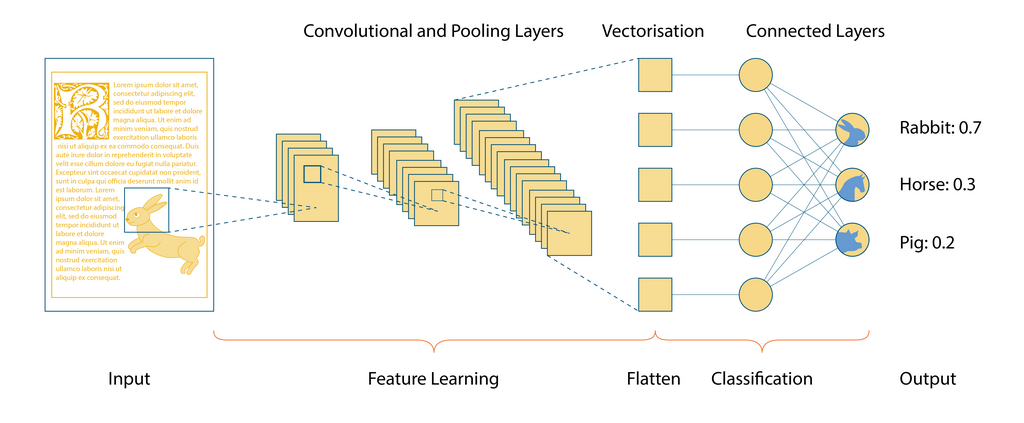
Convolutional Neural Networks (CNNs) are designed with a spatial bias. They excel at understanding data where proximity matters, like pixels in an image. A CNN processes an image by applying filters to small, localized regions. It first learns to recognize simple features like edges and corners. Subsequent layers combine these into more complex shapes like eyes or wheels, eventually building up to complete objects. This hierarchical feature detection mirrors how our own visual cortex works.
Recurrent Neural Networks (RNNs), on the other hand, have a sequential bias. They're built to process data where order is critical, such as words in a sentence or measurements in a time series. An RNN processes one element at a time, maintaining an internal 'memory' or hidden state that carries information from previous elements forward. This makes them ideal for tasks that require understanding context built up over time.
The downside is that this sequential processing creates a bottleneck. RNNs can't process an entire sequence at once. Furthermore, their memory can be short-lived. Information from early in a long sequence often fades by the end, a problem known as the vanishing gradient problem This makes it difficult for a standard RNN to connect a word at the beginning of a paragraph to one at the end.
Parallelism and Global Context
This is where Transformers come in. Originally designed for language translation, their architecture abandons recurrence entirely. Instead of processing data sequentially, a Transformer looks at the entire input sequence at once. It uses a mechanism called to weigh the importance of all other elements in the sequence for the current element it's considering. This allows it to draw direct connections between distant words, capturing long-range dependencies far more effectively than an RNN.
Unlike traditional Recurrent Neural Networks (RNNs) and Long Short-Term Memory (LSTM) networks, which rely on sequential data processing, the Transformer processes input data in parallel, making it more efficient and scalable for large datasets.
The key advantage here is parallelization. Since a Transformer doesn't need to wait for the previous element to be processed, it can perform its calculations for the entire sequence simultaneously. This makes training on massive datasets feasible and is a primary reason for the explosion in the size and capability of models like GPT-4.
Cost and Efficiency
This power comes at a cost. The self-attention mechanism is computationally expensive. Its memory and processing requirements scale quadratically with the length of the input sequence. Doubling the sequence length quadruples the computation. This makes Transformers less efficient for extremely long sequences compared to some specialized RNN or CNN variants.
We can compare these architectures by looking at their computational cost, often measured in FLOPs (Floating Point Operations per Second), and their parameter efficiency—how well they learn relative to the number of parameters they have.
| Architecture | Primary Use Case | Parallelization | Handles Long-Range Dependencies | Computational Cost |
|---|---|---|---|---|
| CNN | Spatial Data (Images, Video) | High (within layers) | Poor (limited by filter size) | Moderate |
| RNN | Sequential Data (Text, Time Series) | Low (inherently sequential) | Poor (vanishing gradients) | Low |
| Transformer | Sequential Data (Text, Genomics) | Very High | Excellent | High () |
When selecting an architecture, the goal is to match the model's inductive bias with the data's structure. For image recognition, a CNN is the clear choice. For real-time audio processing where latency is critical and sequences are processed piece-by-piece, an RNN might be more suitable. For translating a whole document where the context of the entire text is crucial, a Transformer is the dominant architecture.
In many modern systems, these architectures are even combined. A model might use a CNN to extract features from an image and then feed those features into a Transformer to generate a descriptive caption. The best solution often involves a thoughtful blend of these powerful tools.