Advancing Through the Quantum Realm
Schrödinger Equation Fundamentals
The Quantum Rulebook
In classical physics, if you know a baseball's position and velocity, you can predict its entire flight path using Newton's laws. Quantum mechanics needs a different rulebook. Instead of tracking exact positions and velocities, it tracks a particle's , denoted by the Greek letter psi, .
The Schrödinger equation, a cornerstone of this field, describes how quantum systems evolve over time, replacing classical determinism with probabilistic outcomes.
The master equation governing this wave function is the time-dependent Schrödinger equation. It tells us how evolves over time for a particle moving in a potential .
This equation is the quantum equivalent of Newton's second law (). It's a differential equation that, once solved, gives you the wave function for all positions and future times. But what does the wave function actually tell us?
From Waves to Probabilities
A wave function itself isn't directly measurable. Its value at a certain point, , can be a complex number. The physical meaning comes from its magnitude squared, . This value gives us the probability density of finding the particle at position . A higher value means a higher chance of detecting the particle there.
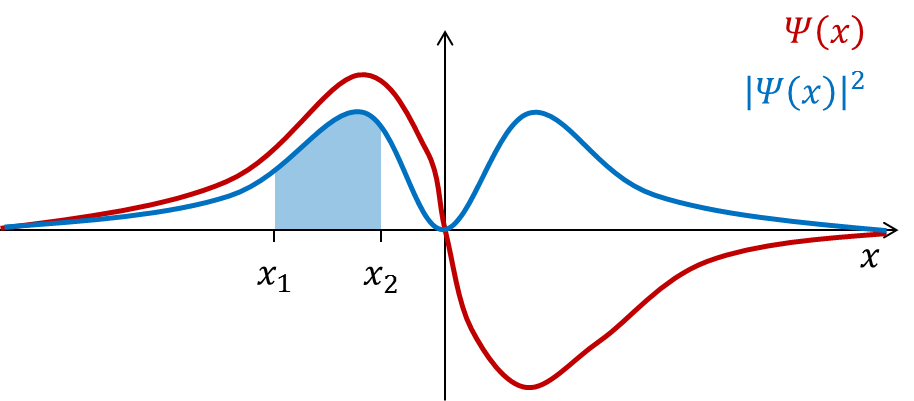
Since the particle must be somewhere, the total probability of finding it across all possible positions must be 1 (or 100%). This common-sense rule is a mathematical requirement called normalization. It means that if you integrate the probability density over all space, the result must be 1.
For many problems, the potential energy doesn't change with time. In these cases, we can simplify our approach by separating the time and space parts of the wave function. This leads to the time-independent Schrödinger equation.
The solutions to this equation are special. Not just any energy will work. Only specific, discrete energy values, called eigenvalues, will produce valid wave functions. This is the origin of energy quantization.
A Particle in a Box
Let's apply this to a simple, classic problem: the infinite square well, also known as the "particle in a box." Imagine a particle trapped inside a one-dimensional box of length . The potential energy is zero inside the box (from to ) and infinite everywhere else. The particle can't escape, so its wave function must be zero outside the box.
Solving the time-independent Schrödinger equation with these reveals something remarkable. The only solutions that work are standing sine waves that fit perfectly inside the box. This means the particle's energy can't be just any value; it's quantized.
Notice that the lowest possible energy (when ) is not zero. This is the zero-point energy, a fundamental consequence of quantum mechanics. A confined particle can never be perfectly at rest.
The particle in a box is more than a textbook exercise. It's a basic model for understanding how electrons behave in atoms and how quantum confinement works in nanomaterials like quantum dots. The simple act of confining a particle forces its properties to become discrete, a core lesson of the quantum world.
Ready to test your understanding? Let's see how these concepts fit together.
What does the magnitude squared of a particle's wave function, , represent?
In the 'particle in a box' model, the requirement that the wave function must be zero outside the box is an example of a __________.
By solving the Schrödinger equation, we move from abstract ideas like wave-particle duality to concrete, predictive models of quantum systems.