Advancing through Artificial Intelligence
Learning Paradigms and Mechanics
The Engine of Supervised Learning
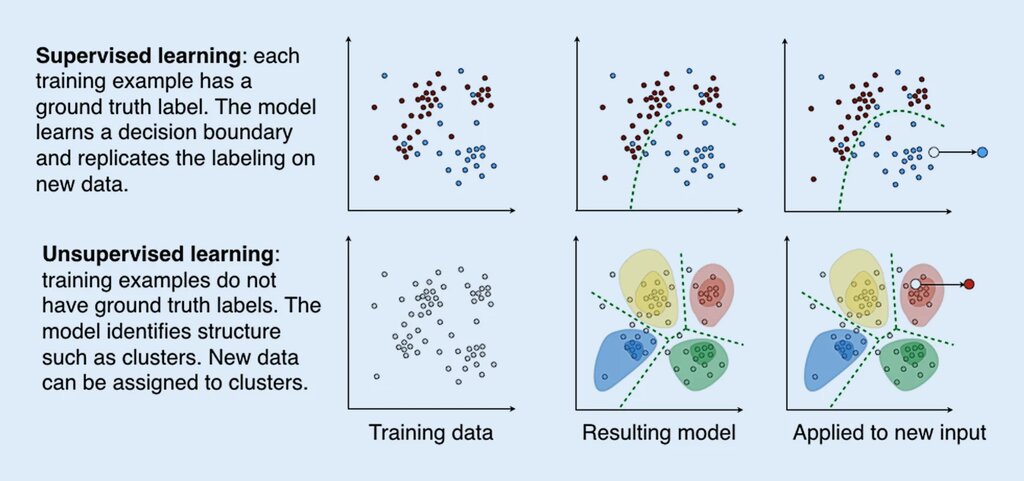
At its core, supervised learning is a sophisticated form of function approximation. Given a set of input data and corresponding target labels , the goal is to learn a function such that . The model, whether it's a linear regression or a deep neural network, makes a prediction, . The key question is: how wrong is that prediction?
This is where the loss function comes in. It's a mathematical way of measuring the error, or "loss," between the model's prediction and the actual target value. For a regression problem, a common choice is the Mean Squared Error (MSE), which penalizes larger errors more heavily.
The entire training process is an optimization problem: we want to find the model parameters (weights and biases) that minimize this loss function. The primary mechanism for this is gradient descent. Imagine the loss function as a hilly landscape, where the elevation represents the amount of error. Our goal is to find the lowest point in the valley. Gradient descent does this by calculating the slope (the gradient) at the model's current position and taking a step in the steepest downward direction.
In neural networks, this process is powered by . After a forward pass where the network makes a prediction, the error is calculated. Backpropagation then works backward from the output layer, calculating the gradient of the loss with respect to the weights of each layer and updating them accordingly. This cycle of forward pass, loss calculation, and backward pass is repeated thousands of times, iteratively nudging the model's parameters toward a minimum loss.
Unsupervised Discovery
Unsupervised learning operates without labels. Its goal isn't to predict a specific value but to discover the inherent structure or patterns within the data. This is often framed as representation learning: finding a new, more useful way to represent the data. Instead of approximating a function, it seeks to understand the data's underlying probability distribution.
A key idea here is the . It posits that high-dimensional data, like images or text, actually lies on or near a much lower-dimensional manifold embedded within that high-dimensional space. Think of a long, thin roll of paper. In 3D space, it's a complex shape. But if you unroll it, you see it's fundamentally a 2D surface. Unsupervised algorithms, particularly in dimensionality reduction, aim to 'unroll' the data to find this simpler, intrinsic structure.
Algorithms like Principal Component Analysis (PCA) find the directions of greatest variance in the data to create a lower-dimensional representation. Clustering algorithms, such as k-means, partition the data into groups based on proximity, essentially performing density estimation. They identify centroids, or centers of high data density, and group nearby points together, revealing the data's natural groupings without any prior labels.
The Fundamental Tradeoffs
No single model architecture is universally best. This reality is captured by two critical concepts: the bias-variance tradeoff and the No Free Lunch theorem.
The [{
}] describes the tension between a model's complexity and its ability to generalize to new, unseen data.
-
Bias is error from erroneous assumptions in the learning algorithm. High bias can cause a model to miss relevant relations between features and target outputs (underfitting). A simple linear model trying to fit a complex, wavy pattern has high bias.
-
Variance is error from sensitivity to small fluctuations in the training set. High variance can cause a model to capture random noise instead of the intended output (overfitting). A highly complex polynomial model that wiggles to hit every single data point has high variance.
Increasing a model's complexity typically decreases bias but increases variance. The goal is to find the sweet spot where the total error is minimized. This is a central challenge in model selection and tuning.
Related to this is the . In simple terms, it states that no single machine learning algorithm is universally the best-performing one for all problems. An algorithm that works wonderfully on image classification might perform poorly on time-series forecasting. The effectiveness of an algorithm is deeply tied to the structure and nature of the data it's applied to. This is why the field has such a diverse toolkit of models; choosing the right architecture requires understanding the problem's context and the data's underlying patterns.
Understanding these mechanics—optimization for supervised learning, structure discovery for unsupervised learning, and the fundamental tradeoffs governing all models—is the foundation for designing and building effective AI systems.