Advancing through Artificial Intelligence
Machine Learning Paradigms
Choosing the Right Tool
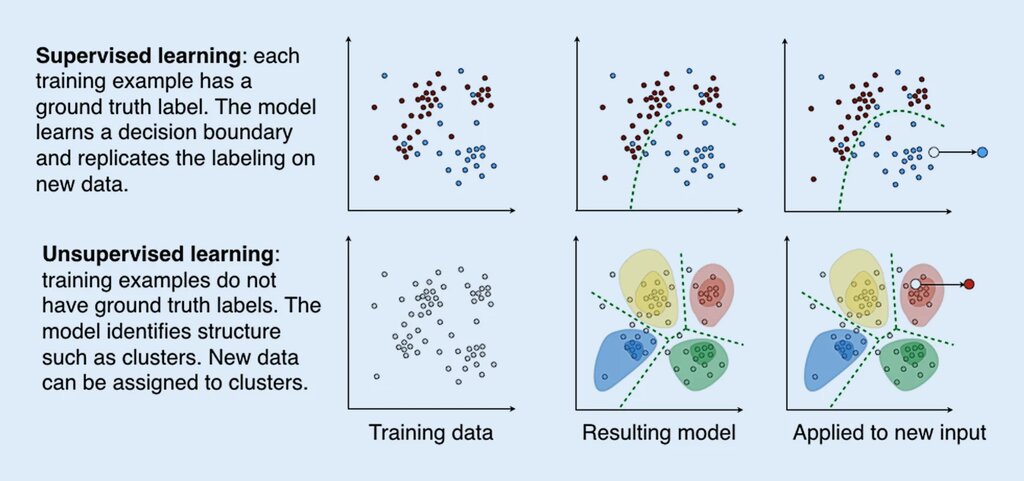
You wouldn't use a hammer to turn a screw. In machine learning, choosing the right paradigm is just as crucial. The decision between supervised and unsupervised learning isn't just academic; it directly impacts your model's performance and the kind of business problems you can solve. Supervised learning, which uses labeled data, excels at prediction. Think of it as a student learning with an answer key. It's perfect for tasks like forecasting sales or identifying which customers are likely to churn.
Unsupervised learning, on the other hand, works with unlabeled data. It's like being given a pile of mixed Lego bricks and asked to find patterns. It won't tell you what the patterns are named, but it will group them. This is ideal for customer segmentation, where you want to discover natural groupings in your user base without any preconceived notions, or for anomaly detection in financial transactions.
The core trade-off: Supervised learning gives you specific answers to known questions. Unsupervised learning helps you discover the questions you didn't know you should be asking.
For structured data—the neat rows and columns you find in a typical database—the choice often comes down to specific algorithms. A model might outperform a deep neural network for a credit scoring problem. Why? Because tree-based models are highly interpretable and handle tabular data exceptionally well without requiring extensive feature engineering. Deep learning shines with unstructured data like images or text, but for many common business tasks, it can be overkill.
Learning from Consequences
Reinforcement Learning (RL) is a completely different beast. It's not about labels or patterns; it's about actions and consequences. An RL agent learns by trial and error, guided by a reward function. Think of training a dog: you give it a treat (a reward) when it performs the correct action (like 'sit').
In a business context, this is powerful for optimizing processes with a clear goal. For example, an RL agent could manage a supply chain by learning which shipping routes minimize costs and delivery times. The "reward" isn't a simple correct/incorrect label. It’s a carefully designed function that might balance fuel costs, driver time, and customer satisfaction scores. A standard loss function in supervised learning measures a single error, but a in RL can encapsulate complex, multi-objective business logic.
Strength in Numbers
Sometimes, one model isn't enough. Ensemble methods combine the predictions of several models to produce a more robust and accurate result than any single model could. It's the machine learning equivalent of asking a group of experts for their opinion instead of just one. The two most common approaches are Bagging and Boosting.
| Method | Core Idea | Analogy |
|---|---|---|
| Bagging | Train many models in parallel on random data subsets | A diverse team of experts voting |
| Boosting | Train many models sequentially, each fixing prior errors | A single student revising their work |
, short for Bootstrap Aggregating, involves creating multiple subsets of the training data, training a separate model on each, and then averaging their predictions. The popular Random Forest algorithm is a prime example. By introducing randomness and averaging, Bagging reduces variance and helps prevent overfitting.
Boosting, as we saw with Gradient Boosted Trees, works differently. It builds models sequentially. Each new model is trained to correct the errors made by the previous ones. It focuses on the most difficult cases, gradually improving the overall performance. While Bagging is about reducing variance, Boosting is about reducing bias.
Measuring What Matters
Building a model is one thing; knowing if it's any good is another. The metrics you use to evaluate your model are critical. For classification problems, accuracy is often the first metric people reach for, but it can be misleading, especially with imbalanced datasets.
For example, if you're trying to detect a rare disease that affects 1% of the population, a model that simply predicts "no disease" for everyone will be 99% accurate, but completely useless.
This is where metrics like the Precision-Recall curve and the ROC-AUC score come in. The choice between them depends on the business problem.
-
Precision-Recall (PR Curve): Best for imbalanced classes. Precision asks, "Of all the positive predictions we made, how many were actually correct?" Recall asks, "Of all the actual positives, how many did we find?" You'd use this for fraud detection, where the number of fraudulent transactions (positives) is tiny compared to legitimate ones. You care much more about finding the few frauds without flagging too many real customers.
-
: Best when the classes are balanced, or when you care equally about correctly identifying both positive and negative cases. The Receiver Operating Characteristic (ROC) curve plots the true positive rate against the false positive rate. The Area Under the Curve (AUC) gives a single score for the model's performance. This is useful in medical diagnosis, where the cost of a false negative (missing a disease) and a false positive (unnecessary treatment) are both high.
The heart of AI, driving predictive analytics with techniques such as supervised, unsupervised learning, and neural networks.
Time to check your understanding of these core concepts.
A marketing team wants to group its customer base into distinct segments based on purchasing behaviour, but they do not have any predefined labels for these groups. Which machine learning paradigm is most suitable for this task?
In Reinforcement Learning, what is the primary purpose of a reward function?
Choosing the right learning paradigm, ensemble method, and evaluation metric is a strategic decision that separates functional models from truly effective, business-driving AI systems.