Advancing in Artificial Intelligence
Architectural Paradigms
Architectural Revolutions
Early neural networks handled data point by point, but they struggled with context and sequence. For tasks like translating a sentence, understanding the relationship between words is everything. For years, the go-to solutions were Recurrent Neural Networks (RNNs) and their more sophisticated cousins, LSTMs. They process information sequentially, like reading a sentence one word at a time, carrying a memory of what came before.
This sequential approach created a bottleneck. A network couldn't process the tenth word until it had finished with the ninth, making it slow. More importantly, its memory was flawed. The influence of early words would fade by the time the network reached the end of a long sentence, a problem known as the vanishing gradient.
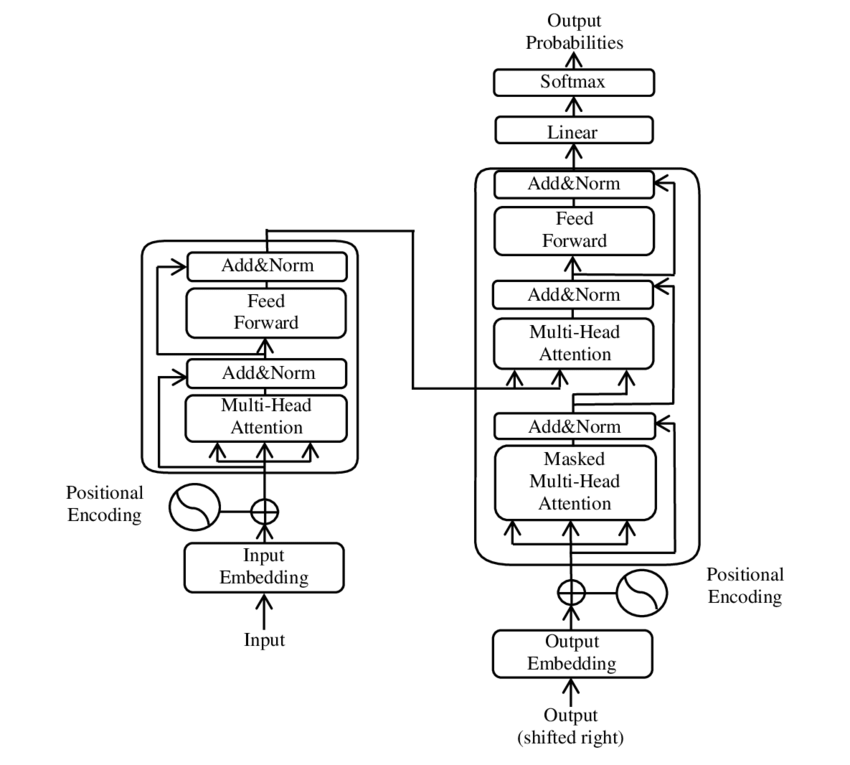
In 2017, everything changed with a paper titled "Attention Is All You Need." It introduced the Transformer architecture, which did away with sequential processing entirely. Instead, it looks at all the words in a sentence at once, using a mechanism to weigh the importance of every word in relation to every other word. This core idea is called the self-attention mechanism and it allows for massive parallelization and a far deeper understanding of context.
How Attention Works
Imagine you're translating the sentence: "The robot picked up the red ball because it was heavy." To understand what "it" refers to, you need to pay attention to other words. Does "it" refer to the robot or the ball? Common sense tells you it's the ball. Self-attention gives a model this same capability mathematically.
For each word, the network creates three vectors: a Query (Q), a Key (K), and a Value (V). The Query is like a question about the word's role. The Key represents the word's own identity. The Value is the word's actual meaning.
The model calculates an attention score by taking the dot product of a word's Query vector with the Key vectors of all other words in the sentence. These scores are then scaled and passed through a softmax function to turn them into weights that sum to one. Finally, these weights are used to create a weighted sum of all the Value vectors, producing a new representation for the word that is deeply aware of its context.
Beyond Language
The success of Transformers in natural language processing quickly inspired researchers to apply them to other domains, most notably computer vision. Traditionally, Convolutional Neural Networks (CNNs) were the undisputed champions of image tasks. CNNs work by sliding small filters across an image to detect features like edges, corners, and textures, building up a hierarchical understanding of the image.
take a different approach. A ViT model slices an image into a grid of fixed-size patches, treats them like words in a sentence, and feeds them into a standard Transformer. By applying self-attention to these patches, the model can learn global relationships between different parts of the image from the very beginning, something a CNN struggles with until its final layers.
While CNNs excel at recognizing local patterns, ViTs can capture long-range dependencies across an entire image, making them powerful for tasks that require understanding the overall scene context.
Foundation Models and the New AI
The efficiency and scalability of the Transformer architecture enabled the rise of foundation models — massive models trained on vast, internet-scale datasets. Instead of building a new model from scratch for every specific task, we now often start with a pre-trained foundation model like BERT or GPT.
This process, known as , involves taking the general knowledge learned by the foundation model and fine-tuning it on a smaller, task-specific dataset. For example, a model pre-trained on all of Wikipedia can be fine-tuned on a collection of legal documents to become an expert legal assistant. This approach saves enormous amounts of time and computational resources, and it has democratized access to state-of-the-art AI capabilities.
The choice of architecture today depends on the task and constraints. For some lightweight image tasks on smaller datasets, a CNN might still be more efficient. For time-series data where sequential order is paramount, an RNN might be suitable. But for most large-scale sequence and vision problems, the Transformer has become the new default, serving as the powerful and flexible foundation for modern AI.
What fundamental limitation of Recurrent Neural Networks (RNNs) did the Transformer architecture's self-attention mechanism overcome?
In the self-attention mechanism, what is the role of the Query (Q), Key (K), and Value (V) vectors?