Advanced Vertebrate Integumentary Systems
Aquatic Integument Adaptations
The Mucous Barrier
The first line of defense for a fish isn't armor, but a slick, slimy layer called the mucous cuticle. This coating, produced by unicellular glands scattered throughout the epidermis, serves multiple crucial roles. It's a physical barrier against bacteria, fungi, and parasites trying to invade the body.
Functionally, this layer is also an osmotic regulator. It helps freshwater fish prevent excess water from bloating their cells and assists saltwater fish in avoiding dehydration. By smoothing the body's surface, the mucous cuticle also reduces hydrodynamic drag, allowing the fish to slip through the water with less effort. The most common mucus-producers are goblet cells, which continuously secrete glycoproteins that mix with water to form this vital slime.
A Spectrum of Scales
Beneath the mucus lies a diverse array of dermal scales, which vary significantly across major fish lineages. These structures are not just passive armor; they represent an evolutionary journey from heavy plating to lightweight, flexible coverings. The differences are most apparent when comparing jawless fish, cartilaginous fish, and bony fish.
Jawless fish, the Agnatha, are the most ancient living vertebrates. Modern examples like lampreys and hagfish lack scales entirely, relying on their tough skin and mucous layer for protection. Their extinct ancestors, however, were often covered in heavy, bony dermal armor.
Cartilaginous fish (Chondrichthyes), such as sharks and rays, possess placoid scales or 'dermal denticles.' These are not flat plates but tiny, tooth-like structures complete with a pulp cavity, dentin, and an enamel-like coating. They are not designed for growth and are shed and replaced as the animal gets bigger. The rough, sandpaper-like texture of sharkskin is a direct result of these countless, pointing scales, which help reduce turbulence and make swimming more efficient.
Bony fish (Osteichthyes) feature the scales most people are familiar with. These scales are thin, overlapping plates of bone that grow as the fish grows, creating concentric growth rings similar to those on a tree. There are several main types:
- Ganoid scales: Found on primitive bony fish like gars and sturgeons, these are thick, diamond-shaped scales that fit together like a mosaic. They are composed of a bony layer topped with a hard, enamel-like substance called ganoine.
- Cycloid scales: Thin, flexible, and circular scales with a smooth outer edge. They are common on fish with soft fin rays, like salmon and carp.
- Ctenoid scales: Similar to cycloid scales but with a comb-like or toothed posterior edge. These are typically found on fish with spiny fin rays, such as perch and bass. The tiny teeth, or ctenii, may also help reduce drag.
This evolutionary trend moves from heavy, inflexible armor (ganoid) towards lightweight, flexible scales (cycloid and ctenoid) that provide protection without compromising mobility, a key factor for more modern, agile swimmers.
Beyond Armor
The aquatic integument has evolved to do far more than just protect. Many species have developed specialized dermal structures for communication, camouflage, and defense. Special pigment cells called chromatophores allow fish to change color rapidly. These cells contain sacs of pigment that can be expanded or contracted, altering the fish's appearance to match its surroundings, signal to mates, or startle predators. Chromatophores are responsible for the vibrant, shifting colors of a cuttlefish and the camouflage of a flounder.
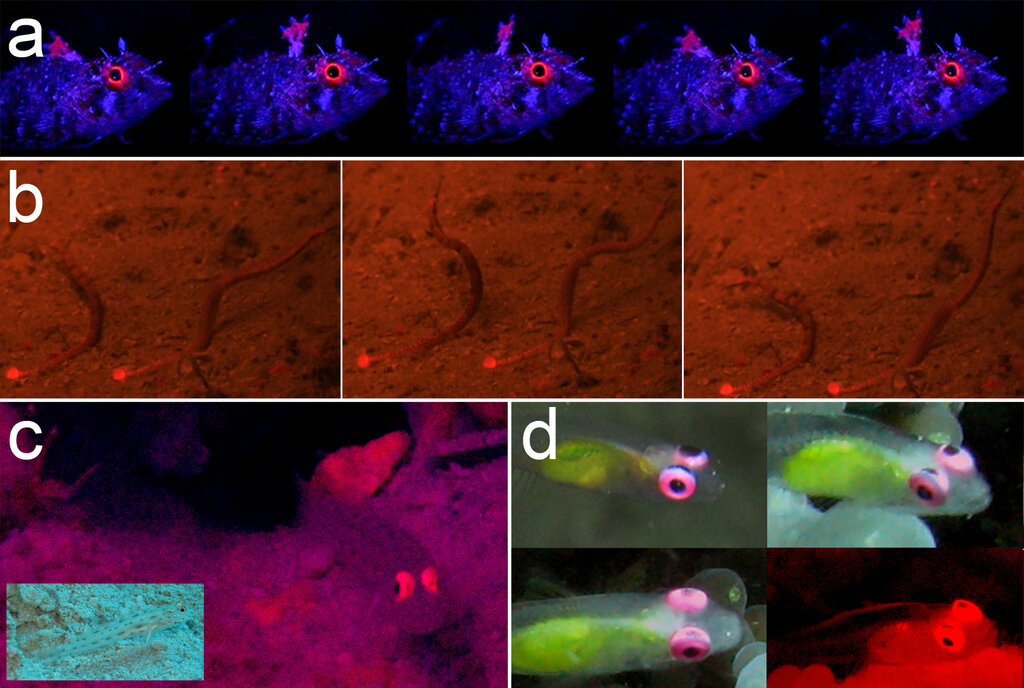
In the deep ocean where light is scarce, some fish have evolved photophores. These are light-emitting organs that function like biological flashlights. The light is typically produced by a chemical reaction involving a compound called luciferin. Fish use this bioluminescence to attract prey, find mates, and create counter-illumination, a form of camouflage where they match the faint light filtering down from above to hide their silhouette from predators below.
Finally, some fish have integrated venom into their skin. Venom glands, often associated with sharp spines on the fins, deliver potent toxins as a powerful defense mechanism. The stonefish, one of the most venomous fish in the world, uses this system to protect itself with deadly effectiveness.
These adaptations show how the integumentary system, which began as simple protective armor, has evolved into a complex and multifunctional organ system crucial for survival in diverse aquatic environments.
What is the primary function of the mucous cuticle on a fish?
How do the placoid scales of a shark differ from the ctenoid scales of a bass?