Advanced User Research Techniques
Advanced User Research Methods
Seeing Through Their Eyes
Surveys and interviews are powerful tools, but they have a fundamental limit: they rely on what users say they do or feel. People have flawed memories and aren't always aware of their own subconscious behaviors. To get a deeper, more objective look into the user experience, researchers turn to methods that observe behavior and biological responses directly.
Eye-tracking is one such method. It uses specialized cameras to measure exactly where a person is looking, in what order, and for how long. The output is often visualized in two ways:
- Gaze Plots: These are like connect-the-dots drawings that show the path a user's eyes took across a screen. They reveal the user's journey of attention.
- Heat Maps: These use color overlays to show where users looked the most. Bright red areas indicate intense focus, while blue or transparent areas were largely ignored.
This data is invaluable. It can show if a critical button is being overlooked, if an advertisement is distracting, or if the layout of a page guides the user logically from one point to the next.
Beyond the eyes, biometric measurements tap into the body's involuntary physiological responses to gauge a user's emotional state. These can include:
- Galvanic Skin Response (GSR): Measures changes in sweat gland activity, which is a strong indicator of emotional arousal like excitement or stress.
- Heart Rate (ECG): Tracks changes in heart rate, which can indicate engagement, frustration, or surprise.
- Facial Expression Analysis: Uses software to identify subtle muscle movements in the face corresponding to emotions like happiness, confusion, or anger.
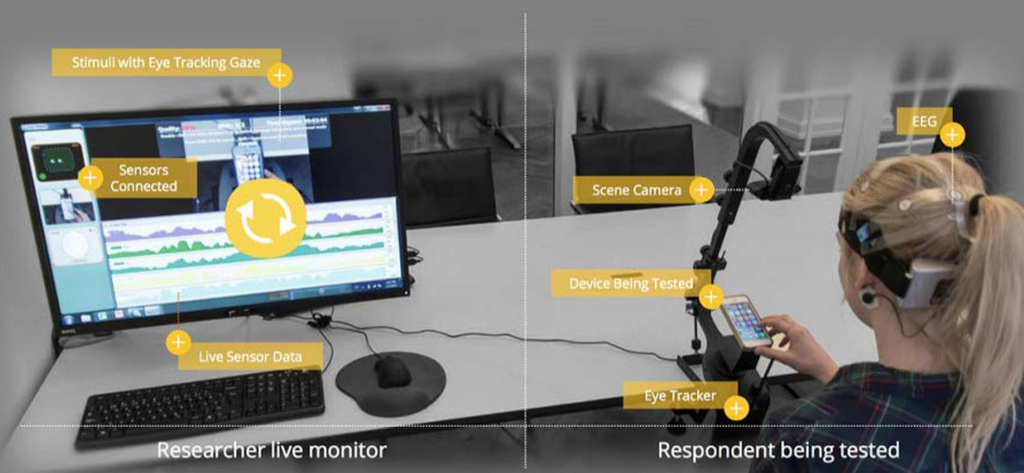
By combining these methods, a researcher can see that a user’s eyes lingered on a confusing instruction, their heart rate increased, and their brows furrowed in frustration, all without the user ever saying a word. This provides objective evidence of a usability problem that needs to be fixed.
Predicting User Behavior
While biometrics offer a window into the present moment, other advanced techniques aim to predict the future. Predictive analytics uses statistical algorithms and machine learning to analyze current and historical data in order to make predictions about future events. In UX, this means forecasting user behavior.
Predictive Analytics
noun
The use of data, statistical algorithms, and machine learning techniques to identify the likelihood of future outcomes based on historical data.
Machine learning (ML) is the engine behind much of this predictive power. ML models can sift through massive datasets of user interactions—clicks, scrolls, time on page, purchase history—and uncover subtle patterns that are invisible to a human analyst. For example, an ML model might identify a new user segment that is highly likely to cancel their subscription after 30 days based on a unique combination of behaviors. This allows the design team to proactively intervene with a targeted tutorial or special offer to prevent that churn.
Machine learning enables personalization at a scale that would be impossible to achieve manually, tailoring experiences for thousands or even millions of users simultaneously.
This isn't just about preventing negative outcomes. Predictive models can also enhance the user experience by powering recommendation engines, personalizing content, and simplifying complex workflows by anticipating a user's next move.
Testing in New Realities
As technology moves beyond flat screens, so must our research methods. Virtual reality (VR) and augmented reality (AR) create immersive experiences that can't be adequately tested with traditional mouse-and-keyboard setups. Research in this space requires evaluating interactions in a three-dimensional world.
VR and AR testing can answer questions like:
- Is the user interface intuitive when controlled by hand gestures?
- Does the experience cause motion sickness or discomfort?
- Are digital objects in an AR view placed realistically within the physical environment?
- How do users navigate a virtual space to complete a task?
Understanding the user’s needs, personal interests, cultural background and technological proficiency is essential for crafting an AR experience that is relevant, accessible and intuitive for the target audience of a product or service.
Testing these experiences often involves observing users in a lab setting as they wear headsets and interact with prototypes. Researchers collect data on task completion, physical movement, and verbal feedback to understand the usability of the immersive design. As these technologies become more common, mastering how to test them will become an essential skill for UX researchers.
Ready to check your understanding of these advanced techniques?
What is a fundamental limitation of surveys and interviews that methods like eye-tracking and biometrics are designed to overcome?
A UX researcher wants to see the aggregate areas of a webpage that received the most visual attention from a group of users. Which visualization is most appropriate?
These advanced methods provide deeper, more objective insights into user behavior and emotion. By seeing through a user's eyes, predicting their next move, and testing in immersive new worlds, we can design experiences that are not just usable, but truly intuitive and engaging.