Advanced US Options Strategies and Risk Management
Advanced Option Strategies
Beyond Simple Bets
So far, we've treated options as straightforward bets on a stock's direction. But the real power of options comes from combining them. By buying and selling different calls and puts together, you can create a strategy tailored to almost any market forecast. These are called multi-leg strategies, and they allow you to fine-tune your risk and potential reward.
Instead of just betting on whether a stock will go up or down, you can now bet on how much it will move, or even if it will stay completely still. This opens up a new world of possibilities for profiting from volatility or the lack of it.
Options trading strategies run the gamut from straightforward "one-legged" trades to exotic “multi-legged” beasts.
Betting on Volatility
What if you're sure a stock is about to make a big move, but you have no idea which way? Maybe a company is about to release earnings, or a major news event is pending. In these high-volatility situations, you can use strategies that profit from a large price swing, regardless of direction.
The two most common ways to do this are with straddles and strangles.
A long straddle is a bet on a big move. It combines buying a call and a put with the same strike price and expiration date. You profit if the stock price moves significantly up or down, enough to cover the cost of both options.
The maximum loss on a long straddle is the total premium you paid for the two options. This happens if the stock price stays exactly at the strike price on expiration. The potential profit, however, is theoretically unlimited if the stock makes a massive move in either direction.
A long strangle is a slightly cheaper version of the straddle. Instead of using the same strike price, you buy an out-of-the-money call and an out-of-the-money put. Because the options are out-of-the-money, the total premium is lower. The trade-off is that the stock price has to move even further before the position becomes profitable.
Betting on Stability
Sometimes your prediction is the opposite: you expect a stock to trade sideways, staying within a narrow price range. These are low-volatility strategies, and they typically involve selling options to collect premium. The goal is for those options to expire worthless, letting you keep the cash.
Two popular strategies for this scenario are the iron condor and the butterfly spread. They sound complex, but they're just clever combinations of the spreads you already know.
The iron condor is a four-legged strategy designed to have a high probability of a small, limited profit. You build it by selling an out-of-the-money put spread and selling an out-of-the-money call spread at the same time.
Your goal is for the stock price to stay between the strike prices of the options you sold. If it does, all four options expire worthless, and you keep the entire net premium you collected when you opened the trade. Both your potential profit (the premium) and your potential loss are capped, so you know your exact risk from the start.
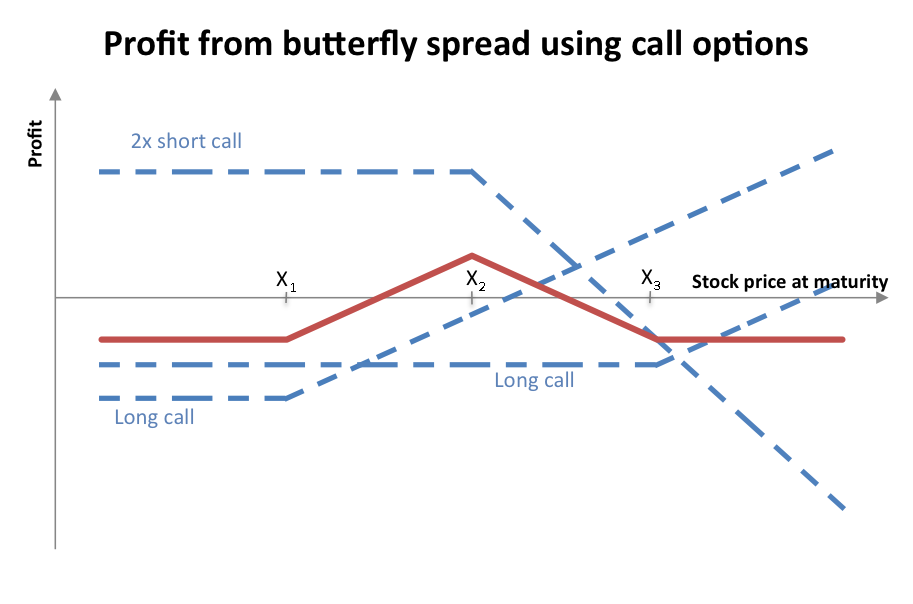
The butterfly spread is another strategy for neutral markets, but it's more precise. It's designed to achieve maximum profit if the stock price lands on a very specific price at expiration.
A long call butterfly is built by buying one in-the-money call, selling two at-the-money calls, and buying one out-of-the-money call. All options have the same expiration date, and the strike prices are equidistant.
This trade has a very low cost to put on (a small net debit). The maximum profit is achieved if the stock price is exactly at the strike price of the two calls you sold. The further the price moves away from that central strike, the less profit you make, eventually turning into a small, capped loss.
These advanced strategies require a clear market thesis. You need to have an opinion not just on direction, but on the magnitude and timing of a potential move. They offer a way to express a nuanced view and can be powerful tools for managing risk.
What is the primary advantage of using multi-leg option strategies compared to buying a single call or put?
An investor believes a biotech stock will experience a massive price swing after an FDA announcement but is unsure if the news will be good or bad. Which strategy is most suitable for this high-volatility outlook?