Advanced Two-Stroke Diesel Engineering
Scavenging Mechanics and Efficiency
The Art of Engine Breathing
In a two-stroke diesel engine, there's no dedicated exhaust stroke. The piston's movement uncovers ports in the cylinder liner, creating a brief, chaotic window where exhaust must exit and fresh air must enter, all at once. This process, known as scavenging, is less like a simple clearing of a room and more like a precisely choreographed fluid dynamics ballet. The goal is to purge burnt gases completely and refill the cylinder with a fresh charge of air, without wasting any of that precious incoming air straight out the exhaust.
The efficiency of this gas exchange is paramount. It directly dictates the engine's power output, fuel consumption, and emissions. Three primary methods have been developed to manage this flow: cross-flow, loop, and uniflow scavenging. While older or smaller engines might use cross-flow or loop designs, large-bore marine and industrial engines almost exclusively rely on uniflow scavenging for its superior efficiency.
Uniflow scavenging creates a single, upward flow of fresh air that acts like a piston, pushing the exhaust gases ahead of it and out through a valve in the cylinder head. This orderly, one-way traffic is far more effective at clearing the cylinder than the turbulent mixing seen in cross-flow or loop systems. The result is a purer charge of air for combustion, which translates directly into a higher power-to-weight ratio.
Ports, Pressure, and Performance
The secret to effective scavenging lies in the precise geometry and timing of the ports. The size, shape, and angle of the scavenge ports are meticulously designed to direct the incoming air, creating a stable swirl that improves the mixing of fuel and air later in the cycle. The timing of when the ports open and close relative to the exhaust valve is critical. Ideally, the exhaust valve opens first to allow the high-pressure exhaust to escape, a process called 'blowdown'. This reduces the cylinder pressure before the scavenge ports are uncovered.
This pressure differential is the driving force of scavenging. The fresh air isn't sucked in; it's forced in from a —a large manifold running alongside the cylinders that is kept at a higher pressure than the exhaust system. This pressure is typically supplied by a turbocharger or a separate blower. Maintaining this positive pressure gradient ensures that fresh air flows into the cylinder, not the other way around.
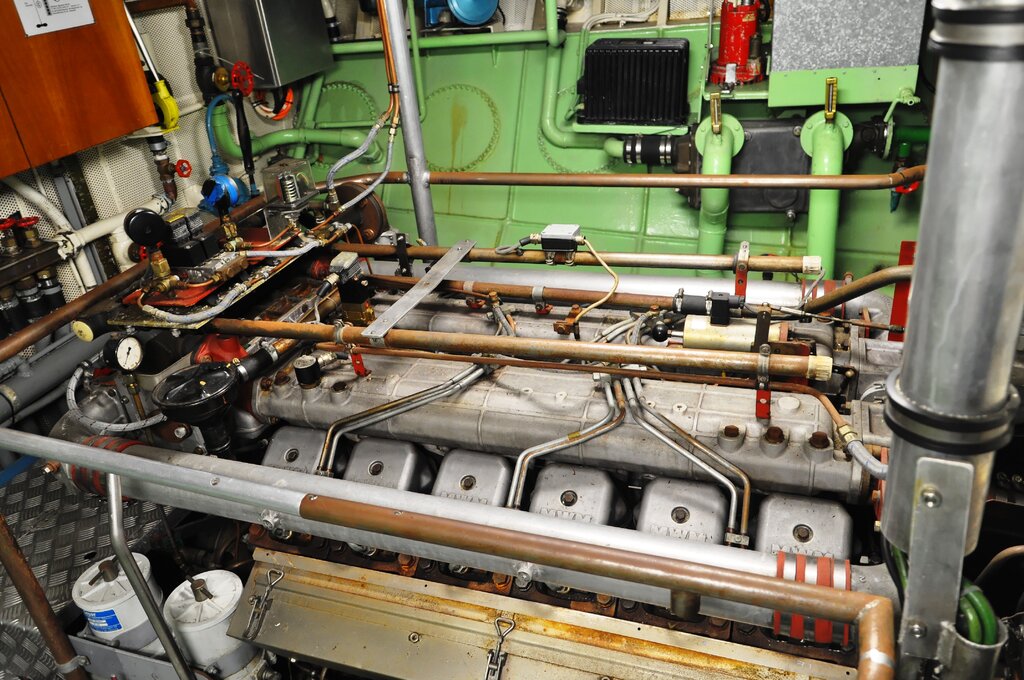
Measuring Success
Perfect scavenging is impossible. Some fresh air will always escape with the exhaust, a phenomenon known as short-circuiting or blow-through. At the same time, some pockets of exhaust gas will inevitably get trapped in the cylinder, diluting the fresh charge. The challenge is to minimise both of these losses.
Engineers measure success using a few key metrics: scavenging efficiency, trapping efficiency, and purity of the charge.
Scavenging efficiency () is the proportion of the fresh charge delivered that is retained in the cylinder. It tells us how much air we're losing out the exhaust.
A related concept is trapping efficiency, which measures how well the cylinder traps the delivered air once the exhaust valve closes. A high trapping efficiency is crucial for ensuring a high-density charge for compression.
Finally, the purity of the charge refers to how little exhaust gas remains. A high-purity charge leads to better combustion and higher thermal efficiency. These metrics are all interconnected and optimised through careful design of the engine's entire air handling system.
Time to test your knowledge on the finer points of two-stroke scavenging.
What is the primary purpose of scavenging in a two-stroke diesel engine?
In uniflow scavenging, which event ideally happens first to initiate the gas exchange process?
Understanding these scavenging principles is key to appreciating how large two-stroke engines achieve their impressive power and efficiency.