Advanced Twelve Bar Blues Soloing
Advanced Harmonic Concepts
Beyond the Basics
You've got the standard twelve-bar blues down. You know the I, IV, and V chords and can feel the natural flow of the progression. Now, it's time to add new layers of color and tension to your playing. We'll explore three ways to make your blues harmony more sophisticated: substituting chords, adding extensions, and applying modes.
Chord Substitutions
A chord substitution is exactly what it sounds like: swapping a standard chord in a progression for a different one. The goal is to create a fresh sound while maintaining the overall harmonic direction. One of the most common and powerful substitutions in blues and jazz is the tritone substitution.
A tritone is an interval spanning three whole steps. For a V7 chord, you can substitute it with another dominant 7th chord whose root is a tritone away.
Let's take a blues in C. The V chord is G7. The note a tritone away from G is D♭. So, you can replace G7 with a D♭7 chord. Both chords create a strong pull back to the C7 tonic, but the D♭7 adds a different, more chromatic flavor to the resolution.
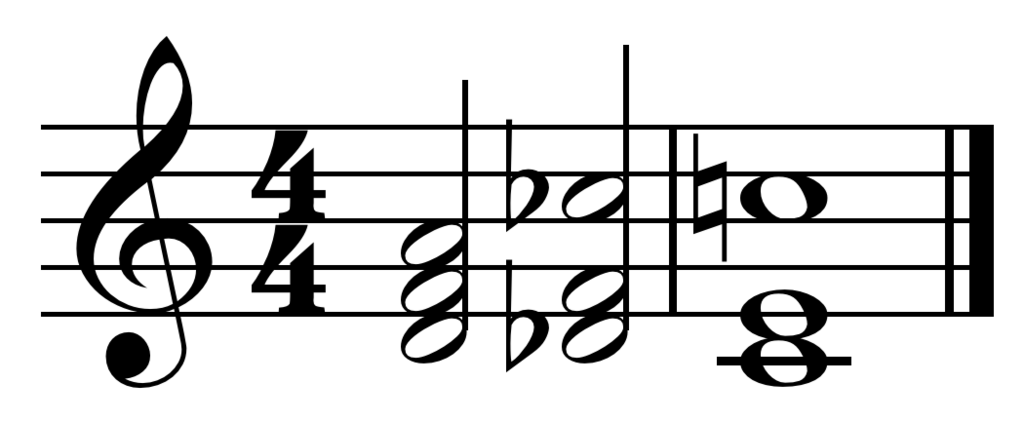
Why does this work? It's all about the two most important notes in a dominant 7th chord: the 3rd and the 7th. These two notes form a tritone themselves and are the source of the chord's tension. The G7 and D♭7 chords actually share these crucial notes.
| Chord | Root | 3rd | 5th | 7th |
|---|---|---|---|---|
| G7 | G | B | D | F |
| D♭7 | D♭ | F | A♭ | C♭ (B) |
As you can see, the 3rd of G7 (B) is enharmonically the same as the 7th of D♭7 (C♭), and the 7th of G7 (F) is the 3rd of D♭7. This shared tension allows them to function interchangeably before resolving to the I chord.
Another common technique is to set up the IV chord with its own V chord. This is called a secondary dominant. In a C blues, the IV chord is F7. The V chord of F is C7. So, in the fourth measure, just before you move to F7, you can change the C7 to a C dominant 7th (C7) to create a stronger pull to the IV chord.
Extended Harmonies
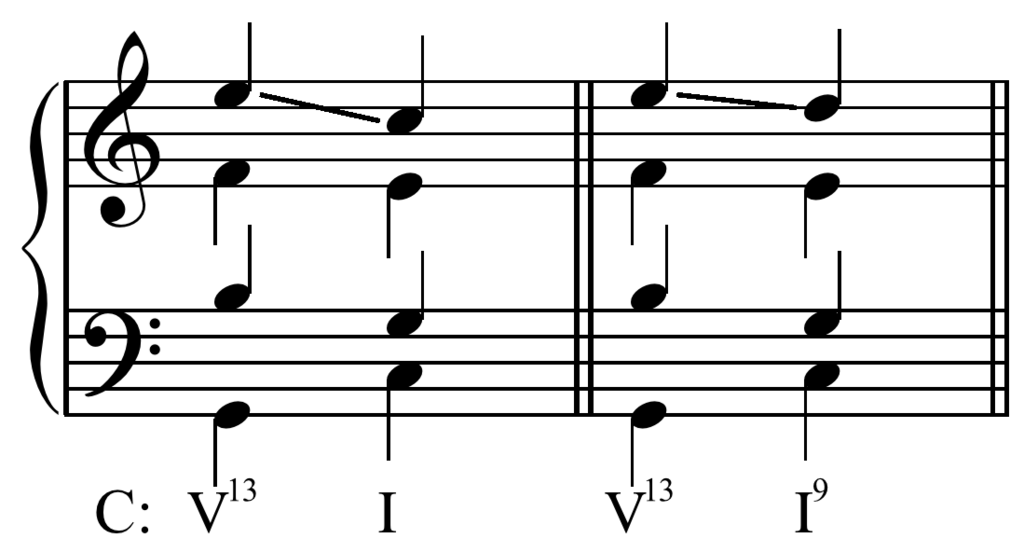
You can add more complexity to your chords by stacking additional notes on top of the basic triad and 7th. These are called extensions, and they typically include the 9th, 11th, and 13th.
Extended Harmony
noun
Chords containing notes beyond the seventh, such as the ninth, eleventh, and thirteenth.
In a C7 chord (C-E-G-B♭), you can add these extensions:
- 9th: Adding a D creates a C9 chord (C-E-G-B♭-D). This adds a smooth, soulful quality.
- 11th: Adding an F creates a C11. However, the major 3rd (E) clashes with the 11th (F), so the 3rd is often omitted, or the 11th is sharpened to an F♯.
- 13th: Adding an A creates a C13 chord (C-E-G-B♭-A). This chord is rich and often has a bright, upbeat feel.
These extensions can be applied to the I, IV, and V chords throughout the blues progression. Experiment with replacing a standard C7 with a C9 or C13, or an F7 with an F9, to see how it changes the mood. You don't need to play all the notes, especially on guitar. Often, a voicing will include the root, 3rd, 7th, and one or two extensions.
Applying Modes
Instead of just using the blues scale over the entire progression, you can use different modes to outline each chord change. This approach, known as chord-scale theory, adds a melodic sophistication to your solos.
A great place to start is with the Mixolydian mode. The Mixolydian mode is the fifth mode of the major scale, and it has a major triad with a flat 7th—perfect for dominant 7th chords.
| Chord | Corresponding Mode |
|---|---|
| C7 (I chord) | C Mixolydian (C D E F G A B♭) |
| F7 (IV chord) | F Mixolydian (F G A B♭ C D E♭) |
| G7 (V chord) | G Mixolydian (G A B C D E F) |
When the chord changes from C7 to F7, you switch from improvising with the C Mixolydian scale to the F Mixolydian scale. This allows your melody to follow the harmony closely, highlighting the unique notes of each chord.
For minor chords that sometimes appear in blues, like a Dm7 in a ii-V-I turnaround, the Dorian mode is a classic choice. D Dorian (D E F G A B C) contains all the notes of a Dm7 chord and has a distinctly cool, jazzy sound that works perfectly over it.
Combining these ideas—substituting chords, adding extensions, and applying modes—will open up a new world of harmonic possibilities in your blues playing. Start by incorporating one concept at a time, and listen for how it changes the feel of the music.
In a standard blues progression in the key of C, the V chord is G7. What is the correct tritone substitution for this G7 chord?
Why does a tritone substitution work effectively as a replacement for a dominant 7th chord?
By mastering these advanced concepts, you'll be able to create solos and accompaniment that are both expressive and harmonically rich.