Advanced Turning Tools and Insert Technology
Carbide Grade Architecture
The Substrate's Secret
The performance of a turning insert isn't just about its shape or coating. It's rooted deep within its metallurgical structure, in what’s called the substrate. For most modern inserts, this means —a composite material that brilliantly combines the properties of a hard ceramic with a tough metal.
The two key players are tungsten carbide (WC) grains, which provide extreme hardness and wear resistance, and a metallic cobalt (Co) binder, which acts as the 'glue' holding the grains together. The genius of carbide grade architecture lies in manipulating the size of the WC grains and the percentage of the cobalt binder. This balancing act allows tool manufacturers to engineer a precise trade-off between hardness and toughness for any given application.
Grain Size and Binder Content
Think of the tungsten carbide grains as hard stones and the cobalt binder as mortar. If you use very fine sand (small grains) and just enough mortar to hold it together, you get a dense, hard, and smooth surface. This structure offers incredible resistance to deformation and wear, making it ideal for finishing cuts that require high precision and a smooth surface.
Conversely, if you use larger pebbles (coarse grains) with a more generous amount of mortar, the resulting structure is less dense but far more resilient. It can absorb shocks and resist chipping. This makes it perfect for roughing operations or interrupted cuts, where the tool is subjected to repeated impacts.
The cobalt percentage directly dictates fracture toughness. A grade with 6% cobalt will be significantly harder and more wear-resistant than one with 12%, but it will also be more brittle. The 12% cobalt grade can withstand much higher mechanical shock before fracturing, making it suitable for less stable machining conditions.
Advanced Substrate Engineering
Modern tool design goes a step further with functional gradient substratess. Imagine an insert that's not uniform. Instead, it has a cobalt-enriched layer just beneath the surface. This tough, ductile layer acts as a barrier, effectively stopping microscopic cracks that form at the cutting edge from propagating through the bulk of the insert and causing catastrophic failure. Meanwhile, the core of the substrate remains hard and resistant to deformation, and the surface itself is optimized for coating adhesion.
This technology allows for an insert that has the best of both worlds: a hard, wear-resistant cutting edge and a tough, crack-resistant body. It’s a key reason why modern inserts can handle the extreme thermal and mechanical loads of high-speed machining.
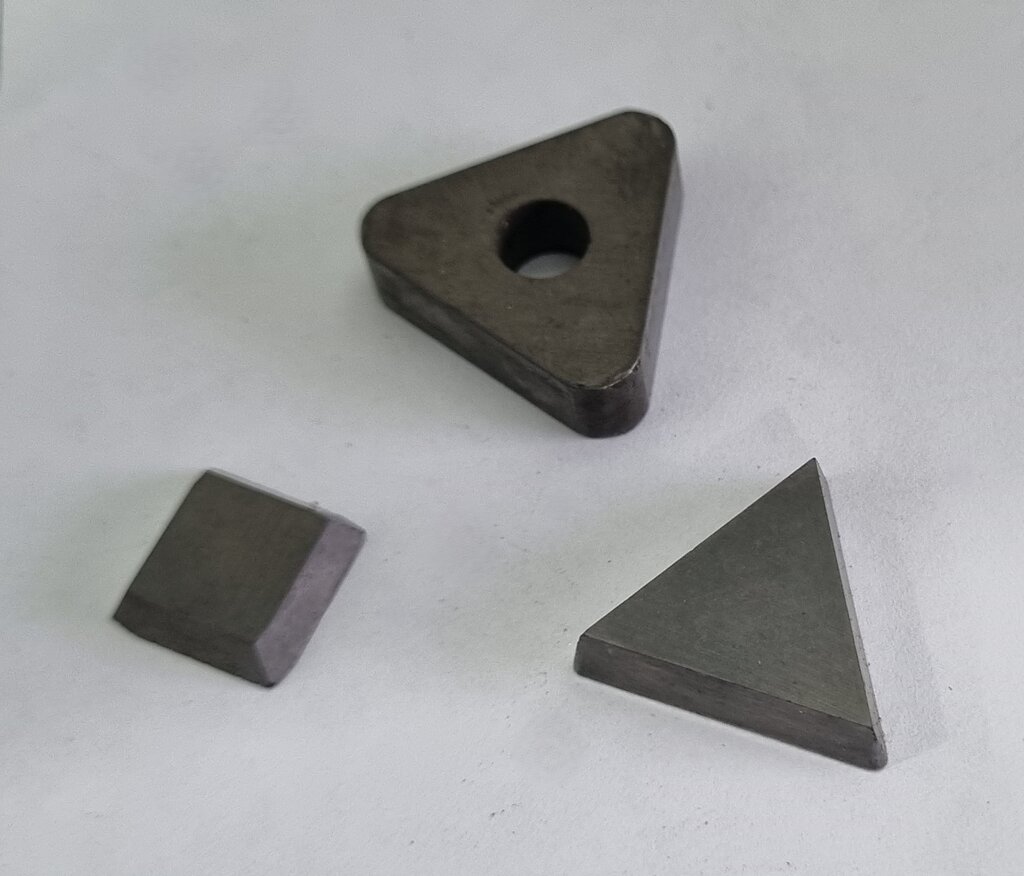
To help machinists select the right tool, the International Organization for Standardization (ISO) created a classification system. It groups workpiece materials into six main categories, each with a letter code and a corresponding colour.
| ISO Code | Colour | Material Group | Characteristics |
|---|---|---|---|
| P | Blue | Steel | Long-chipping materials; common in general engineering. |
| M | Yellow | Stainless Steel | High work hardening, heat, and built-up edge. |
| K | Red | Cast Iron | Short-chipping materials; abrasive wear is a key concern. |
| N | Green | Non-Ferrous Metals | Softer materials like aluminium and copper. |
| S | Orange | Superalloys & Titanium | High heat generation, difficult to machine. |
| H | Grey | Hardened Materials | For materials with hardness > 45 HRC; high thermal load. |
While this system provides a great starting point, most manufacturers develop their own proprietary grade maps. These maps are more detailed, plotting specific insert grades on a chart of toughness versus wear resistance. This allows an experienced machinist to fine-tune their selection, choosing a grade that not only matches the ISO material group but also the specific demands of the operation, whether it’s heavy roughing or fine finishing.
What are the two primary components of the cemented carbide substrate used in modern turning inserts?
For a finishing operation requiring a very smooth surface and high precision, which carbide grade characteristic is most desirable?
Understanding this internal architecture is what separates basic part-making from true precision machining. It provides the metallurgical foundation needed to diagnose tool failure and optimize cutting parameters for maximum performance and tool life.