Advanced Trigonometry and Applications
Inverse Functions
Inverse Trigonometric Functions
Inverse functions reverse the action of their counterparts. For a function that maps to , its inverse, , maps back to . For trigonometric functions, this concept requires careful handling. Since functions like are periodic, they are not one-to-one over their entire domain. An output like corresponds to infinitely many inputs (e.g., , , , etc.).
To define a valid inverse, we must restrict the domain of the original trigonometric function to a principal branch where it is one-to-one. This ensures that each output value corresponds to a unique input angle. The resulting inverse functions are often called arcfunctions, such as for the inverse of . Graphically, an inverse function is a reflection of the original function across the line .
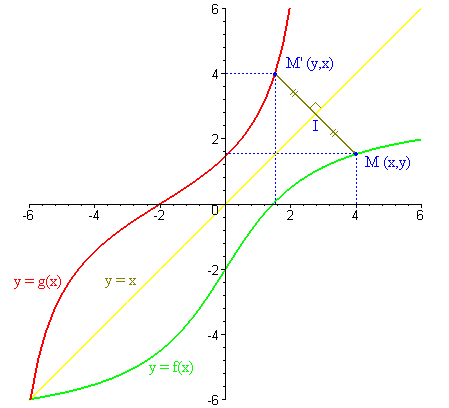
The three primary inverse trigonometric functions are arcsine, arccosine, and arctangent.
| Function | Definition | Domain | Range (Principal Values) |
|---|---|---|---|
Note the different ranges. The range for covers quadrants I and IV, yielding angles where the cosine is positive. The range for covers quadrants I and II, providing angles where the sine is positive. For , the range is identical to that of but excludes the endpoints, as is undefined at .
Reciprocal Inverse Functions
The inverses of the reciprocal trigonometric functions—cosecant, secant, and cotangent—are defined similarly by restricting their domains.
| Function | Definition | Domain | Range (Principal Values) |
|---|---|---|---|
A key property is their relationship to the primary inverse functions. For example, and for in their respective domains. The identity for arccotangent is slightly more nuanced: for , but for . This adjustment ensures the output lies within the correct principal range of .
Solving Equations and Applications
Inverse trigonometric functions are essential for solving trigonometric equations. When an equation is in the form , the principal solution is . To find all solutions, we must account for the periodic nature of the sine function.
The general solution for is , where is an integer. The general solution for is . The general solution for is .
Consider solving the equation . This is a quadratic in terms of . Factoring gives .
The solution is impossible, since the range of sine is .
The other solution is . The principal value is . The general solution is .
In physics, inverse functions appear in problems involving oscillations, waves, and projectile motion. For instance, the range of a projectile launched with initial velocity at an angle is given by . To find the angle required to achieve a specific range, we rearrange the formula:
In electrical engineering, the phase angle in an RLC circuit is given by , where is the inductive reactance, is the capacitive reactance, and is the resistance. The phase angle, which describes the offset between voltage and current, is found using the arctangent: .
Ready to test your knowledge?
Why must the domain of a trigonometric function like sin(x) be restricted to define its inverse, arcsin(x)?
The graph of an inverse function, , is the reflection of the graph of the original function, , across which line?
Understanding the precise definitions and restricted ranges of inverse trigonometric functions is crucial for their correct application in both theoretical and practical contexts.