Advanced Trigonometric Analysis
Unit Circle Analysis
Beyond the Right Angle
Trigonometry isn't just about the ratios in right-angled triangles. To analyse periodic motion, like waves or rotating machinery, we need to extend our understanding to cover angles of any size. The key to this is the unit circle: a circle with a radius of 1, centred at the origin (0,0) of a coordinate plane.
The beauty of the unit circle lies in its ability to translate angular measurement into Cartesian coordinates, which then corresponds to the sine and cosine of an angle.
Instead of degrees, we'll primarily use to measure angles. A full circle is radians, which is equivalent to 360°. This system simplifies many physics and engineering calculations. The length of an arc, , on the unit circle is simply equal to the angle it subtends in radians, .
Coordinates and Functions
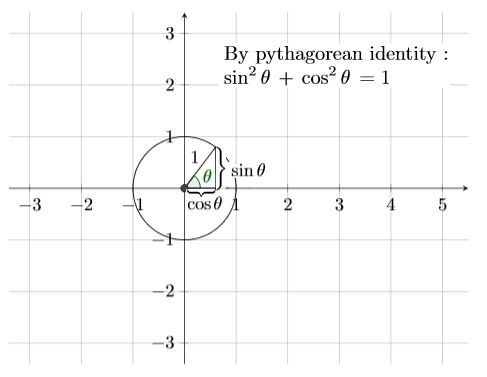
Imagine a point on the edge of the unit circle. A line from the origin to this point forms an angle with the positive x-axis. Because the circle's radius (the hypotenuse) is 1, the familiar SOHCAHTOA relationships simplify dramatically.
The x-coordinate of the point is precisely the cosine of the angle, and the y-coordinate is the sine. This relationship holds true for any angle, even those greater than 90° or negative angles (measured clockwise).
From this, we can define the tangent as the ratio of sine to cosine. This also means tangent is the slope of the line from the origin to the point .
Because the unit circle exists on a coordinate plane, we can apply the distance formula between the origin (0,0) and the point . This gives us the equation of the circle, . By substituting our new definitions for x and y, we arrive at the most fundamental relationship in trigonometry: the Pythagorean identity .
Angles in Any Quadrant
The coordinate plane is divided into four quadrants. The signs of the x and y coordinates change depending on the quadrant, which means the signs of sine, cosine, and tangent also change. For instance, in Quadrant II, x is negative and y is positive, so cosine is negative and sine is positive.
| Quadrant | Angle (Radians) | Angle (Degrees) | sin(θ) | cos(θ) | tan(θ) |
|---|---|---|---|---|---|
| I | 0 to π/2 | 0° to 90° | + | + | + |
| II | π/2 to π | 90° to 180° | + | - | - |
| III | π to 3π/2 | 180° to 270° | - | - | + |
| IV | 3π/2 to 2π | 270° to 360° | - | + | - |
To find the trigonometric values for an angle greater than 90° (or radians), we can use a . This is the acute angle that the terminal side of our angle makes with the x-axis. We find the trigonometric value for the reference angle and then apply the correct sign based on the quadrant.
For an angle of 150° (in Quadrant II), the reference angle is 180° - 150° = 30°. We know sin(30°) = 0.5. Since sine is positive in Quadrant II, sin(150°) = 0.5. For cosine, cos(30°) ≈ 0.866. Since cosine is negative in Quadrant II, cos(150°) ≈ -0.866.
Time to test your understanding of the unit circle.
A point P(x, y) lies on the unit circle. What do the coordinates x and y represent for an angle formed with the positive x-axis?
Which of the following expressions is the Pythagorean identity derived from the unit circle's equation?
This framework, connecting angles to coordinates, is the foundation for analysing any system that involves rotation or oscillation.