Advanced Treading Water Techniques
Eggbeater Kick Mechanics
The Eggbeater Kick
Treading water is a basic survival skill, but for activities that demand stability and height, the standard flutter or scissor kick won't do. The eggbeater kick is the solution. It's the most efficient way to stay upright in the water, keeping your head and shoulders clear without bobbing up and down. This continuous, powerful lift is why it's the standard technique in demanding sports like water polo and for professional lifeguards who need their hands free for a rescue.
Body Position and Motion
Imagine sitting in a chair. That's the starting posture for the eggbeater. Your back should be straight and your thighs parallel to the water's surface, creating a 90-degree angle at your hips and knees. This position lowers your centre of gravity, providing a stable base.
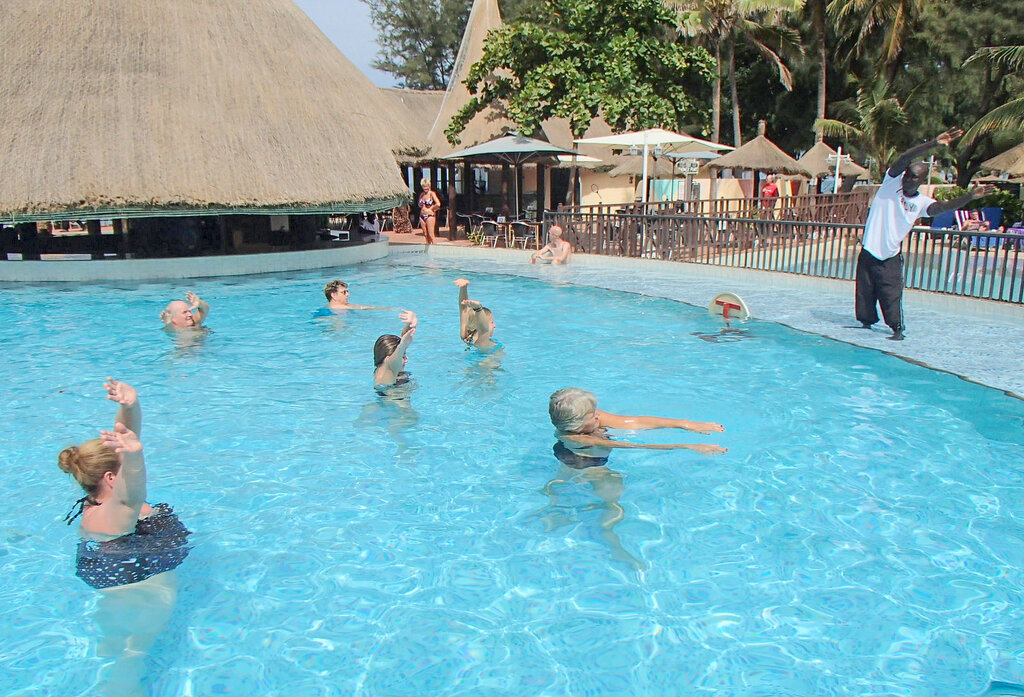
Unlike the breaststroke kick where both legs move together, the eggbeater relies on alternating, independent leg movements. Each leg draws a separate circle, moving from the hip. One leg performs the inward part of the circular motion while the other performs the outward part. Think of it like pedalling a bicycle, but with your legs moving in opposite circular paths horizontally.
This opposing motion is crucial. It ensures that one leg is always in a power phase, pushing water downwards and backwards, which generates continuous lift. There's no pause or glide, eliminating the bobbing motion associated with other treading techniques. The movement comes from the hip, involving both internal and external rotation to create the circular sweep.
The All-Important Foot
The real magic of the eggbeater happens at the ankle. To generate maximum propulsion, your foot must act like a paddle. This requires significant ankle flexion and rotation. As your leg sweeps outward, you flex your foot so your toes point up, and you rotate your ankle so the sole of your foot faces the direction of the sweep. This 'catches' the water.
As the leg sweeps inward to complete the circle, the ankle rotates again so the sole continues to face the direction of movement, pushing water away.
Think of your lower leg and foot as a single, large fin. The goal is to keep the flat, propulsive surface of your foot and inner shin angled to push water down and back throughout the entire circular motion. Your ankles should be loose and floppy, allowing them to pivot and catch water effectively. Stiff ankles will slice through the water instead of pushing it.
The two key things: kick from the hips, not the knees (think about long kicking motions using your whole leg), and keep your ankles relaxed.
Getting the hang of the eggbeater kick takes practice, as the coordinated but opposite movements can feel unnatural at first. A good way to start is by holding onto the side of the pool and practising the motion with one leg at a time before trying to combine them.
What is the primary advantage of the eggbeater kick compared to other treading water techniques?
Which analogy best describes the correct starting posture for the eggbeater kick?