Advanced Transformers for Sequential Data
Transformer Model Foundations
The Transformer Architecture
Before Transformers, models like Recurrent Neural Networks (RNNs) processed text one word at a time, like a person reading a book. This sequential approach was slow and struggled to connect words that were far apart in a long sentence. Transformers changed the game by processing the entire sentence at once, allowing them to see the whole picture from the start.
The original Transformer model has two main parts: an encoder and a decoder. Think of it as a team of two experts. The encoder's job is to read and understand the input sentence. It creates a detailed numerical representation that captures the meaning and context of every word. The decoder then takes this representation and generates the output, like translating the sentence into another language.
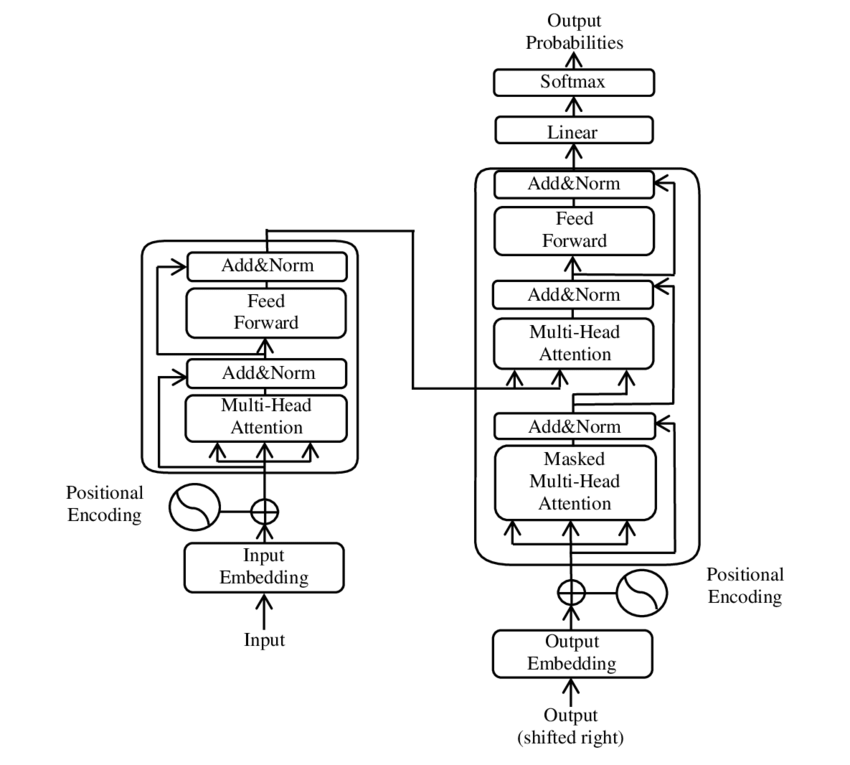
Each of these components is actually a stack of identical layers. For example, the original paper used a stack of six encoders and six decoders. This stacking allows the model to build up a more and more nuanced understanding of the text with each layer it passes through. The real magic, however, happens inside these layers with a mechanism called attention.
The Power of Attention
The core innovation of the Transformer is self-attention. It's a mechanism that allows the model to weigh the importance of different words in a sentence when processing a specific word.
Consider the sentence: "The animal didn't cross the street because it was too tired." What does "it" refer to? The animal. Self-attention helps the model make this exact connection by linking "it" strongly to "animal" and less strongly to other words like "street" or "tired."
To do this, the model creates three special vectors for each word: a Query (Q), a Key (K), and a Value (V).
- Query: A representation of the current word, asking a question like, "Who am I related to?"
- Key: A label for every other word in the sentence, saying, "This is what I am."
- Value: The actual meaning or content of each word.
The model compares the Query of one word with the Key of every other word to calculate a score. A high score means the words are highly relevant to each other. These scores then determine how much attention to pay to each word's Value when representing the current word.
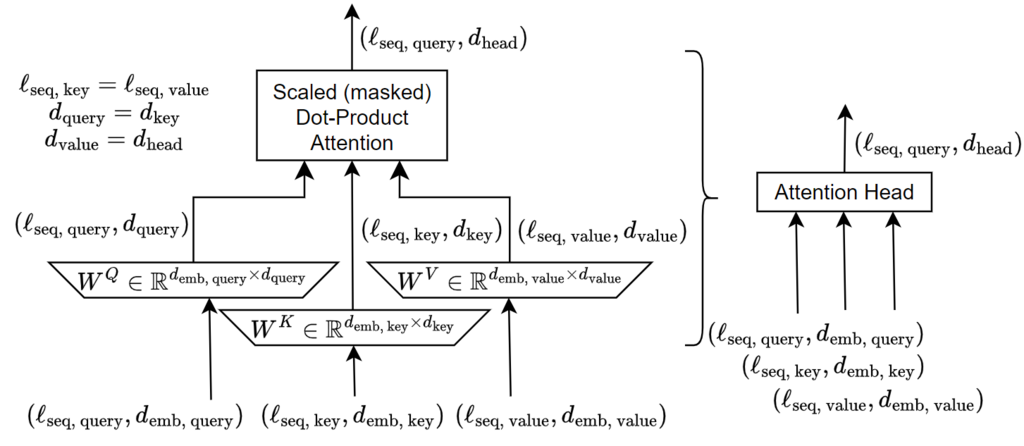
This process happens for every word in the sentence simultaneously, creating a rich, context-aware representation.
Building a Complete Model
While self-attention is powerful, a few other components are needed to make the Transformer work effectively.
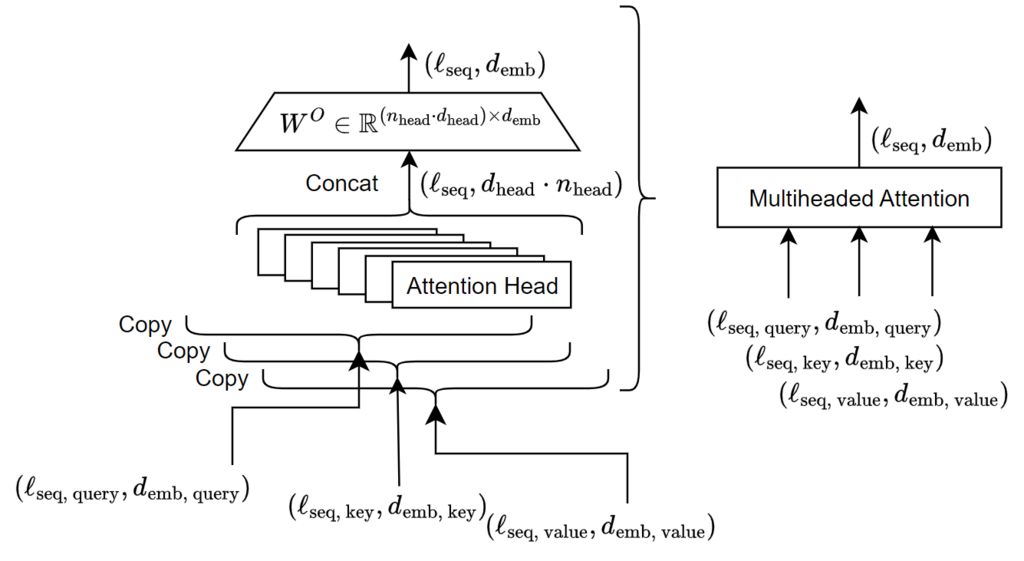
Multi-Head Attention Instead of just one set of Q, K, and V vectors, the model uses multiple sets in parallel. This is called multi-head attention. Each "head" can focus on a different aspect of the sentence. For instance, one head might track grammatical relationships while another tracks conceptual connections. The outputs from all heads are then combined, giving the model a more comprehensive understanding.
Positional Encoding Because the Transformer processes all words at once, it has no inherent sense of word order. "The cat chased the dog" and "The dog chased the cat" would look the same to it. To solve this, we inject information about each word's position into its input embedding. This is done using a clever trick with sine and cosine waves of different frequencies, creating a unique "positional signature" for each spot in the sequence.
Feed-Forward Networks After the attention mechanism does its work in each encoder or decoder layer, the output is passed through a simple feed-forward neural network. This network processes each word's representation independently, adding complexity and allowing the model to learn more abstract features. It's a crucial step for transforming the attention outputs into a format that the next layer can use effectively.
Together, these components—the encoder-decoder structure, multi-head self-attention, positional encodings, and feed-forward networks—create the Transformer, a powerful and flexible architecture that has become the foundation for most modern AI models.
What fundamental problem with Recurrent Neural Networks (RNNs) did the Transformer architecture's parallel processing approach solve?
In the self-attention mechanism, what is the primary role of the Query (Q), Key (K), and Value (V) vectors?