Advanced Transformer Architectures and Applications
Transformer Model Foundations
A New Way to Process Sequences
For a long time, models that processed language, like Recurrent Neural Networks (RNNs), read sentences one word at a time, from left to right. This is intuitive, as it's how humans read. However, this sequential approach created a bottleneck. The model's understanding of a word early in a sentence would fade by the time it reached the end, making it hard to grasp long-range connections.
Transformer models, introduced in 2017, changed everything. They process all the words in a sentence at the same time. This parallel processing is not only faster but also allows the model to directly compare every word with every other word, no matter how far apart they are. The key to this is a mechanism called attention.
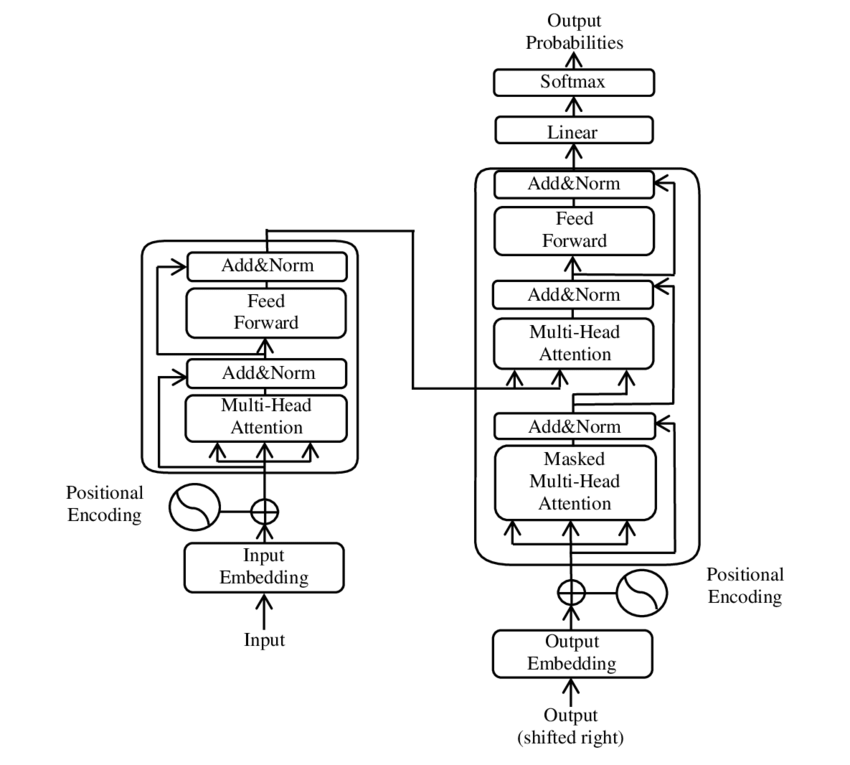
The architecture is typically composed of two main parts: an encoder and a decoder. The encoder's job is to read the input sequence and build a rich, contextual understanding of it. The decoder then uses that understanding to generate an output sequence, like a translation or a summary.
The Power of Self-Attention
Self-attention is the heart of the Transformer. It's how the model weighs the importance of different words in a sequence when processing a specific word. Think about the sentence, "The cat sat on the mat, tired because it was old." To understand what "it" refers to, we naturally pay more attention to "cat" than to "mat" or "sat."
Self-attention automates this process. For each word, it creates three vectors:
- Query (Q): A representation of the current word, asking a question like, "Who am I, and who should I pay attention to?"
- Key (K): A label for all other words in the sentence, essentially saying, "This is what I am."
- Value (V): The actual substance or meaning of each word.
The model compares the Query vector of the current word with the Key vector of every other word. The better the match, the higher the score. These scores determine how much attention, or weight, the current word should pay to every other word. Finally, it combines the Value vectors of all words, weighted by these attention scores.
In essence, self-attention allows the model to look at other positions in the input sequence for clues that can help lead to a better encoding for the current position.
More Heads Are Better Than One
A single self-attention mechanism might focus on one type of relationship, like how verbs relate to subjects. But language is complex; words relate to each other in many ways. This is where multi-head attention comes in.
Instead of doing self-attention just once, multi-head attention runs the process multiple times in parallel, each with its own set of Query, Key, and Value transformations. Each of these "heads" can learn to focus on different aspects of the language. One head might track pronoun references, another might identify subject-object relationships, and a third could focus on syntactic structure.
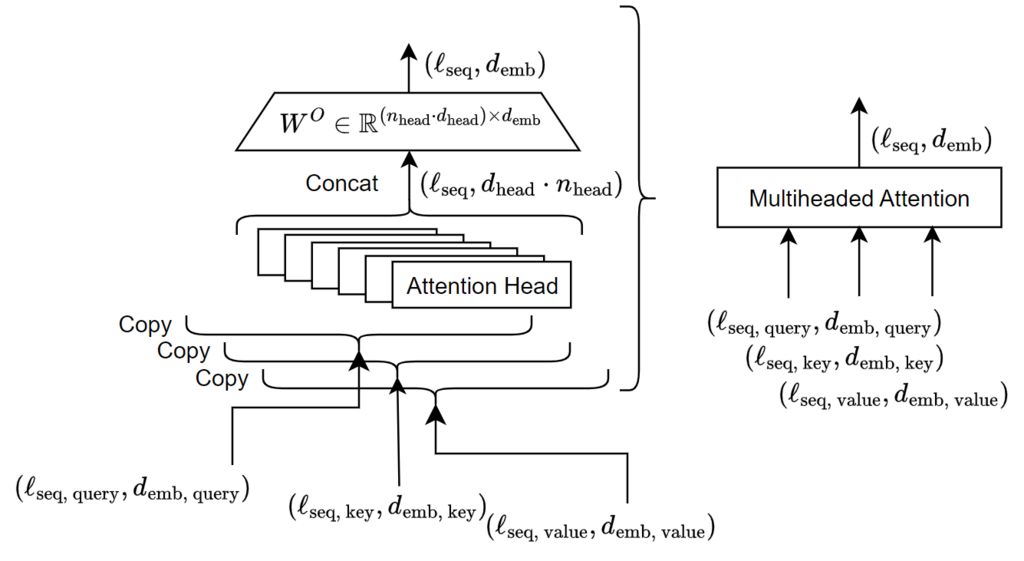
After each head produces its output, the results are concatenated and passed through a final linear layer. This allows the model to integrate the insights from all the different heads, creating a more nuanced and comprehensive understanding of the sequence.
Keeping Track of Order
Because Transformers process all words simultaneously, the model has no inherent sense of word order. To the model, "The dog chased the cat" looks the same as "The cat chased the dog." This is a problem.
To solve this, we inject information about the position of each word into its input embedding. This is called positional encoding. It's a vector of numbers that is unique for each position in the sequence. These vectors are designed so the model can easily learn the relative positions of words. For example, the positional encoding for word 3 will be systematically related to the encoding for word 4.
By adding this positional information directly to the word embeddings, the Transformer can learn to use word order and structure, even without processing the sequence step-by-step.
Putting It All Together
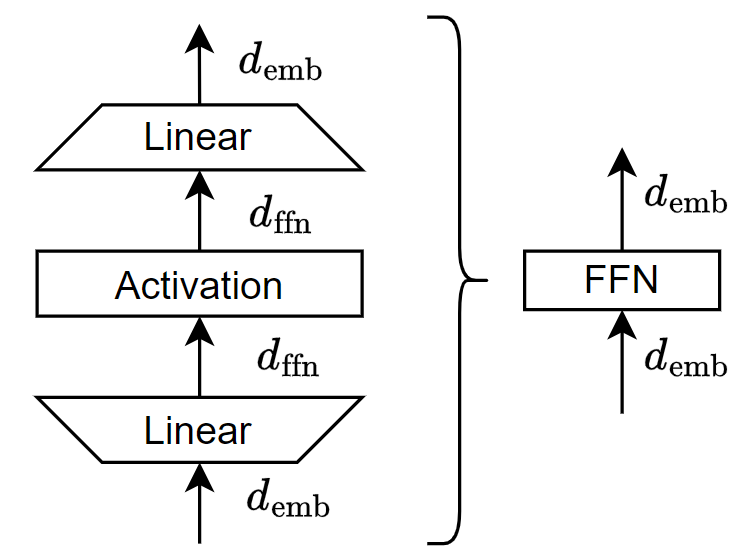
Within each block of the encoder and decoder, there are two main sub-layers. The first is the multi-head attention mechanism we've discussed. The second is a simple, fully connected feed-forward network (FFN).
The output of the attention sub-layer is passed to this FFN. The FFN processes each position's vector independently and identically. Its job is to perform further transformations on the representation, adding more modeling capacity. You can think of the attention layer as collecting and integrating information from across the sequence, and the FFN as processing that integrated information to extra deeper features.
These components—self-attention, multi-head attention, positional encodings, and feed-forward networks—form the building blocks of the Transformer. By stacking these blocks, models can build incredibly deep and powerful representations of language, forming the foundation for nearly all modern large language models.
What is the primary advantage of the Transformer architecture's parallel processing compared to the sequential processing of models like RNNs?
In the self-attention mechanism, what are the three vectors created for each word to determine its relationship with other words?