Advanced Topics in Transcriptional Activation Domain Research
Transcriptional Activation Domains
The Activation Switch
Transcription factors have two main jobs. First, they must find and bind to the right spot on the DNA. Second, they need to kickstart the process of transcription. The part of the protein responsible for this second job is called the transcriptional activation domain, or AD.
Think of the transcription factor as a specialized worker. Its DNA-binding domain is like a key that fits a specific lock on the DNA. The activation domain, however, is like the worker's hand that flips the switch to turn on the machinery. Without the AD, the transcription factor would just sit on the DNA, unable to initiate gene expression.
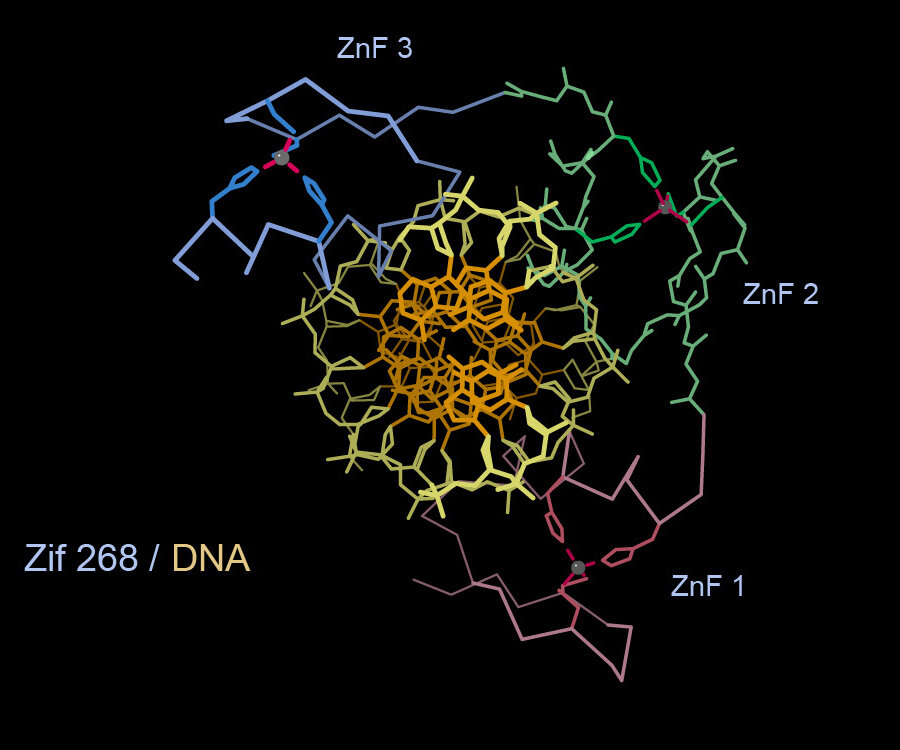
Structure Meets Function
You might expect such an important component to have a rigid, well-defined structure. But for most activation domains, the opposite is true. Many are what scientists call intrinsically disordered proteins (IDPs).
intrinsically disordered protein
noun
A protein or protein segment that lacks a fixed or ordered three-dimensional structure under physiological conditions.
Instead of folding into a stable shape, these domains are flexible and floppy, constantly changing their conformation. This lack of a fixed structure is not a defect; it's a feature. It allows the AD to interact with many different proteins, acting as a versatile hub for molecular communication. This flexibility lets it mold itself to various binding partners.
This structural freedom allows a single activation domain to act as a flexible scaffold, grabbing onto different molecular partners as needed.
Within this disordered chain, two types of amino acid residues are particularly important: acidic and hydrophobic.
- Acidic residues, like aspartic acid and glutamic acid, carry a negative charge. This creates patches of negative charge on the AD, making it attractive to positively charged regions on other proteins.
- Hydrophobic residues are nonpolar, like oil in water. These 'greasy' patches are crucial for making contact with hydrophobic pockets on partner proteins, forming weak but essential interactions.
Recruiting the Machinery
An activation domain doesn't turn on a gene by itself. Its main role is to recruit other, larger protein complexes that do the actual work. These are called coactivator complexes.
When a transcription factor binds to DNA, its flexible AD reaches out and makes contact with a coactivator. This interaction, often involving multiple weak connections through its acidic and hydrophobic residues, anchors the coactivator complex near the gene's starting point. The coactivator can then perform tasks like unwinding the DNA or helping to position RNA polymerase, the enzyme that transcribes DNA into RNA.
This recruitment model explains why ADs don't need a specific, conserved amino acid sequence. Their function relies on a general chemical character—a mix of negative charges and hydrophobicity—rather than a precise lock-and-key fit. Different combinations of these residues can achieve the same result, leading to a great diversity of AD sequences across different proteins and species.
A Challenge to Identify
This lack of a predictable sequence makes activation domains notoriously difficult to identify just by looking at a protein's amino acid code. While DNA-binding domains often have recognizable patterns or motifs, ADs are far more variable. Their disordered nature and reliance on general physicochemical properties mean that two ADs that perform the same function can have completely different sequences.
To find them, scientists often have to rely on functional tests. A common method is a reporter assay. In this experiment, researchers take a protein segment they suspect is an AD and fuse it to a known DNA-binding domain. They then put this hybrid protein into a cell with a 'reporter' gene that produces an easily detectable signal, like a glow. If the cell starts to glow, it means the reporter gene was activated, confirming that the tested protein segment is indeed a functional activation domain.
Let's check your understanding of these activation switches.
What is the primary role of a transcriptional activation domain (AD)?
The function of many activation domains depends on a general chemical character rather than a specific, conserved amino acid sequence.
Understanding activation domains is key to understanding how genes are precisely controlled.