Advanced Timber Properties and Structural Applications
Wood Anisotropy and Strength
The Grain's Direction
Wood isn't like steel or plastic. Its strength and stiffness depend entirely on the direction you measure them. This property is called anisotropy. Specifically, wood is an orthotropic material, meaning its mechanical properties are unique along three mutually perpendicular axes.
These three axes are:
- Longitudinal: Parallel to the grain. This is the direction of the tree's growth, from roots to leaves.
- Radial: Perpendicular to the growth rings, radiating out from the center of the trunk.
- Tangential: Perpendicular to the grain but tangent to the growth rings.
Think of wood as a tight bundle of drinking straws. It's very strong if you try to pull the straws apart lengthwise (longitudinal tension) or crush them end-to-end (longitudinal compression). But it's much easier to crush the bundle from the side or split the straws apart from one another (radial and tangential forces).
Strength Along the Axes
The practical result of wood's structure is a dramatic difference in mechanical properties. Wood is strongest and stiffest along the longitudinal axis. In fact, its tensile strength parallel to the grain can be up to 40 times greater than its tensile strength perpendicular to the grain.
This difference is quantified by the (MOE), a measure of a material's stiffness or resistance to elastic deformation. A high MOE means a material is very stiff. As you'd expect, wood's MOE is highest along the longitudinal axis.
| Property | Longitudinal (Parallel) | Radial (Perpendicular) | Tangential (Perpendicular) |
|---|---|---|---|
| MOE (GPa) for Douglas Fir | 12.2 | 0.9 | 0.6 |
| Compressive Strength (MPa) | 50 | 5.3 | 3.5 |
Notice how much larger the values are in the longitudinal column. This is why structural elements like beams, joists, and columns are always oriented so that the primary loads run parallel to the grain. Applying a major load perpendicular to the grain would risk crushing the wood fibers or splitting the member.
A Look Inside the Cells
This directional strength comes directly from wood's cellular anatomy. Wood is primarily composed of elongated cells, or fibers, that are aligned with the longitudinal axis. These hollow, tube-like structures are cemented together by a substance called lignin.
In softwoods, the dominant cell type is the tracheid. These long, slender cells with tapered ends are incredibly efficient at resisting tensile and compressive forces along their length. They make up about 90% of a softwood's volume.
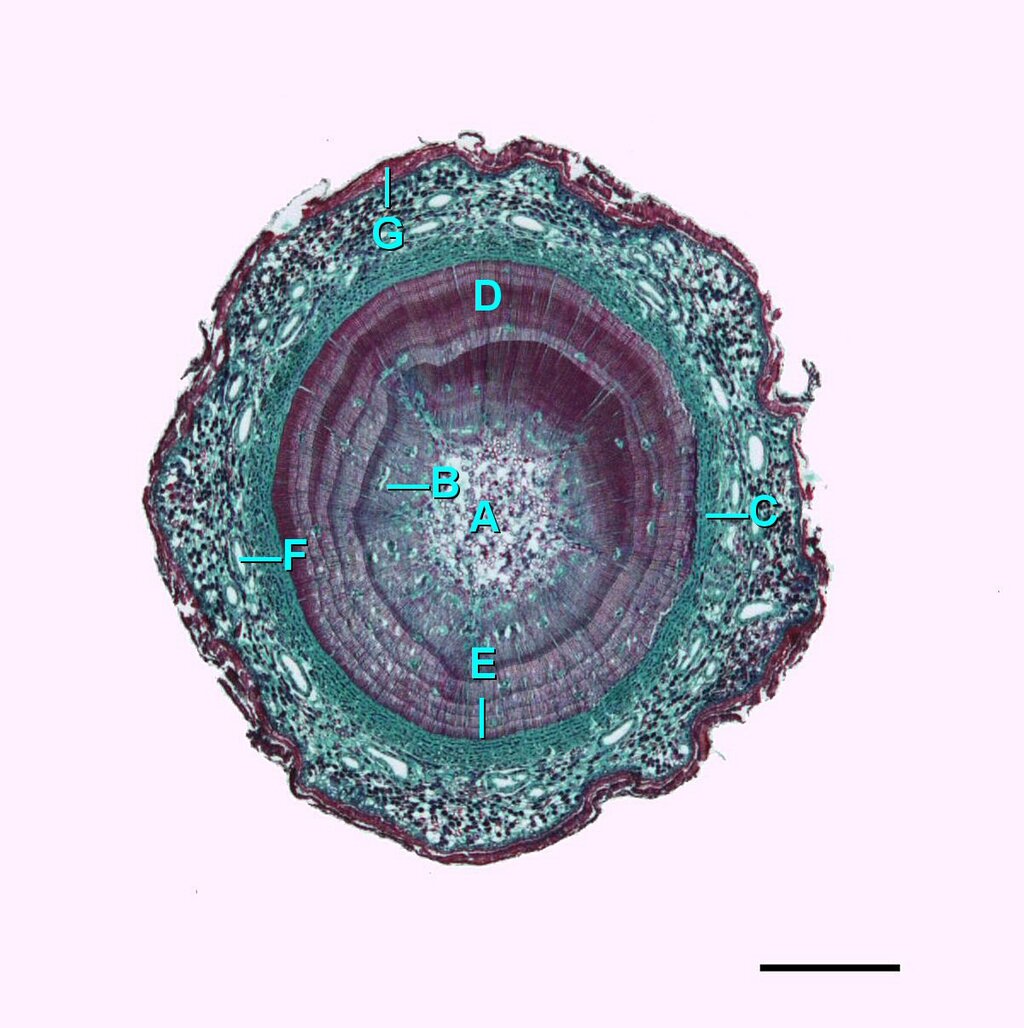
Hardwoods have a more complex structure. While they also have fibers for strength, they contain large-diameter cells called for water conduction. These vessels are essentially wide, open pipes that run parallel to the grain. While effective for transport, they create discontinuities in the cellular structure compared to the dense, uniform arrangement of tracheids in softwoods. This variation in cell types and arrangement is what gives different wood species their unique mechanical properties.
The key takeaway: Always align the load with the grain. This simple principle is the foundation of all timber engineering.
Understanding wood's orthotropic nature is not just academic. It is fundamental to designing safe, efficient, and durable wooden structures. By respecting the grain's direction, engineers can harness the incredible natural strength of this material.
Let's check your understanding of these core concepts.
Wood's mechanical properties, such as strength and stiffness, differ depending on the direction they are measured. What is the term for a material with unique properties along three mutually perpendicular axes?
Along which axis is wood strongest and stiffest?
Now that you understand how wood's internal structure dictates its strength, we can explore how these properties are measured and graded for engineering applications.