Advanced Timber Engineering and Material Science
Anisotropic Wood Mechanics
The Directional Nature of Wood
Unlike steel or plastic, which are isotropic and behave the same way regardless of the direction of force, wood is an orthotropic material. This means its mechanical properties differ along three mutually perpendicular axes. Understanding these axes is the key to effectively engineering with timber.
The Longitudinal axis runs parallel to the grain, along the length of the tree trunk. The Radial axis radiates from the pith (the center of the tree) outwards, perpendicular to the growth rings. The Tangential axis is tangent to the growth rings. Wood is significantly stronger and stiffer along the longitudinal axis than the other two.
Cellular Architecture
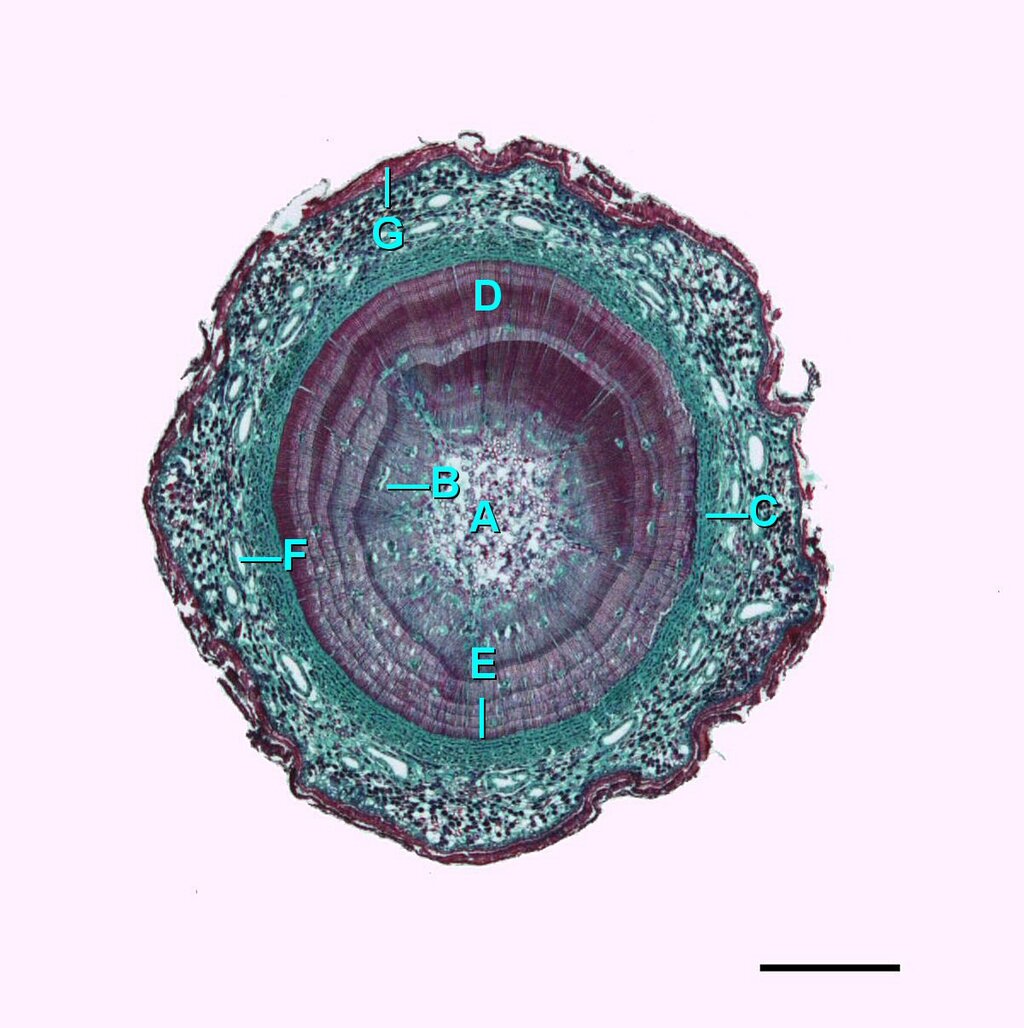
This directional behavior, or anisotropy, is a direct result of wood's cellular microstructure. Wood is composed of elongated, tube-like cells that are oriented along the longitudinal axis. In softwoods, these cells are primarily —long, slender cells that provide both structural support and water conduction. Hardwoods have a more specialized structure, with vessels for water transport and fibers for support.
This alignment of millions of tiny tubes acts like a bundle of drinking straws. It's very strong when you try to crush or stretch it along its length, but much weaker if you apply force across its diameter.
We can quantify this difference using the Modulus of Elasticity (), a measure of a material's stiffness. For wood, we have three distinct moduli: (Longitudinal), (Radial), and (Tangential). The value of can be 10 to 20 times greater than , and often 20 to 30 times greater than . This huge variation is critical for any structural calculation.
| Property | Longitudinal (L) | Radial (R) | Tangential (T) |
|---|---|---|---|
| Modulus of Elasticity Ratio (Typical) | 1 | 0.08 | 0.05 |
| Strength Ratio (Typical) | 1 | 0.1 | 0.07 |
Grain Angle and Strength
In the real world, wood components are rarely loaded perfectly parallel or perpendicular to the grain. The —the angle between the direction of the wood fibers and the direction of the applied load—has a profound impact on strength. As this angle increases from zero, the wood's ability to resist compression and shear forces drops dramatically.
For example, a piece of Douglas Fir loaded in compression at a 15-degree angle to its grain might only have about half the strength of one loaded perfectly parallel to the grain. This is why grain orientation is a primary concern in timber frame joinery and the design of structural beams.
Each species embodies a unique set of physical characteristics: density, stiffness, internal damping, and grain orientation.
To account for this, engineers use a specific formula to calculate the allowable stress for wood at an angle to the grain.
By plugging in the known parallel () and perpendicular () strength values for a species, along with the specific grain angle (), engineers can accurately determine the wood's capacity. This calculation is fundamental to designing safe and efficient timber structures, from simple roof trusses to complex glulam arches.