Advanced Thigh Muscle Animation and Biomechanics
Thigh Biomechanics
Levers in Motion
To animate the thigh realistically, we need to move beyond simple limb rotation. Think of the femur as a mechanical lever. The hip or knee joint acts as the fulcrum, and the muscles provide the force to move the load, which is the weight of the lower leg and anything it's pushing against. Every muscle pulls; they never push. This pull, or force, is a vector—it has both a direction and a magnitude. The exact angle of this pull determines the resulting movement.
The quadriceps pull on the tibia via the patellar tendon to extend the knee, while the hamstrings pull on the back of the tibia and fibula to flex it. These opposing groups are called agonist and antagonist pairs. When the quadriceps (agonist) contract to straighten the leg, the hamstrings (antagonist) must relax and lengthen to allow the movement. This interplay is what creates smooth, controlled motion. In animation, understanding which muscle group is the primary mover helps dictate where the tension and deformation should appear.
How Contractions Create Form
Muscles change shape based on how they're activated. This is critical for realistic rigging. A muscle's action isn't just on or off; it can be contracting while shortening or contracting while lengthening.
Concentric Contraction
adjective
The muscle shortens as it generates force. This is the classic 'flexing' action, where the muscle belly bunches up and becomes more prominent.
Think of a character kicking a ball. The quadriceps contract concentrically to straighten the knee with power. This is when you'd model the most significant bulge in the thigh muscles.
Eccentric Contraction
adjective
The muscle lengthens as it generates force. It's acting as a brake to control a movement, resisting gravity or momentum.
When a character lands from a jump, their quadriceps are firing to slow the descent and absorb shock. The muscle is active and under tension, but it's lengthening as the knee bends. In this case, the muscle would appear firm and taut, but elongated, not bunched. Animating this distinction separates believable movement from robotic action.
The Two-Joint Dynamo
Not all muscles operate on a single joint. The Rectus Femoris, one of the four quadriceps muscles, is a prime example. It's a two-joint muscle, crossing both the hip and the knee. This unique position means it can perform two distinct actions: flexing the hip (lifting the thigh) and extending the knee (straightening the leg).
A single muscle creating motion at two different joints introduces complexity. The Rectus Femoris can't fully contract to perform both actions simultaneously. If you fully flex your hip, you can't fully extend your knee, and vice-versa. This principle is called active insufficiency.
During a walking or running cycle, this dual function is incredibly efficient. As the leg swings forward, the Rectus Femoris initiates hip flexion to lift the thigh. Then, as the leg prepares for foot strike, it contributes to knee extension. For an animator, this means the deformation along the front of the thigh is complex; it's not just tied to the knee angle but also to the hip angle.
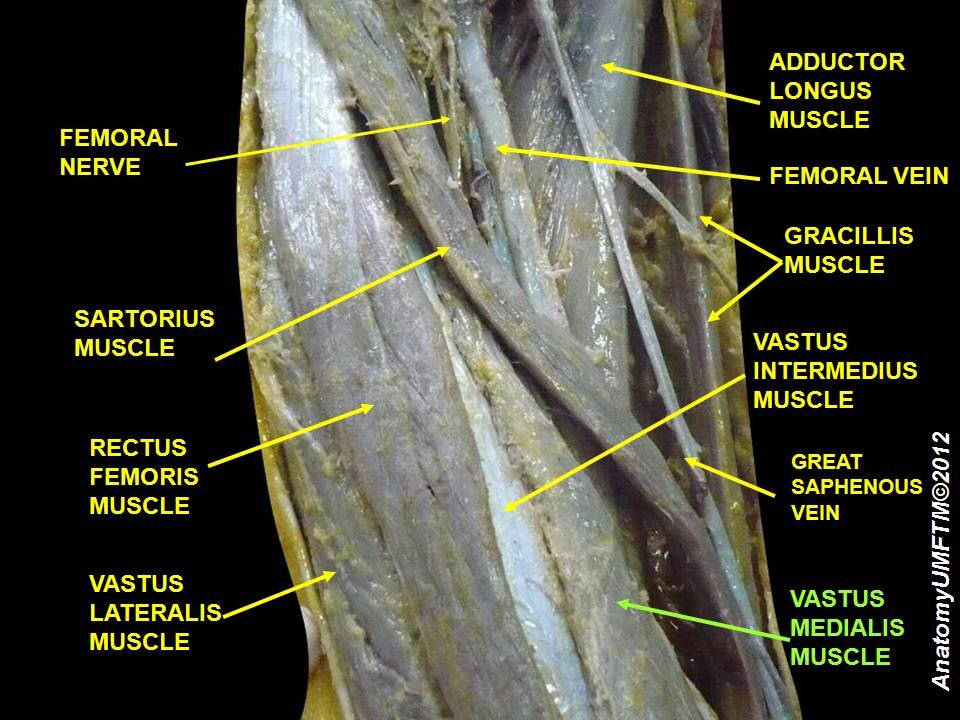
The other quadriceps muscles, the Vasti, only cross the knee joint. When a character puts weight on their leg, like in the middle of a squat, these muscles engage powerfully. The Vastus Medialis, on the inner side, creates a prominent 'teardrop' shape just above and inside the kneecap. The Vastus Lateralis, on the outer side, forms the 'sweep' of the outer thigh. Accurately sculpting these shapes in your rig and triggering them during weight-bearing phases will add a profound level of realism to your character's movements.
When a character kicks a ball, the quadriceps contract to straighten the knee with power. This action, where the muscle shortens while generating force, is known as:
In the mechanical lever system of the leg, muscles can only pull on bones; they never push.