Advanced Theoretical Physics Mastery
Lagrangian Formalism
The Principle of Stationary Action
In classical mechanics, the trajectory of a physical system between two points in time is not arbitrary. It follows a specific path dictated by a fundamental principle: Hamilton's Principle, or the principle of stationary action. This principle posits that the actual path taken by a system is one for which the action is stationary, meaning its first-order variation is zero. The action, denoted by , is a functional—a function of functions—defined as the time integral of the Lagrangian, .
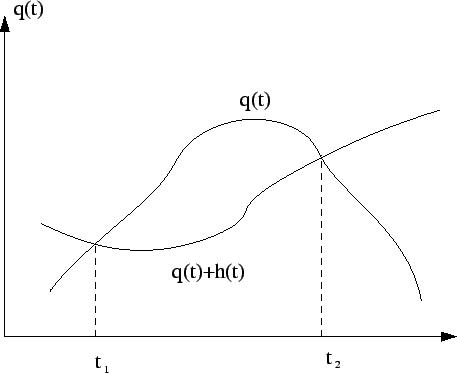
The Lagrangian itself is defined as the difference between the system's kinetic energy, , and its potential energy, . Thus, . To find the path that makes the action functional stationary, we employ the calculus of variations. We consider a small perturbation of the true path, , with the condition that the endpoints are fixed, so . The principle demands that the change in action, , must be zero for any such variation.
Calculus of Variations and Equations of Motion
Applying the calculus of variations to the action integral leads directly to the equations of motion. The condition results in a set of differential equations known as the Euler-Lagrange equations.
For a system described by generalized coordinates , there is one Euler-Lagrange equation for each coordinate. These equations entirely determine the dynamics of the system.
The term is defined as the generalized momentum, , conjugate to the coordinate . The term is the generalized force. In this framework, the equations of motion are derived from a single scalar function, the Lagrangian, rather than from vector forces as in Newtonian mechanics. This often simplifies the problem, especially in systems with many degrees of freedom or complex constraints.
Coordinates, Constraints, and Configuration Space
One of the most powerful features of the Lagrangian formalism is its use of generalized coordinates. These are any set of parameters that uniquely specify the configuration of a system at a given time. They don't have to be Cartesian coordinates; they can be angles, distances, or any other convenient variables. This freedom allows us to choose coordinates that automatically respect the constraints of the system, simplifying the problem significantly.
The set of all possible configurations of a system is its configuration space, an N-dimensional manifold where N is the number of degrees of freedom. The state of the system at any time is a single point in this space, and its evolution over time traces a path on this manifold.
Constraints restrict the motion of a system. They are classified as either holonomic or non-holonomic. are those that can be expressed as an algebraic equation relating the coordinates of the system and time: . A bead confined to a wire is a classic example. Because these constraints reduce the number of independent coordinates, they are ideal for the Lagrangian approach. We can simply choose a set of generalized coordinates that embeds the constraint, thereby reducing the dimensionality of the problem.
Non-holonomic constraints, in contrast, are non-integrable and typically involve velocities. A classic example is a sphere rolling on a plane without slipping. The constraint relates the sphere's linear velocity to its angular velocity. These cannot be used to eliminate coordinates in the same way. While the Lagrangian method can still be used, it requires the introduction of Lagrange multipliers to incorporate the forces of constraint into the Euler-Lagrange equations.
Now, let's test your understanding of these core concepts.
Ready to apply these principles?
According to Hamilton's Principle, what characteristic must the action () have for the actual path taken by a physical system between two points in time?
How is the Lagrangian, , defined in terms of kinetic energy () and potential energy ()?
By defining the system in terms of its kinetic and potential energies and applying the principle of stationary action, we can derive the equations of motion for even highly complex systems in a systematic way. This provides the foundation for more advanced topics in classical and quantum physics.