Advanced Theoretical Physics
Advanced Quantum Field Theory
Symmetry as a Blueprint
In physics, some of the deepest truths come from the idea of symmetry. A perfect sphere is symmetric because it looks the same no matter how you rotate it. Quantum field theory takes this idea to a new level with something called gauge symmetry.
Imagine you have a field, like an electric field, that fills all of space. A gauge symmetry means that the laws of physics describing this field don't change even if you adjust the field's properties differently at every single point in space and time. This is called a local symmetry. It's a much stricter requirement than a global symmetry, where you'd have to make the exact same adjustment everywhere at once.
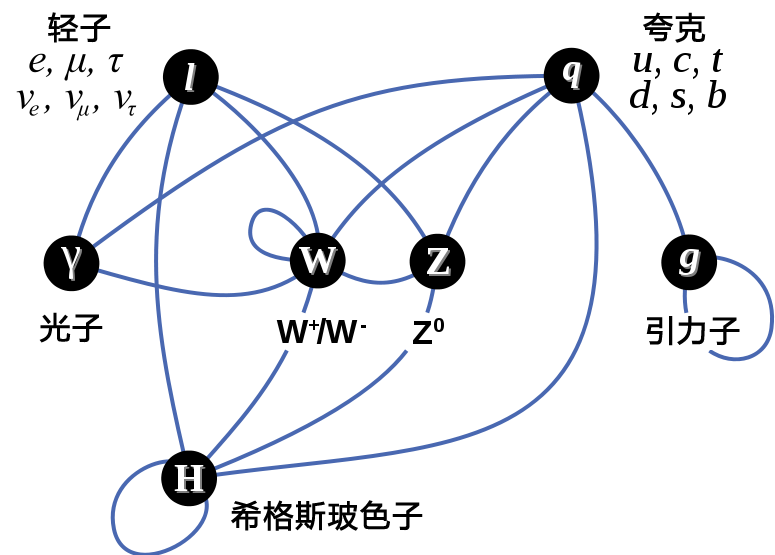
Here’s the amazing part. For the math of our theories to work under these strict local symmetry rules, a new field must exist. This new field acts as a connector, ensuring the symmetry holds true everywhere. These connector fields are what we perceive as the fundamental forces of nature, and their associated particles are called gauge bosons.
This principle is the foundation for the Standard Model of particle physics. Electromagnetism, for instance, is a gauge theory. The requirement of its specific symmetry, called , mathematically forces the existence of the photon. The strong nuclear force, which binds quarks together, arises from a more complex gauge symmetry called , and it predicts the existence of gluons.
Gauge Boson
noun
A force-carrying particle that mediates the fundamental interactions of nature. They arise from the requirement of gauge symmetry in quantum field theories.
Theories based on symmetries like and are called non-Abelian gauge theories. Unlike the photon, the gauge bosons in these theories (the W, Z, and gluons) can interact with each other. This self-interaction is what makes forces like the strong force so incredibly complex and powerful.
Taming Infinity
When physicists first used QFT to predict the outcomes of particle interactions, they ran into a disaster. Their calculations, which involved diagrams of virtual particles popping in and out of existence, kept spitting out the same answer for many quantities: infinity.
This wasn't just a small error. It suggested the theory was fundamentally broken. The problem arises from loops in Feynman diagrams, which represent virtual particles. These particles can have any amount of momentum, and when you add up all the possibilities—all the way to infinite momentum—the calculations diverge.
This happens because the theory treats elementary particles as infinitely small points. The interactions of a point-like particle with the cloud of virtual particles surrounding it lead to infinite corrections to its properties, like its mass and charge.
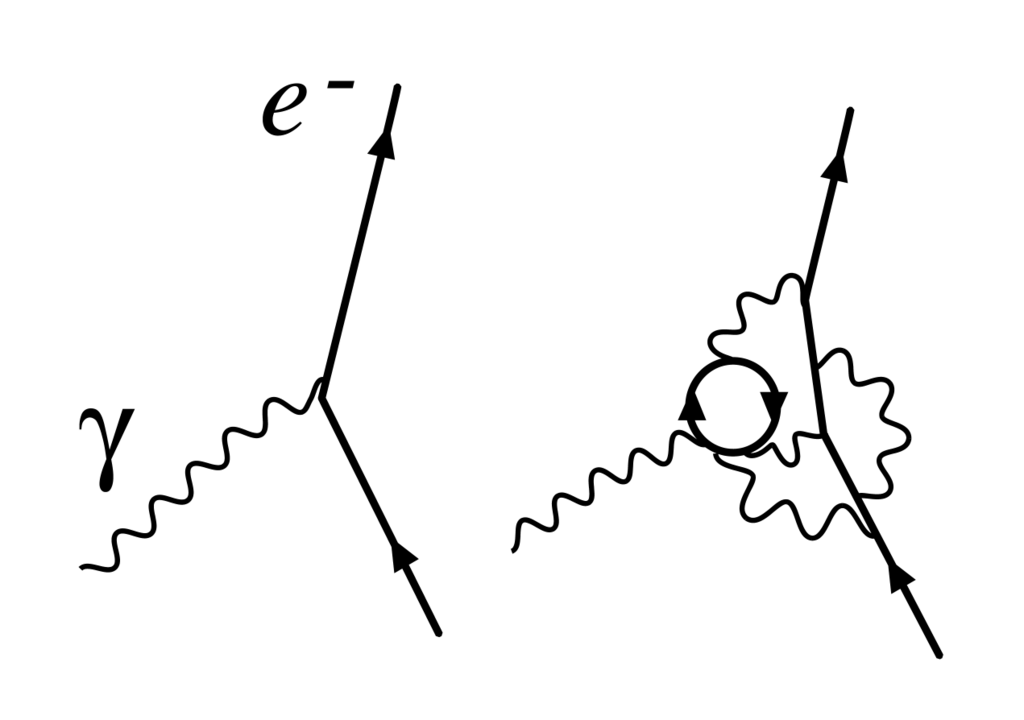
The solution is a set of techniques called renormalization. The core idea is subtle but powerful. The mass and charge we write in our initial equations—the "bare" parameters—are not the values we actually measure in an experiment. The measured value is the "dressed" parameter, which includes the effects of the virtual particle cloud.
Renormalization is a systematic procedure for absorbing the infinities. We start by placing a mathematical limit, called a cutoff ($ \Lambda $), on how much energy the virtual particles can have. This makes our calculations finite, but dependent on the cutoff.
We then realize that the bare parameters in our original theory must also depend on this cutoff. We define them in just the right way so that when we combine them with the messy, infinite parts of our calculation, the cutoffs cancel out perfectly. What's left is a finite, sensible prediction for the physical quantity we can measure in the lab.
It sounds like a mathematical trick, but it works astonishingly well. Renormalization transformed QFT from a problematic theory into the most precise predictive framework in the history of science.
Broken Symmetries
Symmetries are the bedrock of QFT. They aren't just aesthetically pleasing; they lead to conservation laws. For example, the symmetry of physical laws over time leads to the conservation of energy. So, what happens if a symmetry that exists in the classical, non-quantum version of a theory is broken by the quantum effects themselves?
This is called an anomaly. An anomaly is a classical symmetry that is violated by quantum corrections, typically from those same loops of virtual particles that caused the infinity problem.
Sometimes, anomalies are a disaster. A gauge symmetry that becomes anomalous would render the entire theory inconsistent and physically meaningless. A major goal for theoretical physicists is to build models where all gauge anomalies perfectly cancel out. In the Standard Model, for instance, the anomalies from quarks and leptons cancel each other with incredible precision. This cancellation is a deep hint about the underlying structure of our universe.
An anomaly is when a symmetry of a classical theory is not a symmetry of its quantized version.
But not all anomalies are bad. Sometimes, a broken global symmetry can lead to correct physical predictions. One of the most famous examples is the decay of a neutral pion. The classical theory, based on a concept called chiral symmetry, predicts that the pion should be stable and never decay. But it does decay, into two photons.
The chiral anomaly explains this perfectly. The quantum loop corrections break the chiral symmetry, allowing the decay to happen. The rate calculated using the anomaly matches experimental results with remarkable accuracy. What at first looked like a flaw in the theory turned out to be a necessary feature to describe reality.
Test your understanding of these advanced QFT topics.
What is the key distinction between a local gauge symmetry and a global symmetry in Quantum Field Theory?
In the context of gauge theory, the existence of the photon is a necessary consequence of requiring physical laws to be symmetric under which local gauge transformation?
Gauge theories, renormalization, and anomalies are pillars of modern physics, turning the abstract language of symmetry into concrete predictions about the fabric of reality.