Advanced Thalamic Connectivity and Function
Mapping Thalamic Nuclei
Thalamic Organization
The thalamus isn't a single, uniform structure. Instead, it's a collection of distinct processing hubs called nuclei. These nuclei are organized into groups, separated by a Y-shaped sheet of white matter known as the internal medullary lamina. While this anatomical division is a useful landmark, a more powerful way to understand the thalamus is by grouping its nuclei functionally.
We can categorize thalamic nuclei into three primary functional groups: relay nuclei, association nuclei, and non-specific nuclei.
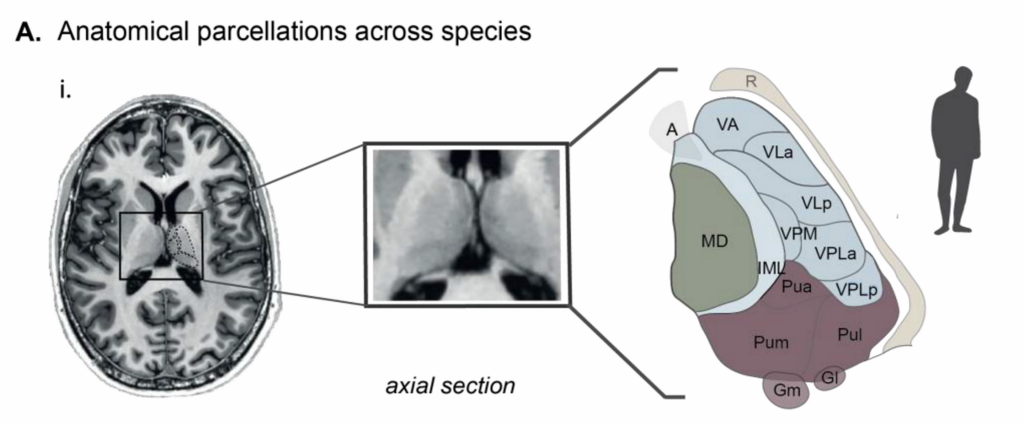
Relay Nuclei
Relay nuclei act as specific, high-fidelity gateways. They receive well-defined inputs from sensory pathways or other subcortical structures and project them to highly specialized areas of the cerebral cortex. Think of them as dedicated couriers, each carrying a specific type of information to a precise destination.
For example, all sensory information from your body, except for smell, must first pass through a specific relay nucleus in the thalamus before it reaches the cortex for conscious perception. The same is true for motor signals coming from the cerebellum and basal ganglia on their way to the motor cortex.
| Nucleus Group | Input From | Projects To | Function |
|---|---|---|---|
| Ventral Posterolateral (VPL) & Posteromedial (VPM) | Body (VPL) & Face (VPM) | Primary Somatosensory Cortex | Touch, pain, temperature |
| Lateral Geniculate Nucleus (LGN) | Retina (Optic Nerve) | Primary Visual Cortex | Vision |
| Medial Geniculate Nucleus (MGN) | Inner Ear (Auditory Pathway) | Primary Auditory Cortex | Hearing |
| Ventral Anterior (VA) & Ventral Lateral (VL) | Basal Ganglia & Cerebellum | Motor & Premotor Cortex | Motor planning & coordination |
Association Nuclei
Unlike relay nuclei, association nuclei don't simply forward raw data from the periphery. Instead, their primary connections are with the cerebral cortex itself. They receive processed information from large areas of the cortex and project back to other cortical association areas. This creates cortico-thalamo-cortical loops that are vital for higher-order cognitive functions.
These nuclei help integrate different types of information and regulate attention and interpretation. They are less like couriers and more like switchboard operators, connecting different cortical departments to enable complex collaboration.
The two largest association nuclei are the Pulvinar and the Mediodorsal (MD) nucleus.
- Pulvinar: This nucleus is extensively connected with visual association areas in the parietal, occipital, and temporal lobes. It's thought to be critical for visual attention, helping to filter relevant visual information from distracting stimuli.
- Mediodorsal (MD) Nucleus: The MD nucleus has strong reciprocal connections with the prefrontal cortex. This loop is essential for executive functions like planning, working memory, and decision-making.
Non-Specific Nuclei
The third group, the non-specific nuclei, do not project to discrete, localized cortical areas. Instead, their projections are diffuse, spreading across wide regions of the cortex. Their main role is to regulate the overall excitability and arousal level of the cerebral cortex.
These nuclei, which include the intralaminar and midline groups, receive input from the brainstem reticular activating system, a network crucial for maintaining consciousness. The intralaminar nuclei are embedded within the internal medullary lamina itself. By broadcasting signals widely, these non-specific nuclei can modulate the brain's general state of alertness, essentially turning up or down the 'volume' of cortical processing.
If you want to alter connectivity across many cortical areas, it may be beneficial to intervene at the level of the thalamus, before signals are broadcast throughout the brain.
This functional mapping reveals the thalamus not just as a simple relay station, but as a dynamic hub. It creates a 'thalamic miniature-map' of the brain, where specific relay nuclei partner with primary cortical areas, and association nuclei form complex loops with higher-order cortex, all while non-specific nuclei manage the brain's overall readiness to process information.
What is the primary role of the thalamic relay nuclei?
The Mediodorsal (MD) nucleus, an association nucleus, has strong reciprocal connections with the prefrontal cortex. This loop is essential for what?
By understanding these functional divisions, we can better appreciate how the thalamus gates sensory input, integrates cognitive processes, and maintains our conscious awareness.