Advanced Swarm and Distributed AI
Introduction to Swarm Intelligence
What Is Swarm Intelligence?
Have you ever watched a colony of ants work together to carry a large crumb back to their nest? Or seen a flock of birds move in perfect, fluid synchrony? In both cases, there's no single leader telling everyone what to do. Instead, each individual follows a few simple rules, and from these simple actions, a complex, intelligent group behavior emerges. This is the core idea behind swarm intelligence.
Swarm intelligence is a collective behavior that emerges from the interactions of individual agents following simple rules, inspired by natural systems like ant colonies and bird flocks
It’s a bottom-up approach to problem-solving. Instead of a central 'brain' making all the decisions, intelligence is distributed across the entire group. Each member acts on local information, unaware of the bigger picture. Yet, together, they achieve goals far beyond the capabilities of any single member.
Nature's Smart Mobs
Nature is filled with examples of swarm intelligence. Ant colonies are classic models. When an ant finds food, it lays down a pheromone trail on its way back to the nest. Other ants are programmed with a simple rule: follow the scent. As more ants use a path, the trail becomes stronger, attracting even more ants. Shorter paths get reinforced faster, so the colony naturally and efficiently finds the quickest route to a food source. No single ant needs a map; the map emerges from their collective actions.
Similarly, a starling murmuration—that breathtaking aerial dance of thousands of birds—is governed by a few basic rules for each bird: stay close to your neighbors, match their speed and direction, and don't collide. From these local interactions, the flock can instantly change shape to evade a predator, acting like a single, massive organism.
The Core Principles
Swarm intelligence operates on a few key principles. Understanding them helps explain how leaderless groups can act so intelligently.
Self-organization
noun
The process where structure or patterns appear in a system without central control or external direction.
This is the bedrock of swarm intelligence. The flock's shape and the ant's trail aren't pre-programmed. They arise spontaneously from the interactions of the agents. Another key principle is decentralized control. Because there's no leader, the system is incredibly resilient. If a few birds or ants are removed, the group continues its task without missing a beat. The loss of one part doesn't cause the whole system to fail.
Finally, these principles lead to emergent behavior. This is the sophisticated, system-level outcome that arises from all the simple, local interactions. The intelligent foraging of the ant colony is an emergent behavior. The flock's defensive maneuvers are an emergent behavior. The whole truly becomes greater than the sum of its parts.
Swarms in the Digital World
The power of swarm intelligence isn't limited to the natural world. Researchers and engineers apply these same principles to create artificial systems that can solve complex problems.
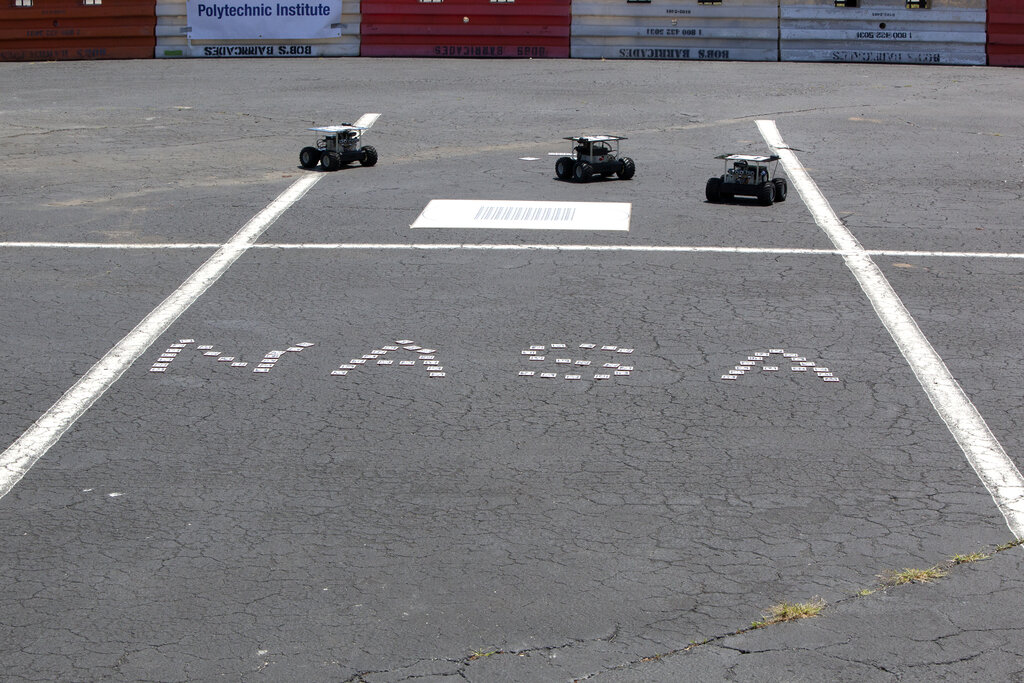
In swarm robotics, teams of small, inexpensive robots can collaborate on tasks like search and rescue in disaster zones, environmental monitoring, or even construction. Because the system is decentralized, it can adapt if some robots are damaged or lost.
By mimicking nature's swarms, we can build robust, scalable, and flexible artificial systems.
Swarm intelligence is also used in software. Optimization algorithms inspired by ant colonies can find efficient routes for delivery trucks or manage data flow in telecommunication networks. In filmmaking and video games, swarm logic creates realistic crowds and battle scenes where hundreds of digital characters move believably without being individually animated. The applications are vast, all stemming from the same elegant idea: simple agents and simple rules can produce profoundly intelligent results.
Let's review the key terms we've covered.
Now, check your understanding of these core ideas.
What is the core idea behind swarm intelligence?
The breathtaking aerial patterns of a starling murmuration, which arise from birds following simple rules like staying close to neighbors, is a perfect example of...
By harnessing the power of the collective, swarm intelligence offers a powerful way to think about and solve problems, drawing inspiration from the time-tested strategies of the natural world.