Advanced String Theory Concepts
Introduction to String Theory
The Universe on a String
For centuries, physics has pictured the fundamental particles of our universe—electrons, photons, quarks—as tiny, zero-dimensional points. It's a useful model, but it leads to some mathematical headaches, especially when trying to unite gravity with quantum mechanics. String theory offers a radical new picture. It suggests that if you could zoom in on a particle, you wouldn't find a point. Instead, you'd find a tiny, one-dimensional loop of vibrating energy: a string.
In string theory, a leading approach to that unification, particles are in actuality one-dimensional objects, small vibrating loops or strands.
This single, simple change has profound consequences. All the different particles and forces we see in the universe are, in this view, just different manifestations of one fundamental object. The variety isn't in the ingredients, but in how those ingredients behave.
A Cosmic Symphony
Think of a guitar string. Plucking it in different ways produces different musical notes. A C note and a G note aren't different kinds of string; they are the same string vibrating at different frequencies. String theory proposes that the universe works in a similar way.
A string vibrating in one pattern might appear to us as an electron. A different vibration pattern would be a photon, the particle of light. Yet another would be a quark. Every particle we've ever discovered, and perhaps many we haven't, could simply be the same kind of fundamental string playing a different "note." The laws of physics, in this sense, are like the rules of harmony for a cosmic symphony.
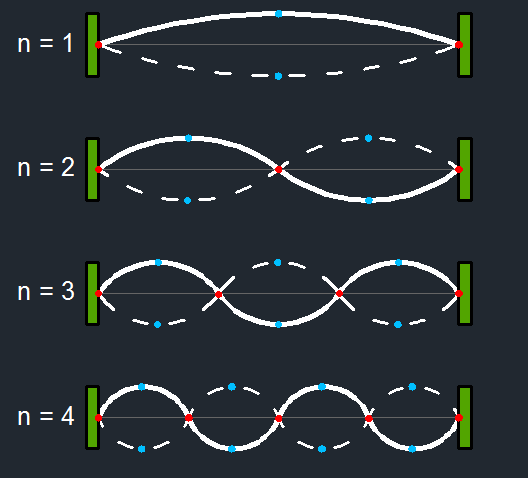
This elegant idea solves many problems. For one, it predicts the existence of a particle with the exact properties of the graviton, the hypothetical particle that carries the force of gravity. This makes string theory a promising candidate for a "theory of everything," uniting quantum mechanics and general relativity.
Hidden Dimensions
This new picture of the universe comes with a strange requirement. For the mathematics of string theory to work, the universe must have more than the three spatial dimensions (length, width, height) and one time dimension we experience. Most versions of the theory require a total of 10 or 11 spacetime dimensions.
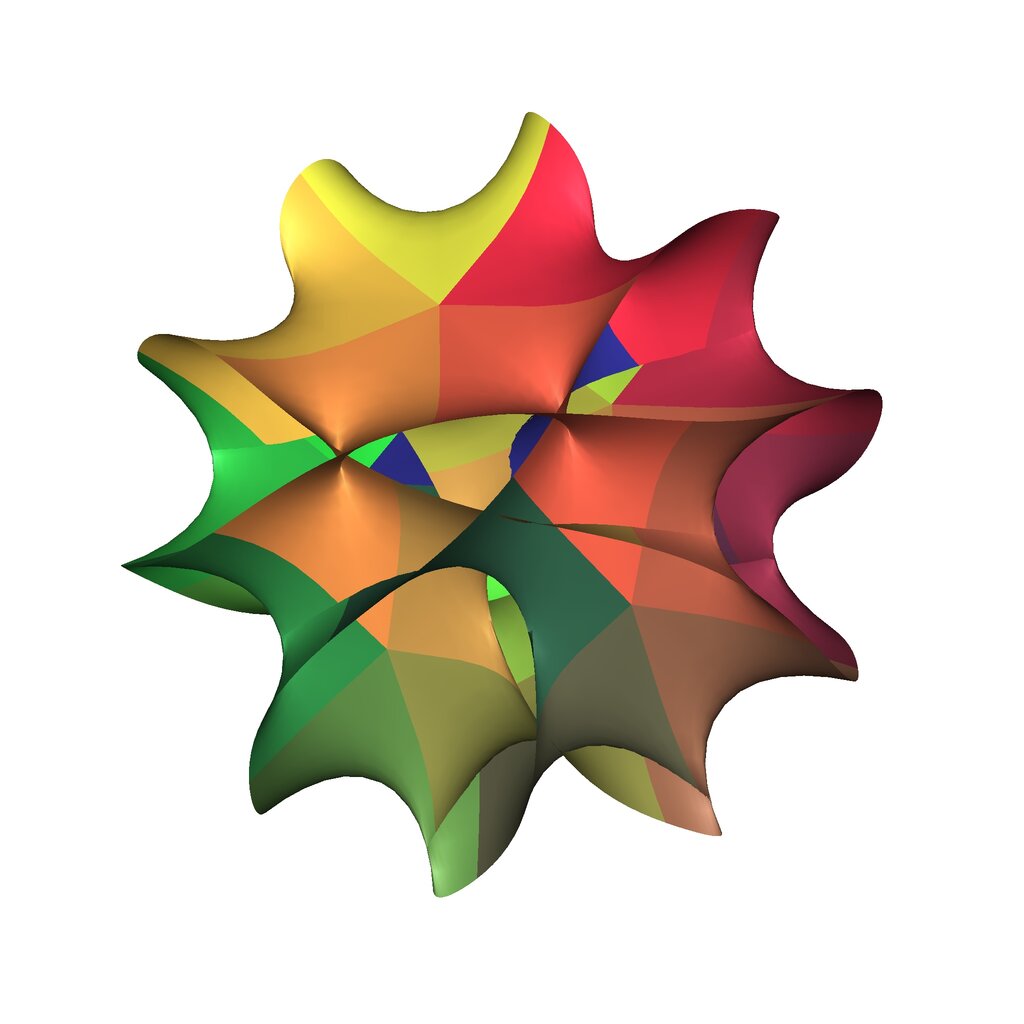
So where are these extra dimensions? The theory says they are "compactified," or curled up on themselves at an incredibly small scale.
Imagine a tightrope walker. From a distance, the rope looks like a one-dimensional line. The walker can only move forward or backward. But for an ant on that same rope, there is another dimension: it can crawl around the circumference of the rope. That circular dimension is hidden from the distant observer because it's so small.
String theory suggests the extra dimensions are like that, but curled up at every single point in our familiar space, far too small for us or even our best instruments to perceive directly. These tiny, hidden dimensions aren't just an afterthought; their specific shape and size would determine the ways strings can vibrate, and therefore dictate the fundamental constants and laws of our universe.
A Supersymmetric Universe
Another key ingredient of most string theories is an idea called supersymmetry. In the Standard Model of particle physics, all particles fall into one of two categories: fermions and bosons.
Fermions are the particles that make up matter, like electrons and quarks. They obey a rule called the Pauli exclusion principle, which means no two identical fermions can occupy the same quantum state. This is why solid matter exists and you don't fall through the floor.
Bosons are the particles that carry forces, like photons (electromagnetism) and gluons (strong nuclear force). Multiple bosons can exist in the same state, which is what makes lasers possible, for example.
| Category | Role | Examples |
|---|---|---|
| Fermions | Building blocks of matter | Electron, quark, neutrino |
| Bosons | Force-carrying particles | Photon, gluon, Higgs boson |
Supersymmetry proposes a deep connection between these two seemingly different families. It predicts that for every known fermion, there should be a corresponding boson, and for every known boson, a corresponding fermion. These undiscovered partner particles are called "superpartners."
So, the electron (a fermion) would have a superpartner called the "selectron" (a boson). The photon (a boson) would have a superpartner called the "photino" (a fermion). While we haven't yet detected any of these superpartners, supersymmetry is a mathematically elegant idea that solves several theoretical problems and is a vital component for making string theory consistent.
Time to test your knowledge of these new ideas.
According to string theory, what fundamental concept replaces the idea of particles as zero-dimensional points?
String theory uses the analogy of a guitar string to explain how different particles arise. What does the 'note' produced by the string correspond to?
String theory presents a beautiful, if unproven, vision of the universe. It replaces the messy zoo of particles with the elegant music of vibrating strings, suggesting a deep unity underlying the cosmos. While it remains on the frontiers of theoretical physics, it continues to inspire new ways of thinking about reality itself.