Advanced Sourdough Bread Techniques
Advanced Fermentation Strategies
The Slow-Down for Flavor
You already know that fermentation creates the gas that makes bread rise. But its other crucial job is to create flavor. By manipulating time and temperature, you can steer the fermentation process to develop deeper, more complex tastes.
One of the most powerful techniques for this is cold fermentation, also known as retarding. It involves placing your shaped dough in the refrigerator for an extended period, typically 12 to 24 hours or even longer, before baking.
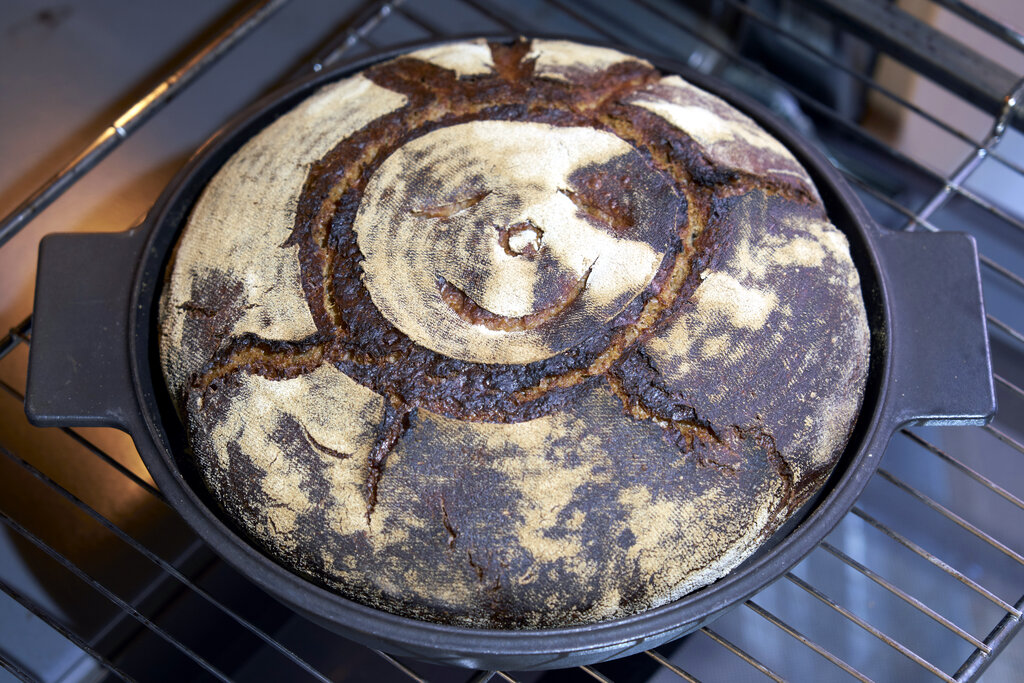
Slowing things down in the cold changes the behavior of the microbes in your dough. The yeast, which is primarily responsible for leavening, becomes much less active at cold temperatures. However, the lactic acid bacteria (LAB), the workhorses of flavor, keep chugging along, albeit at a slower pace. This shift in activity allows for a greater production of acetic and lactic acids, which are the sources of sourdough's signature tang.
A cold ferment doesn't just improve flavor. It also makes the dough firmer and less sticky, which is a huge advantage when it comes time to score. The chilled surface allows for cleaner, more precise cuts, giving you more control over the final look of your loaf.
Refrigerating the dough encourages the production of more acetic acid, which is the tangier of the two.
A Head Start on Complexity
Another way to build flavor is to give a portion of your dough a head start. This is the principle behind using a pre-ferment. The sponge and dough method is a classic example of this technique.
Instead of mixing all your ingredients at once (a "straight dough" method), you first create a "sponge" by mixing a portion of the total flour, water, and all of your starter. You let this mixture ferment for several hours. This sponge becomes incredibly active and develops a significant amount of flavor. Only then do you add the remaining flour, water, and salt to form the final dough.
Using a pre-ferment like a sponge can lead to a more nuanced, less sharply acidic flavor profile compared to a long cold fermentation. It also helps to strengthen the gluten network early on, potentially leading to a better rise and a more open crumb.
Measuring the Sour
For those who want to achieve ultimate consistency and control, monitoring the dough's pH is a game-changer. pH is a scale from 0 to 14 that measures acidity. A pH of 7 is neutral, below 7 is acidic, and above 7 is alkaline. Sourdough is, by its nature, acidic.
Tracking pH tells you precisely where your dough is in the fermentation cycle. The ideal pH for sourdough at the end of bulk fermentation is typically between 3.8 and 4.2. In this range, the dough has developed good flavor, but the gluten structure is still strong.
| pH Level | Dough Characteristics |
|---|---|
| 5.0 - 5.5 | Beginning of fermentation. Mild flavor. |
| 4.2 - 4.6 | Good flavor development, strong gluten. |
| 3.8 - 4.1 | Peak flavor complexity. Optimal for most loaves. |
| Below 3.7 | Very tangy. Gluten may start to weaken. |
If the pH drops too low, the highly acidic environment begins to break down gluten, leading to a slack, soupy dough that's difficult to handle and won't rise well in the oven. This is known as over-proofing.
By measuring pH with a digital meter, you can learn to identify the perfect moment to shape your dough or put it in the oven, taking the guesswork out of the process and leading to more consistent results loaf after loaf.
Ready to test your knowledge on these advanced techniques?
What is the primary effect of placing sourdough in the refrigerator for an extended period, a technique known as cold fermentation or retarding?
In the context of sourdough, if the pH of your dough drops too low (e.g., below 3.8), what is the most likely negative consequence?
Mastering these methods allows you to become the conductor of your dough's microbial orchestra, fine-tuning the process to create bread with the exact flavor and texture you desire.