Advanced Sound Healing with Bowls and Gongs
Physics of Sound Healing Instruments
How Bowls and Gongs Sing
Singing bowls and gongs produce sound through a straightforward physical mechanism. When struck with a mallet, the instrument's shape momentarily deforms. This transfer of kinetic energy causes the metal to oscillate rapidly, creating vibrations that propagate through the air as sound waves. Unlike a simple string, which vibrates primarily in one dimension, the surface of a bowl or gong vibrates in complex, two-dimensional patterns.
These vibrations are not random. They form distinct patterns known as modes. The simplest mode is the fundamental frequency, which determines the main pitch of the instrument. However, the initial strike also excites a whole series of higher-frequency overtones, or partials. The unique combination of these partials gives each bowl and gong its characteristic rich and shimmering timbre.
When a wooden mallet, called a puja, is run around the rim of a singing bowl, it creates a continuous vibration through friction. This is a classic example of a slip-stick phenomenon, where the mallet continuously grabs and releases the rim, feeding energy into the bowl at its natural resonant frequency and causing it to 'sing' with a clear, sustained tone.
Resonance and the Body
The key principle behind how these instruments are thought to affect the body is resonance. Specifically, it's a phenomenon called sympathetic resonance. This occurs when a vibrating object causes another nearby object to start vibrating as well, provided the second object has a natural vibrational frequency that matches one of the frequencies produced by the first.
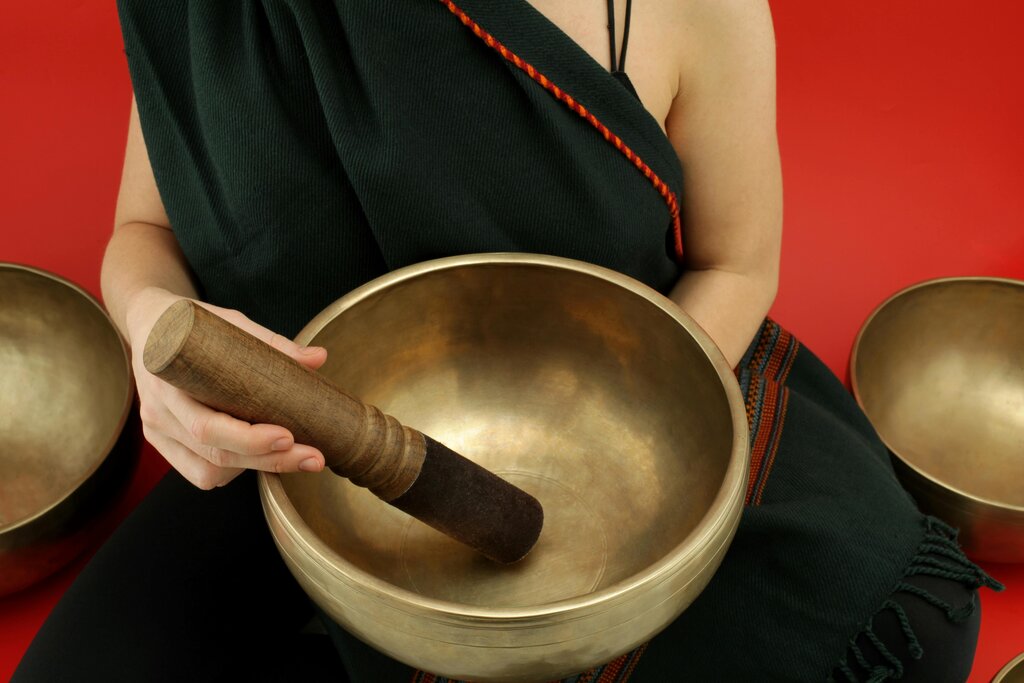
In the context of sound healing, the body is seen as the second object. Different tissues, organs, and even the water within our cells are theorised to have their own natural resonant frequencies. When a bowl or gong produces a wide spectrum of sound frequencies, it's proposed that specific frequencies will match the natural frequencies of various parts of the body, causing them to resonate sympathetically.
This physical vibration at a cellular level is believed to be the mechanism that can induce relaxation, release tension, and restore a sense of balance. The complex sound of a gong, with its deep fundamental tone and cascade of shimmering overtones, provides a broad range of frequencies that can potentially resonate with many different systems in the body simultaneously.
Brainwave Entrainment
Beyond direct physical vibration, another proposed mechanism is brainwave entrainment. This is the tendency for the brain's own electrical cycles, or brainwaves, to synchronise with the rhythm of an external stimulus, such as sound.
The repetitive, rhythmic, and harmonic sounds of bowls and gongs can gently guide brainwave patterns from the active Beta state (associated with normal waking consciousness) to the more relaxed states of Alpha (light meditation), Theta (deep meditation and drowsiness), and even Delta (deep, dreamless sleep).
Sound baths may elicit brainwave states where individuals experience deep relaxation and healing, especially in longer sessions.
This shift in brainwave activity corresponds to a shift in consciousness, moving from an active, thinking mind to a state of deep rest and relaxation. By providing a stable, coherent frequency for the brain to latch onto, sound healing instruments can help quiet mental chatter and facilitate a meditative state without conscious effort from the listener.
Time to check your understanding of the core concepts.
What is the primary physical mechanism that produces sound when a gong is struck with a mallet?
The unique combination of the fundamental frequency and higher-frequency overtones determines an instrument's pitch.
By understanding the physics of vibration, resonance, and entrainment, we can better appreciate the mechanisms through which sound healing instruments may influence our physical and mental states.