Advanced Sound Design for Media Creators
Advanced Sound Design Techniques
Beyond the Basics
You already know your way around a digital audio workstation (DAW) and understand the fundamentals of audio. Now it's time to move beyond simple mixing and editing into the creative world of sound design. This is where you learn to sculpt sound itself, crafting unique audio textures from scratch or transforming existing recordings into something entirely new.
We'll explore advanced methods for creating and manipulating sound, focusing on the techniques professionals use to build immersive soundscapes for film, games, and music. This involves generating sounds with synthesisers, artistically reusing audio through sampling, and adding depth and movement with layering and effects.
Sound design is the art of shaping and manipulating audio to create unique auditory experiences, a skill that's essential for beatmakers and electronic musicians who want their tracks to stand out.
Sculpting Sound from Scratch
Synthesis is the process of creating sound electronically. While you might be familiar with basic subtractive synthesis (starting with a rich waveform and filtering parts of it out), there are other powerful methods that offer a wider creative palette.
synthesis
noun
The technique of generating sound using electronic hardware or software, from basic waveforms to complex textures.
One popular method is Frequency Modulation (FM) synthesis. Instead of filtering a waveform, FM synthesis uses one waveform (a modulator) to alter the frequency of another (a carrier). At low modulation speeds, this creates a gentle vibrato. At higher speeds, it generates complex, harmonically rich tones. FM is famous for creating metallic, bell-like, and electric piano sounds.
Wavetable synthesis works by cycling through a table of different single-cycle waveforms. Imagine a flipbook of different shapes; a wavetable synth scans through them, creating a sound that evolves over time. This is excellent for creating pads and textures that shift and change, as you can modulate the position within the table to create dynamic movement.
Granular synthesis is another powerful technique. It works by taking a sample and chopping it into tiny pieces called 'grains'. It then plays these grains back, but you can manipulate their order, pitch, duration, and density. This can turn any sound—a voice, a field recording, a piano note—into a shimmering, ethereal cloud of sound or a glitchy, rhythmic texture.
The Art of Creative Sampling
Sampling isn't just about triggering pre-recorded sounds. It's a deep art form centred on transforming existing audio into something new. Modern DAWs provide powerful tools to manipulate samples in musically interesting ways.
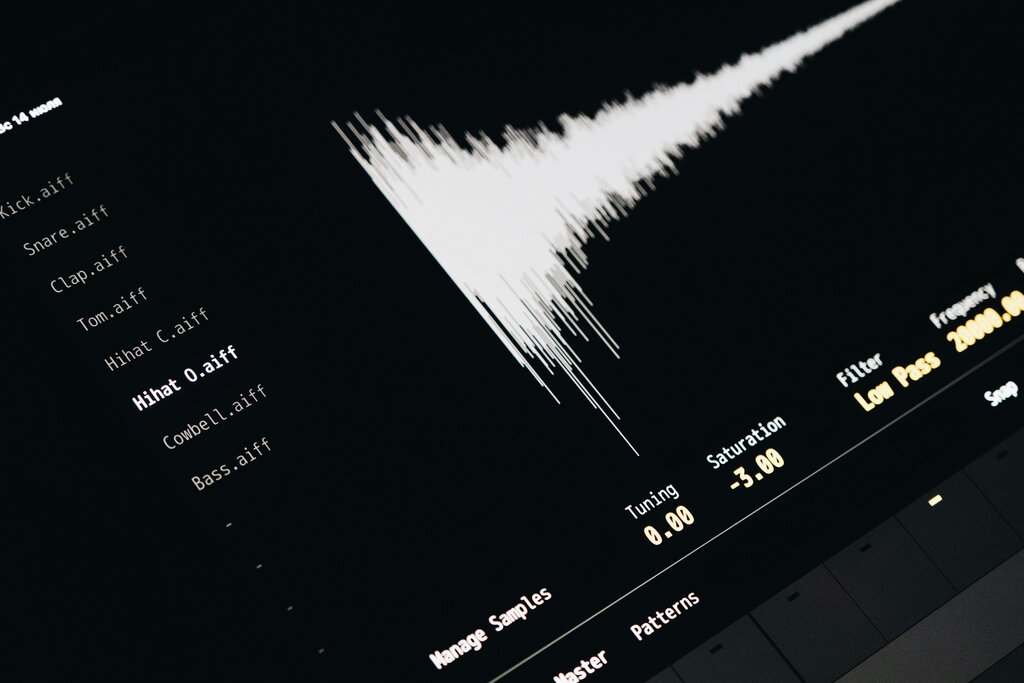
Key techniques include:
- Time-stretching and Pitch-shifting: You can change a sample's length without altering its pitch, or change its pitch without affecting its speed. Pushing these tools to their extremes can create strange and wonderful audio artefacts.
- Slicing: This involves chopping a longer audio file, like a drum loop or vocal phrase, into individual hits or words. You can then re-sequence these slices to create entirely new rhythms and melodies.
- Resampling: This is the process of routing the output of a track (or your entire mix) back into your DAW as a new audio input. By recording audio that already has effects and automation on it, you commit those changes to a new waveform. You can then process this new sample even further, opening up endless creative possibilities.
Building Rich Soundscapes
A complex, engaging sound is rarely a single element. It's usually built by combining multiple sounds, a technique known as layering. Think of it like a painter adding layers of colour to a canvas. Each sound contributes a specific quality—one might provide the low-end weight, another the percussive attack, and a third a sense of atmospheric space.
For example, to create a powerful, futuristic impact sound, you might layer a deep synthesised bass tone, the sharp crack of a distorted snare drum, and the metallic clang of a wrench hitting an anvil.
Once you've layered your sounds, you can bring them to life with modulation. Modulation is the process of using one signal to control a parameter of another. The most common tools for this are Low-Frequency Oscillators (LFOs) and envelopes.
An LFO generates a continuous, repeating waveform (like a sine or square wave) that runs at a very low, often sub-audible, frequency. You can map this LFO to control almost anything: the pitch of an oscillator for vibrato, the filter cutoff for a 'wobble' effect, or the volume for a tremolo effect. It's the key to adding constant, cyclical movement to your sounds.
Envelopes, on the other hand, create a shape that is triggered once every time a new note is played. The standard ADSR (Attack, Decay, Sustain, Release) envelope is perfect for shaping the amplitude of a sound over its lifetime, but you can also apply envelopes to filters, pitch, or any other parameter to create expressive, dynamic changes.
| Effect | Description | Best Used For |
|---|---|---|
| Reverb | Simulates the sound of a physical space. | Adding depth and making sounds feel like they exist in a real environment. |
| Delay | Creates distinct echoes of a sound. | Rhythmic effects, adding a sense of space, or creating trailing textures. |
| Equaliser (EQ) | Boosts or cuts specific frequencies. | Shaping the tonal balance of a sound and making it fit within a mix. |
| Compressor | Reduces the dynamic range of a sound. | Evening out volume levels, adding punch, or 'gluing' layered sounds together. |
| Distortion | Adds harmonic content by clipping the waveform. | Creating aggressive tones, adding warmth and saturation, or transforming sounds. |
By combining synthesis, sampling, layering, and effects, you move from being an audio editor to a true sound designer. You have the tools to create any sound you can imagine, building entire worlds for the listener to explore.
In Frequency Modulation (FM) synthesis, how is a complex sound primarily created?
You want to create a synth pad that slowly evolves and changes its tonal character over time. Which synthesis method would be the most direct choice for this task?
These techniques are the building blocks for crafting professional, unique audio. Experimentation is key—try layering unexpected sounds or applying modulation in unconventional ways to discover your own signature style.