Advanced Sound Design and Synthesis Mastery
Advanced Subtractive Routing
Beyond the Signal Chain
You already know the core building blocks of subtractive synthesis: oscillators generate a rich waveform, a filter carves away frequencies, and an amplifier shapes its volume over time. But a static sound is a boring sound. The real art of sound design lies in creating movement and complexity by routing these components in creative ways. This is where we move beyond a simple, linear signal path and start treating the synthesizer as an interactive system.
Filters in Formation
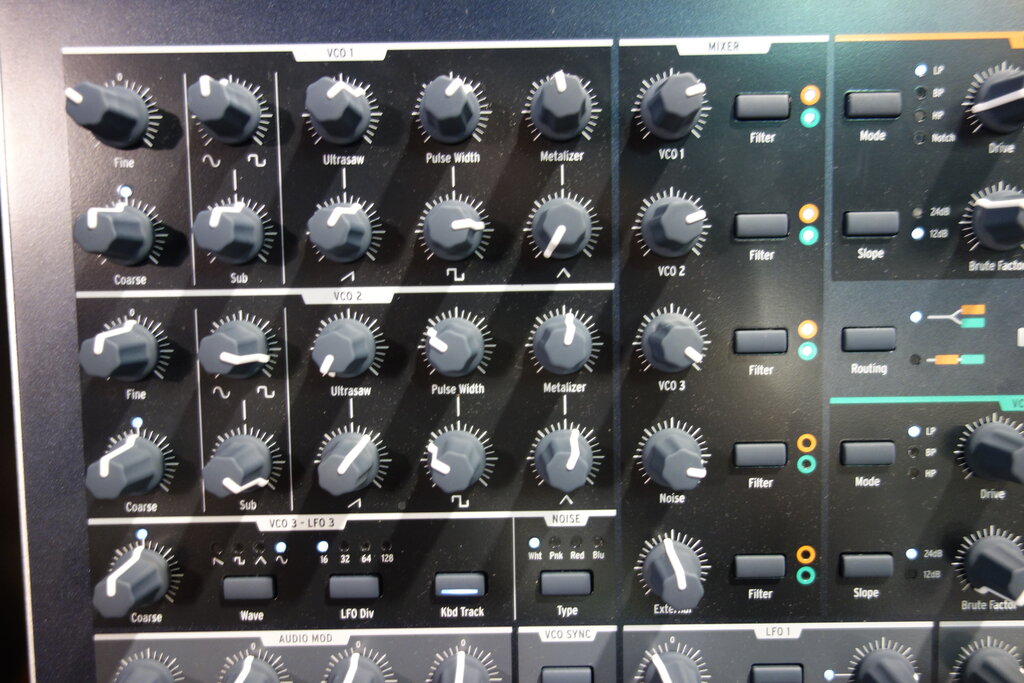
Most synths offer more than one filter, but how they're arranged dramatically changes the outcome. The two most common arrangements are serial and parallel.
Serial filtering is like a production line. The output of the first filter becomes the input for the second. If you use a low-pass filter to remove high frequencies and then feed that sound into a high-pass filter, you've effectively created a band-pass filter. This setup is perfect for sculpting a very specific frequency range and creating focused, precise tones.
Parallel filtering is like splitting a river into two streams. The original oscillator signal is sent to two different filters simultaneously, and their outputs are then mixed back together. You could have a low-pass filter on one path creating a warm, bassy tone and a resonant high-pass filter on the other creating a thin, metallic texture. Blending them gives you a complex sound that wouldn't be possible with a single filter.
The choice between them is a trade-off. Serial offers surgical precision, while parallel excels at creating rich, layered timbres. Neither is better; they are different tools for different jobs.
The Modulation Matrix
The real magic begins when you automate changes to your sound over time. On simpler synths, you might have a dedicated knob to control how much the LFO affects the filter cutoff. But on more advanced instruments, you'll find a —a central command center for routing control signals.
A mod matrix is essentially a grid. On one axis, you have your modulation sources (LFOs, envelopes, key tracking, velocity, the mod wheel). On the other axis, you have your destinations (oscillator pitch, pulse width, filter resonance, panning, etc.). At the intersection of each source and destination, you can set an amount, positive or negative, to determine how strongly the source affects the destination.
| Source | Destination | Effect |
|---|---|---|
| LFO 2 | Pulse Width | Creates a classic PWM chorus effect. |
| Velocity | Filter Resonance | Louder notes have a more "whistling" or "peaking" tone. |
| ENV 2 (fast) | Oscillator Sync | Adds an aggressive, metallic "ripping" sound at the start of a note. |
| Key Tracking | Filter Drive | Higher notes sound grittier and more saturated than lower notes. |
This opens up a universe of sonic possibilities. You can have an LFO subtly modulating the pulse width of a square wave for gentle movement, while a second, faster LFO modulates the panning. You could use an auxiliary envelope, separate from the main amplifier envelope, to create a quick pitch-dive at the start of each note for a punchy bass sound. The matrix is where a synth finds its unique character.
Advanced Oscillator and Filter Tricks
Beyond standard modulation, some techniques directly link components to create distinct timbres.
Oscillator Sync forces one oscillator (the slave) to restart its waveform every time a second oscillator (the master) completes a cycle. If you then change the pitch of the slave oscillator, you get complex, harmonically rich tones that are perfect for aggressive lead sounds and metallic textures. Modulating the slave oscillator's pitch with an envelope or LFO creates the classic 'sync sweep' sound.
Key Tracking allows the pitch of the notes you play to control another parameter. It's most commonly used to make the filter cutoff follow the keyboard—as you play higher notes, the filter opens up more. This keeps the timbre consistent across the keyboard. But you can apply it creatively, too. Try routing to filter resonance. This can make higher notes sound more resonant and squeaky, mimicking how some acoustic instruments behave.
Finally, don't overlook Filter Drive and saturation. Many synths, especially those emulating analog hardware, allow you to overdrive the signal going into the filter. This introduces subtle (or not-so-subtle) clipping and harmonic distortion. Pushing the drive can add warmth, grit, and presence to a sound, making it cut through a mix. It’s a crucial tool for adding analog-style character and avoiding overly sterile, digital sounds.
If you arrange two filters so that the output of the first filter becomes the input for the second, what is this configuration called?
What is the primary function of a modulation matrix in a synthesizer?
Mastering these routing techniques is about thinking of your synthesizer not as a list of features, but as an interconnected ecosystem. By experimenting with how different components influence one another, you can create sounds that are truly dynamic, complex, and your own.