Advanced Solution Dynamics and Distillation Principles
Raoult Law Fundamentals
Vapour Pressure in Mixtures
When a volatile liquid is in a closed container, some of its molecules will escape from the liquid phase and form a vapour. This vapour exerts a pressure on the walls of the container. At equilibrium, the rate of evaporation equals the rate of condensation, and the pressure exerted by the vapour is called the vapour pressure.
But what happens when we mix two volatile liquids? The total vapour pressure above the solution is the sum of the partial pressures of each component. This seems straightforward, but how do we determine the partial pressure of each liquid in the mixture? It depends on two things: how volatile the pure liquid is, and how much of it is in the mixture.
Vapour Pressure
noun
The pressure exerted by a vapour in thermodynamic equilibrium with its condensed phases (solid or liquid) at a given temperature in a closed system.
In the late 19th century, French chemist François-Marie Raoult studied the vapour pressures of solutions and found a simple, elegant relationship for certain mixtures. This relationship, now known as Raoult's Law, provides a model for what we call an "ideal solution."
Raoult's Law states that the partial vapour pressure of each component in an ideal solution is directly proportional to its mole fraction in that solution.
This equation tells us that if we have a component with a mole fraction of 0.5 (meaning it makes up 50% of the molecules in the solution), its contribution to the total vapour pressure will be exactly half of its vapour pressure as a pure liquid. The more of component i you have, the more it contributes to the overall vapour pressure.
The Ideal Solution
Raoult's Law perfectly describes the behaviour of an ideal solution, but what makes a solution ideal? An ideal solution is a hypothetical concept, much like an ideal gas. It's a mixture where the interactions between all molecules are uniform.
Let's say we're mixing two liquids, A and B. In this mixture, we have three types of intermolecular interactions: A-A, B-B, and A-B. For the solution to be ideal, the forces of attraction between unlike molecules (A-B) must be exactly the same as the forces between like molecules (A-A and B-B).
Think of it like a room full of people. If everyone interacts with everyone else with the same level of friendliness, it's an "ideal" social mixing. If people prefer to stick to their own groups (A-A and B-B interactions are stronger) or if they strongly prefer interacting with the other group (A-B interactions are stronger), the mixing is non-ideal.
| Characteristic | Ideal Solution | Explanation |
|---|---|---|
| Intermolecular Forces | A-A ≈ B-B ≈ A-B | Forces between all molecules are identical. |
| Enthalpy of Mixing (ΔH_mix) | Zero | No heat is released or absorbed when mixing because no bonds are being preferentially broken or formed. |
| Volume of Mixing (ΔV_mix) | Zero | The total volume is simply the sum of the individual volumes. No expansion or contraction occurs. |
In reality, no solution is perfectly ideal. However, mixtures of structurally similar, nonpolar molecules often behave very closely to the ideal model. A classic example is a mixture of benzene () and toluene (), as their sizes and intermolecular forces are very similar.
Calculating Total Vapour Pressure
For a binary ideal solution containing components A and B, we can use Raoult's Law along with Dalton's Law of Partial Pressures to find the total vapour pressure above the solution.
By substituting the expressions from Raoult's Law for and , we get the combined equation:
Since we are dealing with a binary mixture, the mole fractions must add up to one (). This allows us to express the total pressure in terms of just one component's mole fraction, say :
This graph visualises Raoult's Law. As the mole fraction of component B increases from 0 to 1, the total vapour pressure of the solution increases linearly from the vapour pressure of pure A to the vapour pressure of pure B.
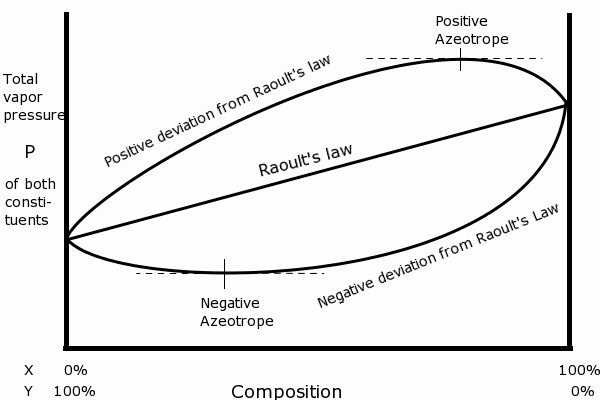
Let's work through an example. Suppose at 25 °C, the vapour pressure of pure benzene () is 95.1 mmHg and the vapour pressure of pure toluene () is 28.4 mmHg. If we create a solution by mixing 50.0 g of benzene with 50.0 g of toluene, what is the total vapour pressure?
First, we need the mole fractions. We'll need the molar masses: Benzene (78.11 g/mol) and Toluene (92.14 g/mol).
-
Calculate moles:
- Moles of benzene = 50.0 g / 78.11 g/mol = 0.640 mol
- Moles of toluene = 50.0 g / 92.14 g/mol = 0.543 mol
-
Calculate total moles:
- Total moles = 0.640 + 0.543 = 1.183 mol
-
Calculate mole fractions:
- = 0.640 / 1.183 = 0.541
- = 0.543 / 1.183 = 0.459
-
Apply Raoult's Law:
- = (0.541) * (95.1 mmHg) = 51.5 mmHg
- = (0.459) * (28.4 mmHg) = 13.0 mmHg
-
Calculate total pressure:
- = 51.5 mmHg + 13.0 mmHg = 64.5 mmHg
The total vapour pressure above this solution is 64.5 mmHg.
Ready to test your understanding? Give these questions a try.
What is the defining characteristic of an ideal solution?
According to Raoult's Law, the partial vapour pressure of a component in an ideal solution is directly proportional to its ________.
Raoult's Law provides a powerful, simplified model for understanding the behaviour of liquid mixtures. By defining the properties of an ideal solution, it gives us a baseline from which we can understand and predict the behaviour of real-world solutions.