Advanced Soccer Tactics and Strategy
Modern Formations
Beyond the Numbers
A soccer team's formation, like a 4-4-2 or 4-3-3, isn't a rigid set of instructions. Think of it less like assigned seating and more like a starting point for a dance. It provides a team with structure and balance, but the real magic happens in the movement and flexibility. The numbers simply describe a team's defensive, midfield, and attacking lines. Modern tactics are all about how these lines bend, shift, and interact during a match. Let's explore two of the most influential modern formations: the 4-3-3 and the 3-5-2.
The Balanced 4-3-3
The 4-3-3 is built on a foundation of four defenders, three central midfielders, and a front three of a central striker and two wingers. Its popularity comes from its inherent balance. Defensively, it's solid. Offensively, it's potent, creating natural passing triangles all over the pitch that allow a team to keep possession and methodically move the ball forward. The three forwards can press defenders high up the field, while the three midfielders provide a screen in front of their own defense.
The main trade-off of the 4-3-3 is in the middle of the park. With only three central midfielders, the team can be outnumbered by formations that pack the midfield, like a 4-4-2 or 3-5-2. To counter this, teams get creative. A team that starts in a 4-3-3 shape might not stay that way for long.
When attacking, a 4-3-3 can morph into what looks more like a 3-2-5. One of the full-backs might push high up the pitch to act as an extra attacker, while the remaining three defenders shift across to cover. The midfield duo then controls the space behind the five-player attacking line. This creates a massive offensive overload, pinning the opposition in their own half. The formation isn't a static blueprint; it's a set of principles that guide player movement.
The Midfield Fortress: 3-5-2
If a coach wants to dominate the center of the pitch, the 3-5-2 is a powerful choice. It uses three central defenders, a packed five-player midfield, and two strikers. That central midfield trio often creates a 3v2 advantage against more traditional two-midfielder systems, making it difficult for opponents to play through the middle. This central density allows a team to control possession and dictate the tempo of the game.
The key to this formation is the two players on the outside of the midfield five: the . They are the engine of the team, responsible for providing width in attack and tracking back to form a five-player defensive line when the team loses the ball. It's one of the most physically demanding positions in modern soccer.
The risk of the 3-5-2 lies in those wide areas. If an opponent can switch play quickly from one side of the field to the other, they can isolate a wing-back and create a 2v1 situation. This formation demands incredible tactical discipline and communication. The three center-backs must be comfortable defending large spaces, and the wing-backs need the stamina to run the entire length of the field for 90 minutes. When it works, it's a suffocating system that's incredibly hard to break down.
Tactics Are a Conversation
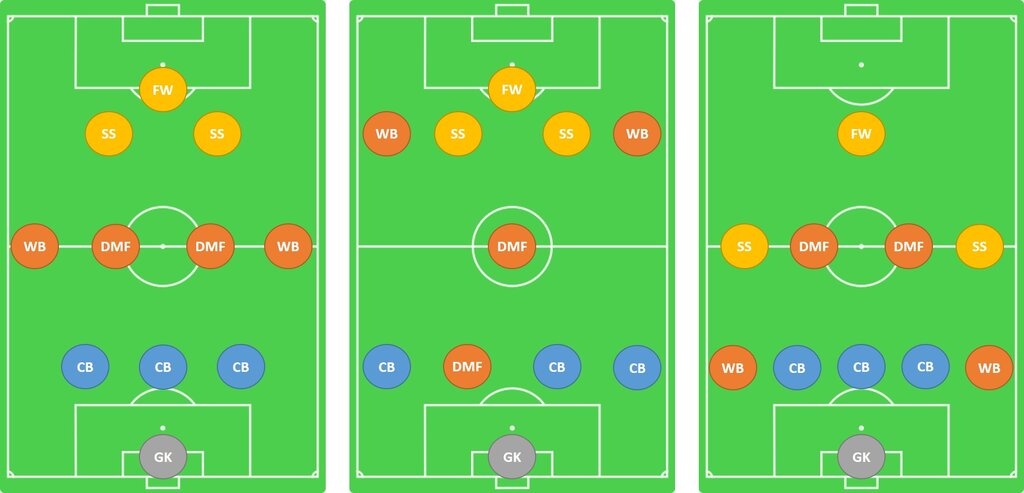
The most important takeaway is that formations are fluid. A starting shape is just the opening line of a conversation. The real tactics unfold in how that shape changes in possession and out of possession. A team might defend in a compact 4-4-2 but attack in an expansive 3-2-5. These shifts are pre-planned and drilled relentlessly in training. Players aren't just memorizing a position; they're learning a system of movement and response.
Watching a match, try to see beyond the initial setup. Notice how a midfielder drops into the defensive line, or how a defender overlaps a winger to join the attack. This is where the tactical battle is won and lost. The numbers are just a language to describe the beautiful, complex geometry of the game.
What is the best way to think about a soccer team's formation, according to the text?
What is the primary strength of the 4-3-3 formation?
Understanding these fluid systems is the first step to seeing the game like a coach. It's not just about who has the ball, but where the space is and how players move to exploit it.