Advanced Sketching and Structural Drawing
Dynamic Line Work
Beyond the Outline
A line is more than a boundary. In drawing, it’s a tool for communicating weight, distance, and light before you ever think about shading. Moving beyond a single, uniform outline is the first step toward making your sketches feel alive and three-dimensional.
The most direct way to create depth is by modulating your line weight. Simply put, objects that are closer to the viewer get thicker, darker lines. Objects farther away get thinner, lighter lines. This mimics how our eyes perceive the world, where atmospheric haze makes distant objects appear less distinct.
This principle creates an immediate visual order, or a functional hierarchy, in your drawing. The heaviest lines command the most attention, establishing the primary subject or the closest parts of an object. The secondary, lighter lines define the less critical details or forms receding into space. This isn't just an artistic effect; it's a way to guide the viewer's eye through the composition intentionally.
Sculpting with Contours
Our brains are excellent at filling in missing information. You can use this to your advantage with a technique called The idea is to use an incomplete line, letting it fade out where a form is hit by bright light and reappear as it turns into shadow. The edge is "lost" in the highlight and "found" again in the shadow.
This makes your drawing feel more natural and less like a technical diagram. It suggests the presence of a light source and forces the viewer's mind to complete the shape, making the experience more engaging.
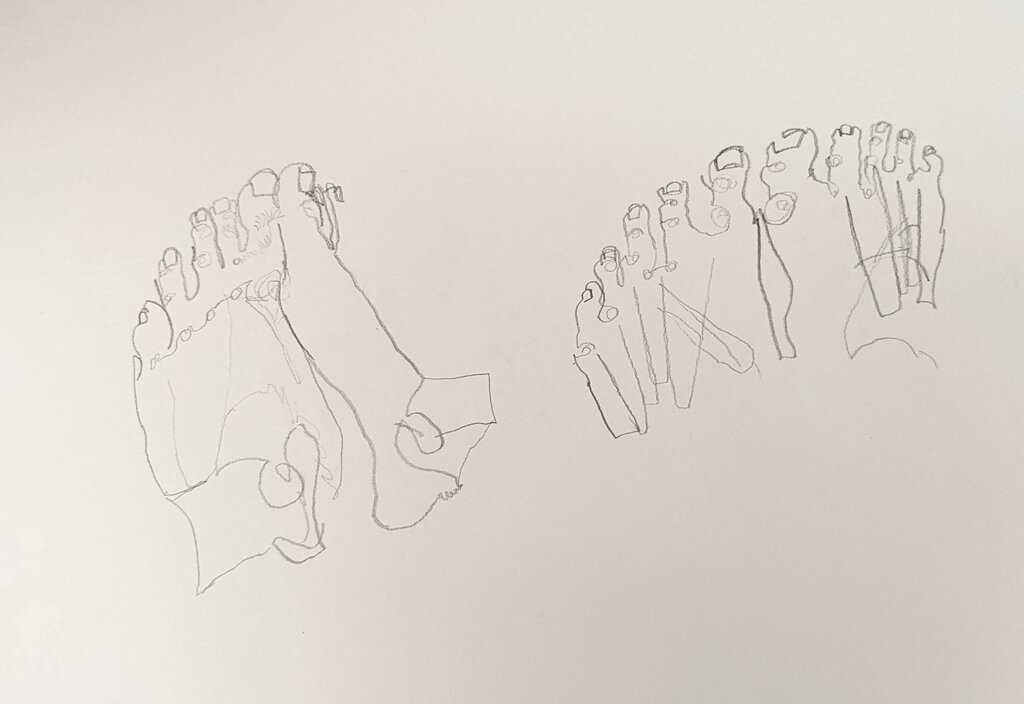
Beyond just starting and stopping, the quality of the line itself can describe the surface it's tracing. This is called structural contouring. A line that wraps around a sphere should be smooth and curved. A line defining a block of wood might be rigid and angular. By varying the rhythm and character of your strokes, you can communicate texture and form.
A line that tapers, going from thick to thin in a single stroke, is particularly useful. It can suggest a form turning away from the viewer or an edge softening into a shadow. Practicing these rhythmic, confident strokes is key to developing a dynamic and expressive style.
Think of your pencil as sculpting the form. Each line traces a path across the object's surface, defining its hills and valleys.
Precision and Practice
Achieving clean, intentional lines requires muscle memory. A common problem for beginners is drawing short, scratchy, or hesitant marks. To build confidence and precision, use the technique.
Before your pencil touches the paper, hover it over the surface and trace the path of the line you intend to draw. Repeat this motion two or three times, getting a feel for the required movement. Once you feel confident in the motion, commit and draw the line in a single, smooth stroke. This small rehearsal builds a connection between your eye and hand, drastically improving the quality and accuracy of your final lines.
If your lines show through in your final drawing, their direction can help to show changes in the planes of the object you are drawing.
By combining line weight, lost and found edges, and precise application, your line work alone can build a convincing illusion of three-dimensional form. This is the foundation upon which all other techniques, like shading and texturing, are built.
Ready to test your knowledge?
When drawing a landscape, how should you use line weight to create a sense of depth?
The technique of letting a line fade out where a form is hit by bright light and reappear as it turns into shadow is known as _______.