Advanced Seismic Engineering and Mitigation
Seismic Wave Dynamics
How Earth Transmits Energy
When an earthquake occurs, it releases a tremendous amount of energy. This energy doesn't stay put; it travels through the Earth as seismic waves. Think of the planet not as a rigid, solid ball, but as a vast elastic medium. Just as a ripple spreads across a pond, these waves propagate outwards, governed by the principles of elastodynamics — the study of how waves and vibrations move through elastic materials. The speed and behaviour of these waves depend entirely on the properties of the rock they travel through.
The two main properties dictating wave speed are the material's elastic moduli and its density. Elastic moduli measure a material's resistance to being deformed. The two key ones for seismology are the bulk modulus (), which describes resistance to compression, and the shear modulus (), which describes resistance to shearing or twisting. Density () is simply the mass per unit volume. Together, these properties determine how fast two types of body waves, P-waves and S-waves, can travel through the Earth's interior.
Body Waves
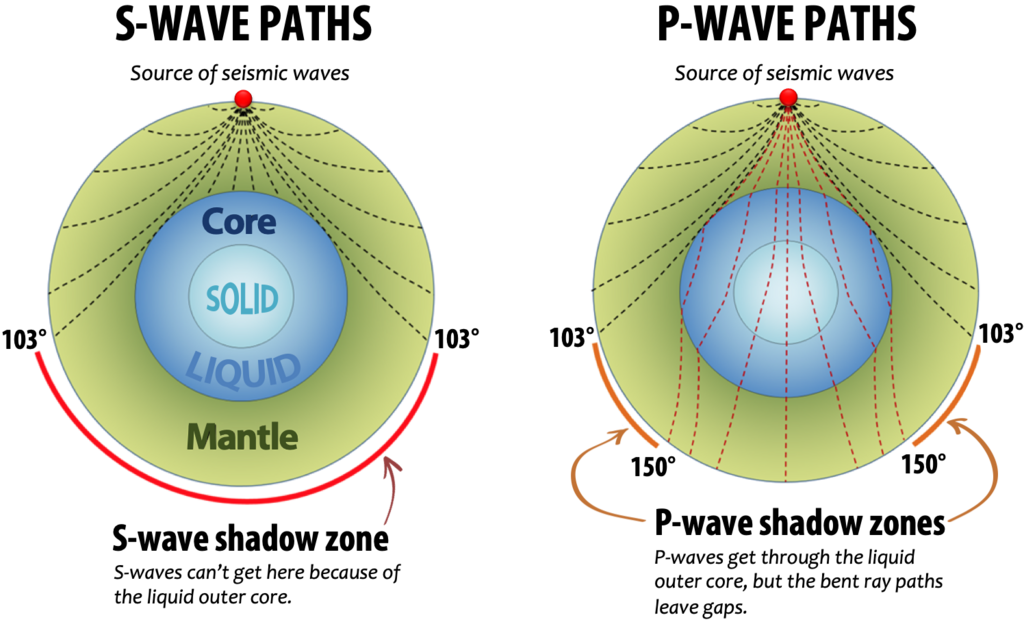
Body waves travel through the interior of the Earth. The fastest are P-waves, or primary waves. They are compressional, meaning they push and pull the rock in the same direction that the wave is travelling, like a slinky being pushed from one end. S-waves, or secondary waves, arrive next. They are shear waves, moving the rock particles perpendicular to the direction of wave propagation, like a rope being flicked up and down.
The velocities of these waves can be calculated precisely. The compressional wave velocity () and shear wave velocity () are given by these equations:
Surface Waves
When body waves reach the surface, some of their energy is converted into surface waves, which are confined to the near-surface layers of the Earth. Though they travel slower than body waves, they are often responsible for the most intense shaking and damage during an earthquake. The two main types are Love waves and Rayleigh waves.
- Love waves produce a horizontal, side-to-side shearing motion. They are particularly damaging to the foundations of buildings.
- Rayleigh waves create a rolling motion, similar to waves on water. The ground moves both vertically and horizontally in a retrograde elliptical pattern. This is the wave that people often feel most distinctly during an earthquake.
Waves on a Journey
As seismic waves travel, they don't remain unchanged. They bend, reflect, and lose energy. When a wave passes from one geological layer to another, such as from the crust to the mantle, its path is refracted, or bent. This phenomenon is described by Snell’s Law and is fundamental to how seismologists map the Earth's interior.
Waves also lose energy as they propagate. This loss, known as attenuation, happens in two main ways. The first is geometric spreading, where the energy is distributed over an increasingly larger area as the wavefront expands. For body waves, this area grows with the square of the distance.
The second is intrinsic attenuation, where energy is converted into heat due to friction within the rock. This is quantified by the (). A high value means low attenuation (the rock is good at transmitting energy), while a low means high attenuation (the rock quickly dampens the wave).
Finally, the shape of a wave can change over time due to dispersion. This occurs when the wave's velocity depends on its frequency. For surface waves in particular, longer-wavelength (low-frequency) components travel faster than shorter-wavelength (high-frequency) components. This spreading out of the wave train means that a sharp jolt at the source can arrive at a distant location as a long, rumbling vibration. This affects both the duration and the peak intensity of ground shaking, which are critical inputs for earthquake engineering.
Which of the following properties are the primary determinants of the speed of seismic body waves?
During an earthquake, you feel a distinct rolling motion, as if you were on the surface of the ocean. Which type of seismic wave is most likely responsible for this sensation?