Advanced Running Biomechanics and Gait Optimization
Kinetic Force Management
The Force You Create
Every time your foot hits the ground during a run, you're not just passively absorbing impact. You're actively creating a force against the planet. This is the Ground Reaction Force (GRF), and understanding it is key to efficient, injury-free running. Think of it less like a collision and more like a rapid, controlled push.
GRF has two main components we care about. The vertical component is the upward force that counteracts gravity and propels you into the air. The anteroposterior component works horizontally: first as a braking force when your foot lands in front of your body, then as a propulsive force as you push off to move forward.
What's fascinating is where this force originates. It's not the passive impact of bone hitting pavement. Muscle-driven simulations show that nearly 100% of the GRF in running is generated by active muscle contraction. As you transition from the double-float phase—when both feet are off the ground—to the stance phase, your muscles preemptively fire to meet the ground and control the landing.
The Muscular Control System
Three muscle groups are the primary managers of this force. During the initial part of the stance phase, the quadriceps and the soleus (a powerful muscle in your calf) perform an eccentric contraction, lengthening under tension.
This action is crucial. It acts like a brake, decelerating your center of mass as it moves forward and downward. This controlled
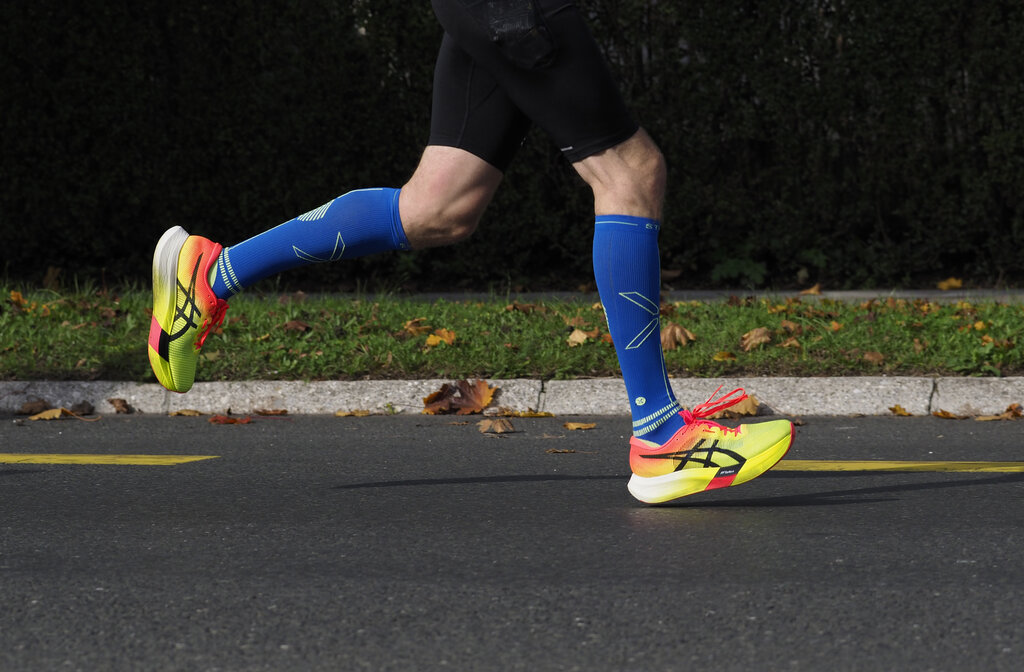
braking is what absorbs the shock of landing, preventing jarring forces from traveling up your skeletal system. A stronger eccentric contraction means better force absorption and a lower risk of injury.
Simultaneously, the gluteus medius on the side of your hip fires to provide stability. Its main job is to prevent your hip from dropping on the side of your swinging leg, providing body weight support and keeping your pelvis level. Without its stabilizing force, your running form would collapse with every step.
The Rotational Balance
Running isn't just a linear motion; it's also a rotational one. As your right leg swings forward, your torso naturally wants to rotate to the left. To counteract this and keep you facing forward, your left arm swings forward. This is the arm-leg counter-balance mechanism.
This opposition creates in the upper body that cancels out the angular momentum from the lower body. This balancing act is essential for stability and efficiency. A coordinated arm swing minimizes wasteful torso rotation, ensuring that more of your energy is directed into forward propulsion. It's a perfect example of how the entire body works as an integrated system to manage forces during locomotion.
Let's test your understanding of these kinetic forces.
According to the text, what is the primary source of the Ground Reaction Force (GRF) generated during running?
During the initial landing phase of a running stride, what is the main function of the eccentric contraction performed by the quadriceps and soleus muscles?
By understanding that running is a series of muscle-driven pushes rather than passive impacts, you can train more effectively to manage these forces, improve performance, and stay healthy.