Advanced Rhetoric and Logical Argumentation
Deductive Logic Mastery
The Architecture of Airtight Arguments
In professional settings, persuasion isn't about volume or charisma alone. It's about building a case so logically sound that your conclusion becomes the only reasonable outcome. This is the power of deductive reasoning. You move beyond simple assertions to create an intellectual framework that guides your audience to a desired belief. The goal is to construct an argument where, if your audience accepts your initial points (premises), they have no logical choice but to accept your final point (conclusion).
Before building, we must understand our materials. The two most important qualities of a deductive argument are and soundness. An argument is valid if its structure is correct, meaning the conclusion logically follows from the premises. The premises themselves don't have to be true for an argument to be valid. An argument is sound when it is both valid and all of its premises are factually true. In business, soundness is the goal. A valid but unsound argument can be logically perfect but lead to a disastrous real-world decision.
Consider this: "All our projects in the European market have failed. This new project is for the European market. Therefore, this new project will fail." This argument is valid in its structure. But if the first premise is an exaggeration and not all projects have failed, the argument is unsound, and its conclusion is unreliable.
Building with Syllogisms
Syllogisms are the primary blueprints for deductive arguments. Understanding their different forms allows you to choose the right structure for the point you need to make. We'll focus on three key types: categorical, hypothetical, and disjunctive.
A Categorical Syllogism makes a statement about a whole category of things. It has two premises and a conclusion, and its strength comes from putting your specific case into a larger, accepted group. The classic form involves a major premise, a minor premise, and a conclusion.
Your most important task is establishing the major premise as common ground. It should be a statement your audience already believes or that is an accepted industry standard, company policy, or undeniable fact. This builds immediate agreement.
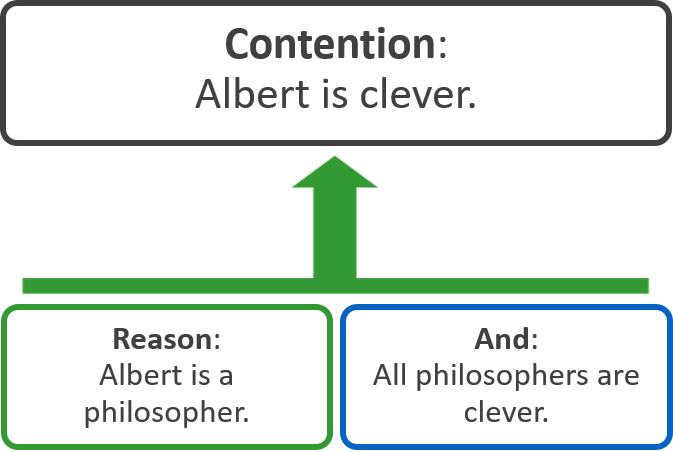
Major Premise: "All software development projects that skip user testing launch with critical bugs." Minor Premise: "The current proposal for Project Phoenix skips user testing." Conclusion: "Therefore, Project Phoenix will launch with critical bugs."
By framing the argument this way, you shift the debate. Instead of arguing about Project Phoenix specifically, the other side must now challenge the widely accepted truth of the major premise.
A Hypothetical Syllogism deals with "if-then" scenarios. It's perfect for discussing consequences and strategic plans. The most common and powerful form is Modus Ponens (the way of affirming). It states that if a condition is met, a certain result will follow.
In a business context, this is incredibly direct. Let's say you're arguing for more server capacity.
Premise 1: "If we get more than 100,000 daily active users (), our servers will crash ()." Premise 2: "Our marketing team projects we will hit 120,000 daily active users next month ()." Conclusion: "Therefore, our servers will crash ()."
This structure forces a decision. To reject the conclusion, your audience must either disprove the if-then statement or challenge the user projections.
Finally, a Disjunctive Syllogism works with "either-or" choices. It’s useful for eliminating options and forcing a decision when facing a limited set of possibilities. The structure is simple: you present two options, then rule one out, leaving the other as the necessary conclusion.
Imagine a resource allocation meeting: Premise 1: "We can either invest in the new marketing automation software () or hire two junior marketers ()." Premise 2: "We don't have the budget to hire two junior marketers ()." Conclusion: "Therefore, we must invest in the new marketing automation software ()."
This method frames the choice starkly, making your preferred option appear not just better, but necessary.
Applying the Rules
Mastering these forms isn't just an academic exercise. It's about translating messy, real-world business problems into clean, persuasive arguments. The next time you build a proposal or enter a debate, don't just state your conclusion. Instead, reverse-engineer it. What major premise would make it inevitable? What if-then condition would trigger it? Which competing option can you eliminate?
By thinking in terms of syllogisms, you start building arguments that don't just suggest—they prove. You create a logical path that is so clear and compelling that your audience arrives at your conclusion feeling like they discovered it themselves.
Ready to test your understanding of these logical structures?
What is the key difference between a valid argument and a sound argument?
Consider the following argument: Premise 1: If our website traffic increases by 20% (), our sales will increase by 10% (). Premise 2: Our website traffic is projected to increase by 25% ( is true). What is the logical conclusion based on the Modus Ponens form of a hypothetical syllogism?