Advanced Reproductive Physiology and Molecular Mechanisms
Epigenetic Germline Dynamics
Germline Specification and Reprogramming
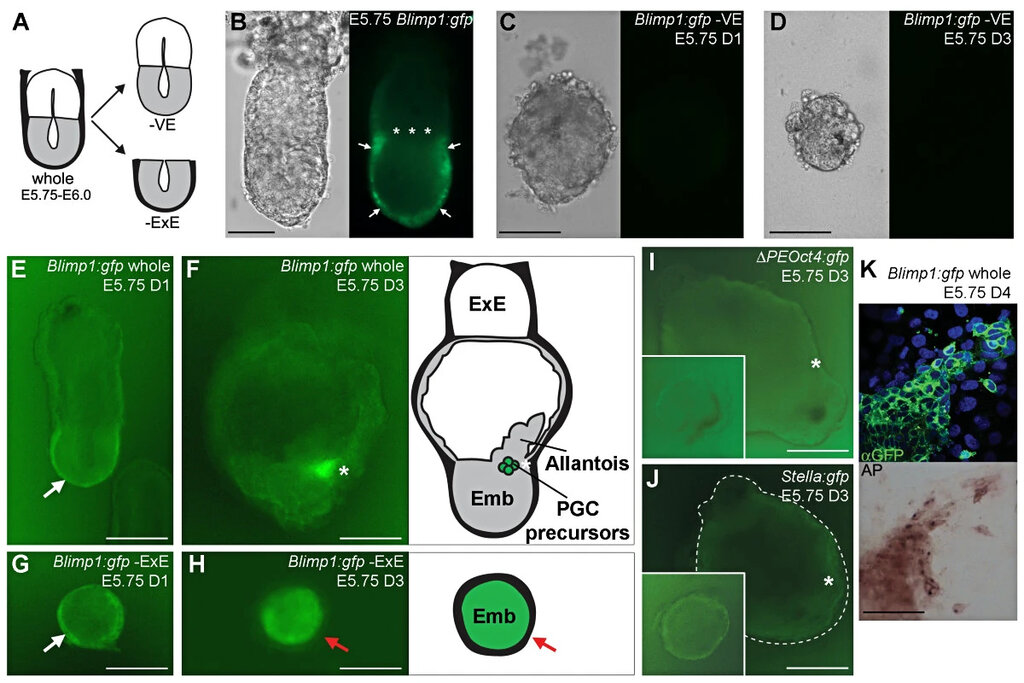
In the early mouse embryo, around E6.25, a small cluster of approximately 40 epiblast cells is specified to become the germline. This fate decision is orchestrated by signals from extraembryonic tissues, primarily Bone Morphogenetic Protein 4 (BMP4) and BMP8b secreted from the extraembryonic ectoderm. These signals induce the expression of key transcription factors, notably PRDM1 (also known as BLIMP1) and PRDM14, in proximal epiblast cells.
PRDM1 acts as a master regulator, initiating the primordial germ cell (PGC) program while actively repressing the somatic mesodermal fate. It achieves this by silencing genes like Hox and those involved in somatic differentiation. Concurrently, these nascent PGCs transiently co-express the mesodermal marker T (Brachyury) before committing fully to the germline lineage. This specification event establishes a distinct cell population that carries the epigenetic blueprint for the next generation, sequestering it from somatic development.
The Second Epigenetic Reset
Once specified, PGCs embark on a migratory journey through the developing embryo to the genital ridges. During this migration (from approximately E7.5 to E12.5), they undergo a second, profound wave of epigenetic reprogramming. This process is distinct from the first wave that occurs in the preimplantation embryo. It involves the near-complete erasure of genomic DNA methylation, including the methylation marks on imprinted genes and transposable elements.
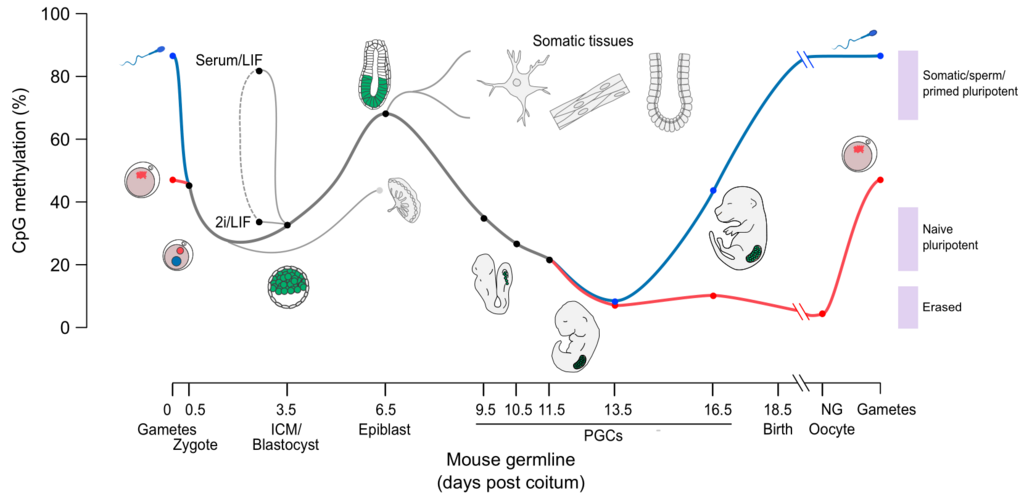
This demethylation is not a passive process of dilution alone. It is actively initiated by the Ten-eleven translocation (TET) family of enzymes, particularly TET1 and TET2. These enzymes oxidize 5-methylcytosine (5mC) to 5-hydroxymethylcytosine (5hmC) and further oxidized forms. These modified bases are not recognized by the maintenance methyltransferase DNMT1 during replication, leading to their passive dilution in subsequent cell divisions. This genome-wide erasure resets the epigenome, ensuring developmental totipotency and removing potentially harmful epimutations acquired by the parents.
Sex-Specific Remethylation
Following the erasure, the epigenome is rebuilt in a sex-specific manner. In the male germline, this de novo remethylation begins around E14.5 in prospermatogonia, which have entered mitotic arrest. The process, driven primarily by DNMT3A and the co-factor DNMT3L, is largely complete by birth. In contrast, the female germline enters meiosis and arrests in prophase I. Remethylation is postponed until after birth, occurring during the oocyte growth phase. This establishes the maternal-specific imprints on differentially methylated regions (DMRs).
Epigenetic information in the mammalian oocyte has the potential to be transmitted to the next generation and influence gene expression; this occurs naturally in the case of imprinted genes.
The different timing and dynamics of remethylation between sexes have profound consequences. The male germline's extended period of mitotic proliferation before methylation makes it more susceptible to certain environmentally-induced epimutations. The female pattern ensures that imprints are established in a non-proliferative state, potentially offering greater fidelity.
Transgenerational Inheritance
While the germline reprogramming is robust, it is not infallible. Certain environmental exposures, such as nutritional stress, toxins, or endocrine disruptors, can induce stable epimutations that escape erasure. These changes, often occurring at specific loci, can be transmitted across generations, a phenomenon known as transgenerational epigenetic inheritance This provides a mechanism for an organism's experiences to influence the phenotype of its descendants without altering the DNA sequence itself.
For example, exposure to the fungicide vinclozolin during a specific window of gonadal development in a pregnant rat (F0) can induce altered DNA methylation patterns in the sperm of the F1 and F2 male offspring. These epimutations are associated with health defects, such as decreased sperm motility and increased disease incidence, which persist into the F3 generation, demonstrating a truly transgenerational effect. Such inheritance challenges the traditional view of the Weismann barrier, suggesting a more fluid relationship between the soma and the germline.
What is the primary role of the transcription factor PRDM1 during the specification of primordial germ cells (PGCs) around E6.25?
The second wave of epigenetic reprogramming in PGCs involves the active erasure of DNA methylation. This process is initiated by which family of enzymes?