Advanced Rehabilitation Exercise Programming
Therapeutic Loading Principles
Beyond Rest
For decades, the standard advice for an injury was RICE: Rest, Ice, Compression, and Elevation. While well-intentioned, the emphasis on complete rest often did more harm than good. Tissues need a certain amount of stress to maintain their structure and function. Without it, they weaken, a state known as 'stress shielding'.
This led to a shift in thinking, evolving the acronym to POLICE: Protection, Optimal Loading, Ice, Compression, and Elevation. The key change is 'Optimal Loading'. Instead of complete rest, the goal is to introduce controlled mechanical stress to the injured tissue. This isn't just about avoiding weakness; it's about actively kick-starting the body's repair mechanisms. This deliberate use of mechanical force as a therapy is the core of modern rehabilitation.
To decide what tissue to load, what activity to use, how often to load it, how intensely to load it, you must employ your clinical reasoning.
How Tissues 'Hear' Force
How can a physical force like stretching or compression tell a cell to build new collagen? The answer is mechanotransduction. Think of it as a biological translation service. Cells in our tissues contain mechanosensors, specialised proteins that can detect physical forces. When you load a tissue, these sensors are pushed, pulled, or sheared.
This physical stimulus triggers a chain reaction, converting the mechanical energy into biochemical signals. It's like flipping a switch that starts a cascade of cellular communication, instructing the cell to produce proteins, remodel its environment, or even multiply. This process is constantly happening in our bodies just to maintain tissue health, an activity called homeostatic loading. When we use it to guide healing, it's called mechanotherapy.
Mechanotransduction
noun
The process by which cells convert mechanical stimuli (such as pressure or stretch) into electrochemical or biochemical signals.
This isn't an all-or-nothing process. The type, duration, and intensity of the load all change the message the cell receives. This is why a physical therapist doesn't just prescribe 'exercise'; they design a specific loading strategy tailored to the injured tissue's needs and current healing stage.
The Therapeutic Window
Every tissue has a relationship between the stress it experiences and the strain (deformation) it undergoes. This can be visualised with a stress-strain curve. For a healing tissue, this curve helps us identify the 'optimal loading' zone, or therapeutic window.
In the early phases, the tissue is weak. A small amount of stress causes a large amount of strain. If we apply too much load, we push the tissue past its elastic limit into the plastic region, causing micro-damage and potentially re-injury. The goal of early rehabilitation is to apply just enough stress to stimulate mechanotransduction without creating further damage. This promotes healing in the proliferative phase, where the body is actively laying down new tissue like collagen.
As the tissue heals, the stress-strain curve changes. The slope of the linear (elastic) region gets steeper, meaning the tissue becomes stiffer. It can withstand more stress before it deforms, and the failure point moves higher. Rehabilitation progressively increases the load to match the tissue's growing capacity, constantly challenging it within its new, expanding therapeutic window.
Tissue-Specific Responses
Optimal loading isn't a one-size-fits-all concept. Different tissues are built for different jobs, and they respond to mechanical loads in unique ways.
Bone: Bone is highly responsive to compressive and torsional forces. It follows Wolff's Law, which states that bone remodels itself in response to the loads it is placed under. Loading stimulates osteoblasts (bone-building cells) to lay down new bone tissue, increasing density and strength. This is why weight-bearing exercises are critical for recovering from fractures.
Tendon: Tendons are designed to transmit tensile (pulling) forces from muscle to bone. They respond best to slow, heavy tensile loads. This type of stimulus encourages tenocytes to produce type I collagen, the strong, organised fibre that gives tendons their incredible strength. Eccentric exercises, where the muscle lengthens under load, are particularly effective.
Muscle: Muscle tissue responds to tensile loading that creates micro-damage. This damage is a key signal for hypertrophy—the process of rebuilding muscle fibres bigger and stronger. This requires overcoming a load that is greater than what the muscle is accustomed to.
Cartilage: Articular cartilage, which lines our joints, is unique. It lacks a direct blood supply, so it gets nutrients through a process of cyclical loading and unloading. Compressing the cartilage (like during walking) squeezes out waste products, and decompressing it allows synovial fluid with fresh nutrients to seep back in. This is why gentle, controlled movement is often better than complete immobilisation for joint injuries.
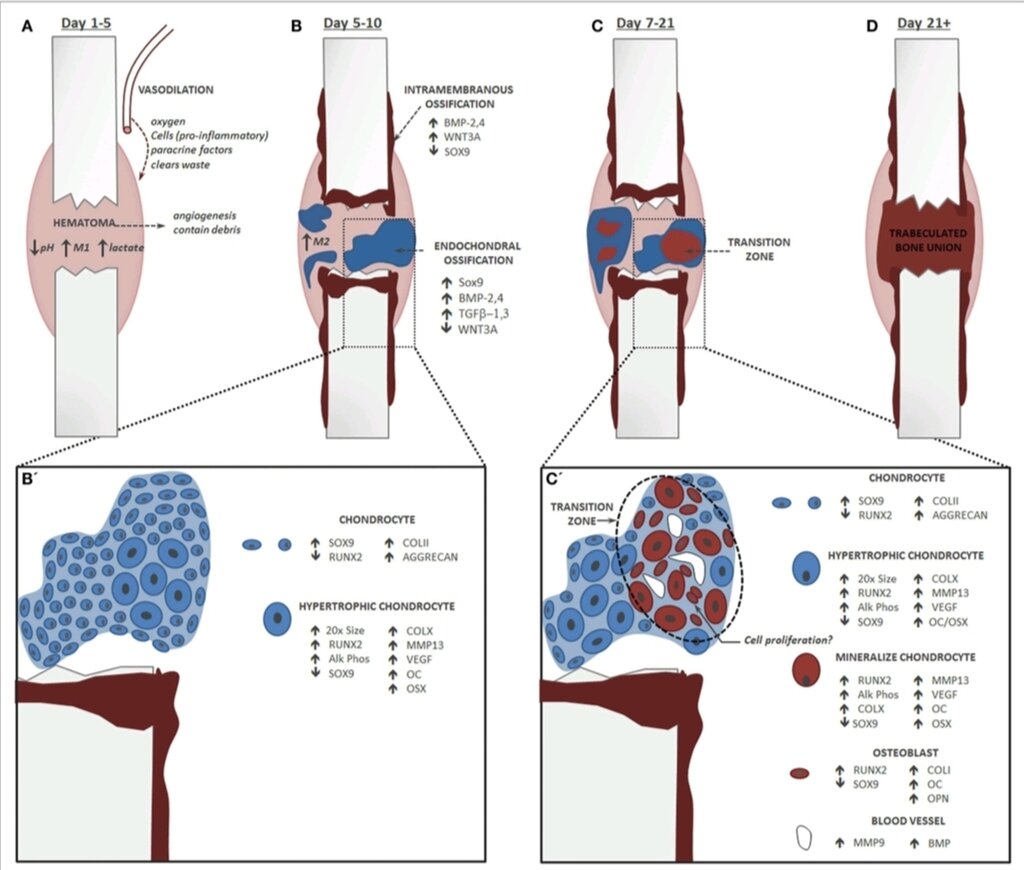
Understanding these tissue-specific needs is what allows a clinician to move a patient from the early inflammatory phase, where protection is key, to the proliferative and remodelling phases, where progressive loading is essential for a full recovery.
What is the key change in the evolution of the RICE protocol to the POLICE protocol for injury management?
What is the biological process where cells convert physical forces, like stretching or compression, into biochemical signals?