Advanced Reading Comprehension Mastery
Logical Argument Mapping
The Skeleton of an Argument
When we read, it's easy to get lost in the details. We follow the story or absorb the facts, but we often miss the underlying structure. Sophisticated writing, whether in an editorial or an academic paper, isn't just a collection of sentences. It's an architecture of ideas, carefully built to persuade you of a specific point.
Learning to see this architecture is like getting X-ray vision for texts. You start to see how writers construct their arguments. The first step is to distinguish between the main point and the reasons they give to support it.
Every argument has two core components: a conclusion (the claim being made) and at least one premise (the reason or evidence for that claim).
Think of it like building a house. The conclusion is the roof, the final point that everything else is holding up. The premises are the foundations and walls; without them, the roof would collapse. Your job as a critical reader is to check if those walls are strong and properly placed.
For example:
- Premise 1: All dogs are mammals.
- Premise 2: Fido is a dog.
- Conclusion: Therefore, Fido is a mammal.
The first two statements (the premises) provide the support for the final statement (the conclusion).
Two Paths of Logic
Arguments don't just throw premises at a conclusion. They connect them using patterns of reasoning. The two most common patterns are deductive and inductive.
Deductive reasoning starts with a general rule (a premise) and applies it to a specific case to reach a certain conclusion. If the premises are true, the conclusion must be true. The Fido example above is a classic case of deductive reasoning. It's a top-down approach.
Inductive reasoning, on the other hand, works from the bottom up. It takes specific observations and uses them to form a general conclusion. This type of reasoning deals in probability, not certainty. For instance, if you see hundreds of swans and they are all white, you might conclude, "All swans are white." This is a strong conclusion based on your evidence, but it isn't guaranteed. A single black swan would prove it false.
Most arguments you encounter, especially in editorials and social sciences, use a mix of both. They might use inductive reasoning to establish a likely principle, then use that principle deductively to argue for a specific action. You'll often see this in the of argumentation, which focuses on how arguments work in the real world.
| Feature | Deductive Reasoning | Inductive Reasoning |
|---|---|---|
| Direction | General to Specific | Specific to General |
| Certainty | If premises are true, conclusion is certain. | Conclusion is probable, not certain. |
| Goal | To prove a conclusion based on established rules. | To form a likely generalisation from evidence. |
| Example | All men are mortal. Socrates is a man. Therefore, Socrates is mortal. | Every quiz I've had in this class was hard. Therefore, the next quiz will be hard. |
Sorting the Evidence
A conclusion is only as strong as the premises supporting it. When you're mapping an argument, it’s not enough to just identify the premises; you also need to evaluate them. What kind of evidence is the writer using? Is it solid and relevant?
Evidence can come in many forms:
- Facts and Statistics: Measurable, verifiable data. (e.g., "The city's population grew by 15% in the last decade.")
- Expert Testimony: Quoting someone with authority or expertise on the subject.
- Anecdotes: Personal stories or specific, isolated examples.
- Analogies: Making a comparison to a more familiar situation.
Strong arguments tend to use a blend of evidence types, relying mostly on facts and expert opinion. Arguments that lean too heavily on anecdotes can be persuasive emotionally, but are often logically weak. Recognising these patterns helps you spot flawed arguments, sometimes called .
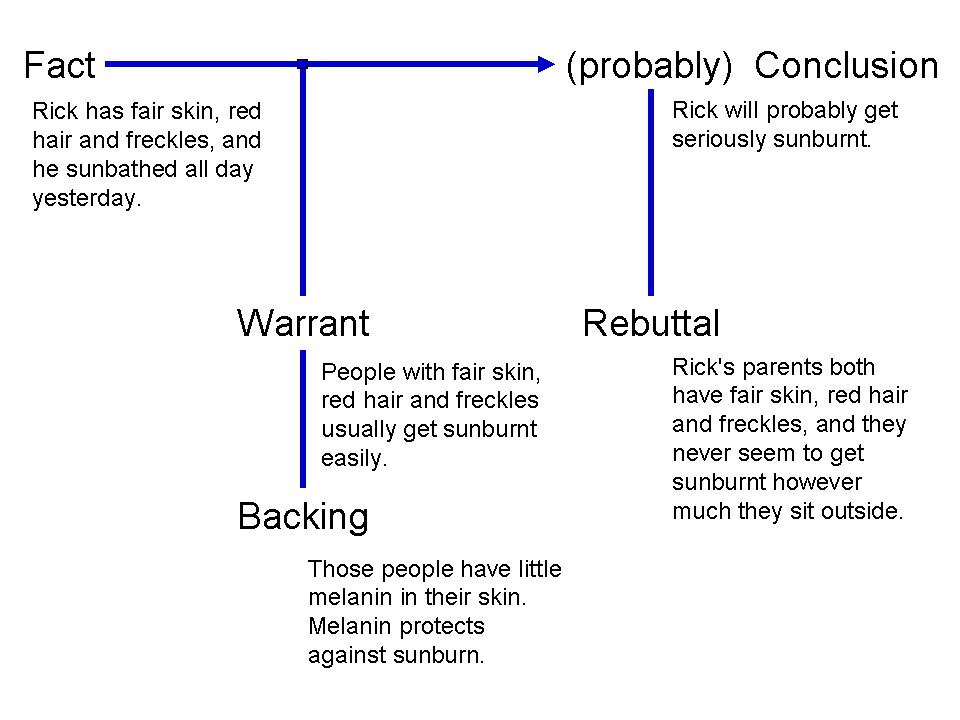
Mapping the logical flow means tracing the path from the premises to the conclusion. Pay attention to transition words. Words like because, since, and for often introduce a premise. Words like therefore, thus, and consequently typically signal a conclusion.
By breaking down an argument into its core components and mapping its flow, you move beyond simply agreeing or disagreeing. You start to understand why the argument succeeds or fails, giving you a much deeper comprehension of the text.
In the analogy of building a house to represent an argument, what does the 'roof' symbolise?
Consider the following argument: 'Every time I've eaten strawberries, I've had an allergic reaction. Therefore, I am allergic to strawberries.' What type of reasoning is this?