Advanced Ray Optics for Class 12
Spherical Mirror Derivations
From Geometry to Images
The relationship between an object, its image, and a spherical mirror isn't magic. It's geometry. To derive the formulas that govern mirrors, we rely on a key simplification called the paraxial ray approximation or small-angle approximation. This assumes that light rays striking the mirror are very close to the principal axis and make small angles with it. For these rays, the curved surface of the mirror behaves almost like a flat plane at the point of reflection.
This assumption is crucial. It allows us to use simple geometry and trigonometry, like the property of similar triangles, without getting bogged down in complex curves. Without it, we'd have to deal with spherical aberration, where rays hitting different parts of the mirror don't all converge at a single focal point.
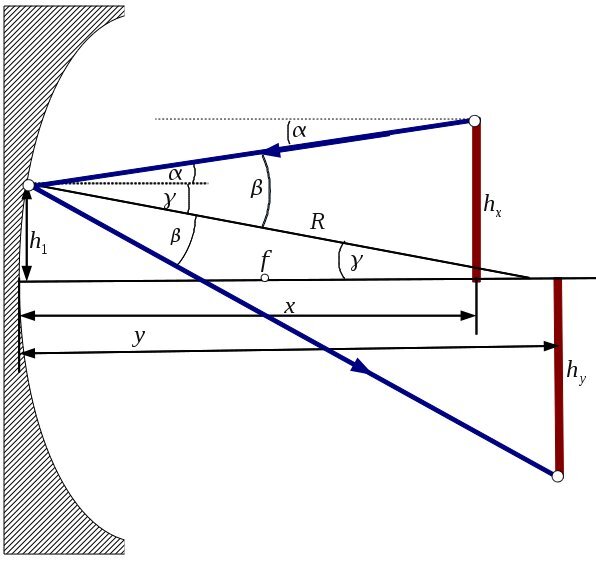
Let's derive the mirror formula using the concave mirror above. An object of height is placed at a distance from the pole (P). A real, inverted image of height is formed at a distance . The center of curvature is C, and the focal point is F.
From the geometry, we can see two pairs of similar triangles:
- Triangle ABC is similar to A'B'C.
- Triangle MDF is similar to A'B'F. (We assume M is at the pole P for paraxial rays, so MD has height .)
From the first pair, we get the ratio:
which translates to
From the second pair, we get:
which translates to
Equating these two expressions and simplifying leads us to the mirror formula. But to use it correctly, we need a consistent way to handle signs for distances.
The Rules of the Road
The provides a standard set of rules for optical measurements. It's essential for getting the right answer every time, whether you're dealing with mirrors or lenses.
| Rule | Description |
|---|---|
| Origin | All distances are measured from the pole (P) of the mirror. |
| Incident Light Direction | The direction of the incident light is taken as positive. Distances measured in this direction are positive. |
| Opposite Direction | Distances measured against the direction of incident light are negative. |
| Heights | Heights measured upwards and perpendicular to the principal axis are positive. Heights measured downwards are negative. |
Applying these rules, for a real image formed by a concave mirror, the object distance , image distance , and focal length are all negative because they are measured to the left of the pole, against the incident light.
The Mirror Formula
After applying the sign convention and a bit of algebra, the geometric relationships simplify into a single, elegant equation.
The relationship between object distance (u), image distance (v), and focal length (f) is expressed through the mirror equation:
A simple but important related formula connects the focal length () to the radius of curvature ().
Magnification
The mirror formula tells us where an image will be, but not how large it is. For that, we need the linear magnification formula, which is the ratio of the image height () to the object height ().
Let's work through an example. An object is placed 30 cm in front of a concave mirror with a focal length of 20 cm. Where is the image formed, and what is its nature?
- Apply Sign Convention:
- Object distance, cm (in front of mirror).
- Focal length, cm (concave mirror).
- Use the Mirror Formula:
- cm. The image is 60 cm in front of the mirror.
- Calculate Magnification:
- .
Since is negative, the image is real. Since is negative, the image is inverted. Since , the image is magnified twice.
Let's review the key terms and formulas we've derived.
Now, test your understanding of these derivations and calculations.
What is the primary reason for using the paraxial ray approximation (or small-angle approximation) when deriving the mirror formula?
In the standard geometric derivation for a concave mirror, the ratio of image height to object height () can be expressed from two different pairs of similar triangles. Which of the following correctly represents one of these expressions?
Understanding these derivations is the key to solving more complex problems involving combinations of mirrors and lenses.