Advanced RAG with Vector Databases
Introduction to Retrieval-Augmented Generation
Giving AI an Open Book
Imagine a brilliant student taking a final exam. They've studied for years and know a vast amount about many subjects. But the exam is closed-book. They can only rely on what they've memorized. Now, imagine that same student taking an open-book exam. They can access textbooks, notes, and articles to find specific, up-to-the-minute information. Their answers will be more accurate, detailed, and trustworthy.
Large language models (LLMs) are like that brilliant student. Their training data is their memory, but it's frozen in time and can have gaps. Retrieval-Augmented Generation, or RAG, is the technique that gives an LLM an open-book test. It connects the model to external knowledge sources, allowing it to pull in relevant, current information before generating a response.
RAG enhances LLMs by grounding them in specific, verifiable facts, leading to more reliable and contextually aware answers.
How RAG Works
The RAG process is a straightforward, two-step dance: first retrieve, then generate. It turns a simple question into a research-informed answer.
-
The Retrieval Step: When you submit a prompt, the system doesn't immediately send it to the LLM. First, a component called the “retriever” searches a pre-defined knowledge base. This could be anything from a company's internal wiki to a database of legal documents or a collection of recent news articles. The retriever finds the snippets of text most relevant to your query.
-
The Generation Step: The system then bundles your original prompt with the relevant information it just retrieved. This new, enriched prompt is sent to the LLM. With this added context, the LLM can generate an answer that is not only fluent but also grounded in the provided facts.
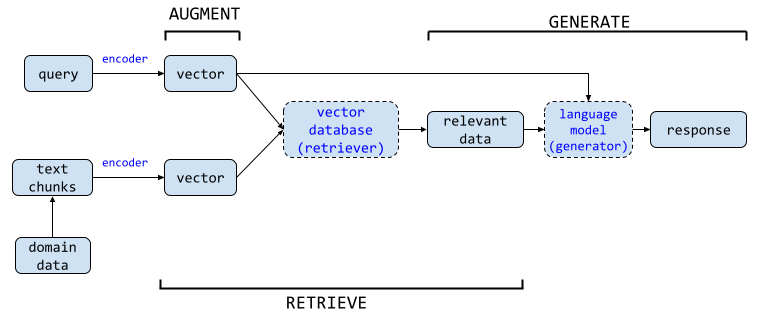
Think of it like asking a research assistant for help. You ask a question, they go to the library and pull the right books, and then you use those books to write your answer. RAG automates this entire process in seconds.
Why RAG is a Game-Changer
Integrating a retrieval step before generation offers powerful advantages that address some of the core weaknesses of standalone LLMs.
First, it dramatically improves factual accuracy. LLMs are known to “hallucinate,” or invent facts, when they don't know an answer. By providing relevant data, RAG grounds the model in reality, reducing the chance of generating misinformation.
Second, RAG keeps information current. An LLM’s knowledge is only as fresh as its last training run. A RAG system, however, can be connected to a constantly updated database. This means it can answer questions about recent events or the latest company policies without needing to be retrained—a costly and time-consuming process.
This ability to tap into live data makes RAG systems ideal for dynamic environments where information changes quickly.
Finally, RAG provides transparency. Because the system can cite its sources—the very documents it retrieved to form the answer—users can verify the information for themselves. This builds trust and is essential for applications in fields like law, medicine, and finance.
RAG in the Real World
The applications for RAG are broad and impactful. Here are a few examples:
-
Customer Support: A chatbot can use RAG to search a company’s product manuals and troubleshooting guides to provide customers with specific, accurate solutions instead of generic answers.
-
Healthcare: A physician’s assistant tool could retrieve information from the latest medical journals and clinical trial results to help a doctor understand treatment options for a patient with a rare condition.
-
Financial Analysis: An analyst could ask a RAG system to summarize market sentiment based on the last 24 hours of financial news, pulling from a live feed of articles to generate an up-to-the-minute report.
In each case, RAG transforms the LLM from a generalist into a domain-specific expert, capable of providing relevant, timely, and trustworthy information.
Now, let's test your understanding of these core concepts.
What is the primary function of Retrieval-Augmented Generation (RAG)?
In the RAG process, what is passed to the LLM during the 'Generation' step?
RAG is a powerful technique for making AI more reliable and useful. By giving models an 'open book,' we can harness their generative power while grounding them in the world of facts.