Advanced RAG System Design and Optimization
Advanced RAG Architecture
Advanced RAG Architecture
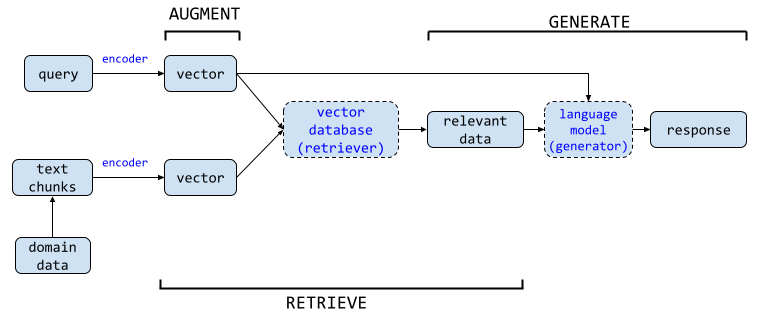
In a sophisticated Retrieval-Augmented Generation (RAG) system, the retriever and the generator are not just sequential components but deeply integrated modules in a dynamic pipeline. The core architectural challenge is to design a seamless data flow that optimizes the quality of information fed into the Large Language Model (LLM) for generation. This isn't a simple hand-off; it's a continuous process of refinement.
The pipeline begins with a user query, which is first processed and potentially transformed. The retriever then fetches a set of relevant documents from a knowledge base, often a vector database. These documents aren't immediately passed to the generator. Instead, they enter a processing phase that can involve re-ranking, filtering, and summarization to distill the most salient information and fit it within the LLM's context window.
This pipeline's efficiency hinges on its retrieval strategy. Simple vector search is often insufficient for complex, real-world applications. More advanced architectures employ a variety of methods to ensure the most relevant and diverse set of documents is retrieved.
Sophisticated Retrieval Strategies
Hybrid retrieval methods are a cornerstone of modern RAG systems. They combine the strengths of different search paradigms, typically sparse retrieval (like keyword-based TF-IDF or BM25) and dense retrieval (vector search). Sparse methods excel at finding documents with exact keyword matches, which is crucial for queries involving specific terms, names, or codes. Dense methods, on the other hand, capture semantic similarity, allowing them to find conceptually related documents even if they don't share keywords.
The results from these parallel retrieval systems must be intelligently merged. A common and effective technique is Reciprocal Rank Fusion (RRF), which combines ranked lists from different sources by prioritizing documents that consistently rank high across multiple lists, without needing to normalize the underlying relevance scores.
| Retrieval Method | Primary Strength | Weakness | Computational Cost | Ideal Use Case |
|---|---|---|---|---|
| Keyword (Sparse) | High precision for exact matches | Fails on semantic variance | Low to Medium | Queries with specific jargon, names, or codes |
| Vector (Dense) | Captures semantic meaning | Can miss keyword-specific results | High (during embedding) | Conceptual or open-ended queries |
| Hybrid | Balances precision and recall | Increased complexity and latency | High | Most production systems requiring robustness |
Beyond hybrid approaches, dynamic retrieval strategies adapt the retrieval process based on the query itself. This is a move from a static pipeline to an intelligent, multi-step process.
One such strategy is query transformation. Instead of using the raw user query, the system might use an LLM to rewrite it, generating multiple variations to capture different facets of the user's intent. For a query like "What were the economic impacts of the Apollo program?" a transformed set might include "cost-benefit analysis of Apollo program," "technological spinoffs from NASA moon missions," and "Apollo program budget vs GDP."
Another dynamic approach is multi-step retrieval, or query decomposition. For a complex question, the system can break it down into sub-questions, retrieve documents for each, and then synthesize the results. This mirrors how a human researcher would tackle a difficult problem, gathering evidence piece by piece before forming a conclusion.
Optimizing the Generation Context
Once a set of relevant documents is retrieved and ranked, the next challenge is preparing it for the generator's limited context window. Naively concatenating documents is suboptimal. Research has shown that LLMs often suffer from the "lost in the middle" problem, where information presented at the very beginning or very end of the context is recalled more accurately than information in the middle.
To combat this, sophisticated RAG systems employ strategic document re-ranking. Instead of relying solely on the initial retrieval score, a secondary ranking model might re-order the documents to place the most critical information at the edges of the context window. This ensures the LLM's attention is focused where it matters most.
Context compression is another vital optimization. An intermediate LLM call can be used to summarize retrieved chunks or extract only the specific sentences that directly answer the query. This technique creates a dense, highly relevant context, filtering out noise and redundant information. This not only improves the quality of the generated response but also reduces the computational overhead and cost associated with processing large contexts.
Ensuring the relevance of retrieved information is an ongoing process. Some systems implement a final validation step where the generated response is checked against the source documents to verify factual consistency and mitigate hallucinations. This cyclical process of retrieval, generation, and validation defines the frontier of RAG architecture, moving it from a simple lookup tool to a robust reasoning engine.
What is the primary architectural challenge in a sophisticated Retrieval-Augmented Generation (RAG) system?
A user asks a RAG system, "Analyze the pros and cons of nuclear energy considering both economic and environmental factors." Which technique is best suited for handling this complex query?
These advanced techniques transform a basic RAG setup into a highly effective and reliable system for knowledge-intensive tasks.