Advanced Quantum Mechanics for Theoretical Research
Quantum Mechanics Review
The Rules of the Quantum World
Classical physics, the world of Newton, describes the things we see every day: a thrown ball, a spinning planet. It’s intuitive and deterministic. If you know where something is and where it’s going, you can predict its entire future. Quantum mechanics is different. It governs the microscopic world of atoms and particles, and its rules are strange, probabilistic, and deeply counterintuitive. To understand it, we start with its foundational principles, or postulates.
- The State Postulate: The state of a quantum system is completely described by a state vector, , which is a vector in a complex vector space known as a Hilbert space. All possible information about the system is contained in this vector.
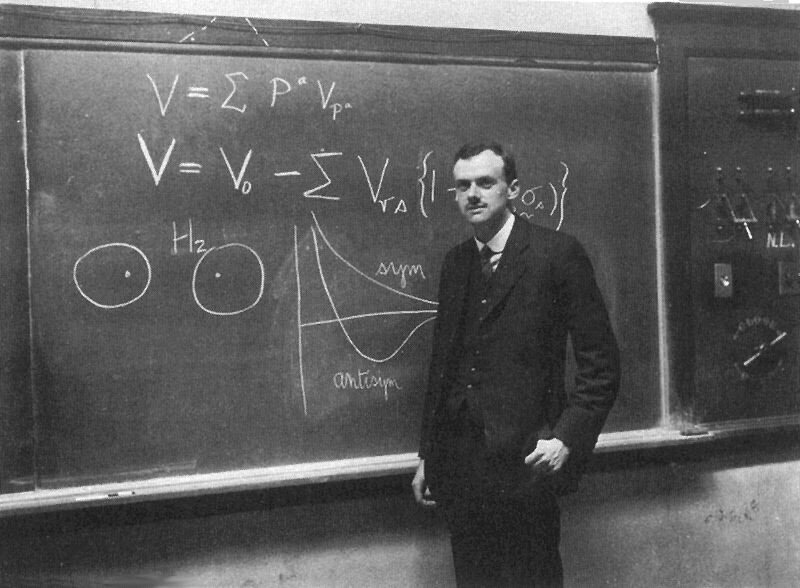
Think of the state vector as the ultimate description of a particle. It's not just its position or momentum, but everything about it, encoded in a mathematical object. This notation, , is called a "ket" and is part of the bra-ket notation developed by Paul Dirac, one of the pioneers of quantum theory.
- The Operator Postulate: Every measurable physical quantity (like energy, position, or momentum) corresponds to a mathematical operator. For a quantity , its operator is denoted by $"\hat{A}".
An operator is something that acts on a state vector to extract information. You can't just "look" at a quantum particle to know its position. Instead, you apply the position operator to its state vector.
Particles as Waves
One of the most mind-bending ideas in quantum mechanics is that particles like electrons can also behave like waves. This isn't just an analogy; they exhibit wave properties like interference and diffraction. The most famous demonstration of this is the double-slit experiment.
Imagine firing a stream of electrons, one by one, at a barrier with two thin, parallel slits. If electrons were just tiny balls, you'd expect to see two bands on the detector screen behind the barrier, corresponding to the two slits. But that's not what happens.
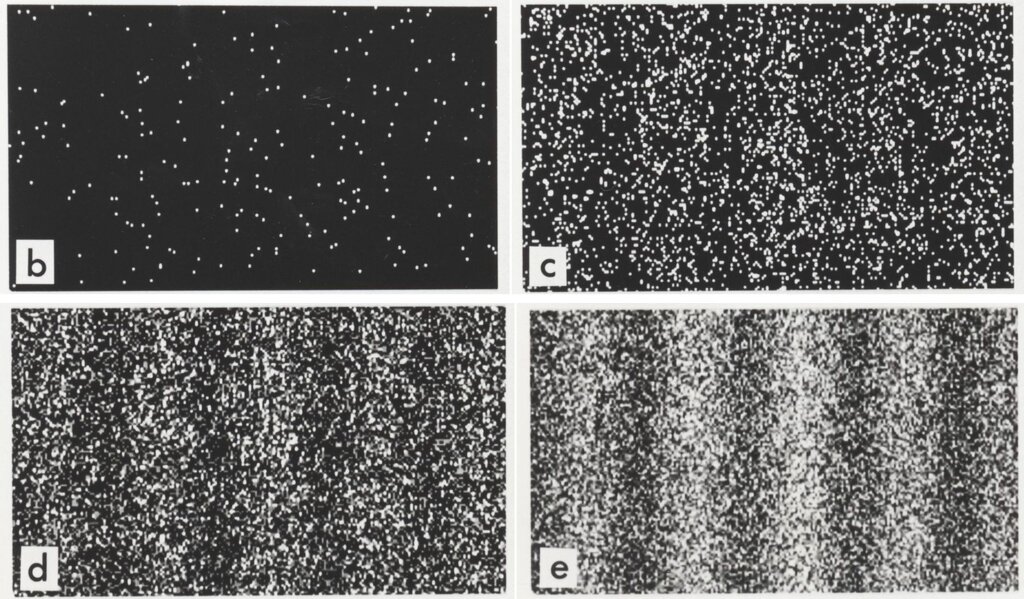
Instead, an interference pattern emerges, a series of bright and dark bands, just as you'd see if you passed a light wave through two slits. It seems each individual electron passes through both slits simultaneously, interfering with itself like a wave. The electron's state is described by a wave function, |"\Psi"⟩xt$.
So how does this state evolve over time? That's described by another postulate, centered on one of physics' most famous equations.
- The Dynamics Postulate: The time evolution of the state vector is governed by the Schrödinger equation.
Here, is the imaginary unit, is the reduced Planck constant, and is the Hamiltonian operator, which corresponds to the total energy of the system. This equation is the quantum equivalent of Newton's second law (). It tells us how the quantum state changes from one moment to the next.
Measurement and Collapse
The quantum world is probabilistic. We can't know for certain what the result of a measurement will be. We can only calculate the probabilities of different outcomes. This is where the last two postulates come in.
- The Measurement Postulate (Born Rule): The possible results of measuring a physical quantity are the eigenvalues of its corresponding operator . The probability of measuring a particular eigenvalue is given by the square of the amplitude of the corresponding eigenvector in the state's expansion.
That sounds complicated, but the core idea is simpler. A particle can be in a mix of many possible states at once. This is called superposition. For example, an electron's spin can be both "up" and "down" simultaneously. When you measure its spin, you will get either up or down, never something in between. The Born rule tells you the probability of each outcome.
- The Collapse Postulate: Immediately after a measurement of yields the result , the state of the system collapses from its initial state to the corresponding eigenvector .
This is perhaps the strangest part. The act of measurement fundamentally changes the system. Before you measure the electron's spin, it's in a superposition of up and down. The moment you measure it and get "up," the wave function collapses. The particle is now definitively in the "up" state. All the other possibilities have vanished.
superposition
noun
The principle that a quantum system can exist in multiple states at the same time. The state is a combination of all possible states.
An even more bizarre quantum phenomenon is entanglement. It's possible to link two or more particles in such a way that their fates are intertwined, no matter how far apart they are. If you have two entangled electrons, you know that if you measure one and find its spin is "up," the other must instantly be "down," and vice versa. This connection is instantaneous, what Einstein famously called "spooky action at a distance."
Two concepts in quantum physics that are the building blocks of quantum computing are superposition and entanglement.
These concepts, from wave-particle duality to entanglement, form the bedrock of quantum mechanics. They challenge our classical intuition but provide an incredibly accurate description of the universe at its smallest scales.
Ready to check your understanding? Let's tackle a few questions on these core concepts.
What is the primary role of a state vector, represented as , in quantum mechanics?
In the double-slit experiment, firing electrons one by one at the barrier results in an interference pattern on the detector screen. What does this outcome demonstrate?
These principles aren't just theoretical curiosities. They are the foundation for technologies like lasers, semiconductors, and the emerging field of quantum computing.