Advanced Quantum Mechanics Applications
Mathematical Formalism
From Waves to Vectors
In quantum mechanics, we describe the state of a system not with definite properties like position and momentum, but with a mathematical object called a state vector. Instead of picturing a particle as a tiny ball, think of its state as an arrow pointing in a specific direction within a vast, abstract space. We denote this state vector using bra-ket notation as , which is called a "ket" vector.
These vectors don't live in the familiar 3D space we walk around in. They exist in a —a type of complex vector space that provides the mathematical arena for quantum mechanics. Just as a vector in 3D can be described by its components along the x, y, and z axes, a quantum state vector can be described by its components along a set of basis vectors. A key feature of Hilbert space is that it includes an "inner product," a way to multiply two vectors to get a scalar. This operation is crucial for calculating probabilities.
Observables as Operators
If a system's state is a vector, how do we extract physical information like its energy or momentum? We can't just "look" at the vector. Instead, every measurable property, or "observable," is represented by a specific linear operator. An operator is a mathematical rule that transforms one vector into another.
Think of an operator as a question you ask a quantum system. The operator for energy asks, "What is your energy?" The operator for position asks, "Where are you?"
For example, the most important operator is the Hamiltonian, denoted , which corresponds to the total energy of the system. When the Hamiltonian operator acts on a state vector, it dictates how that state will evolve through time. Other observables, like momentum () and position (), also have their own unique operators.
The Eigenvalue Equation
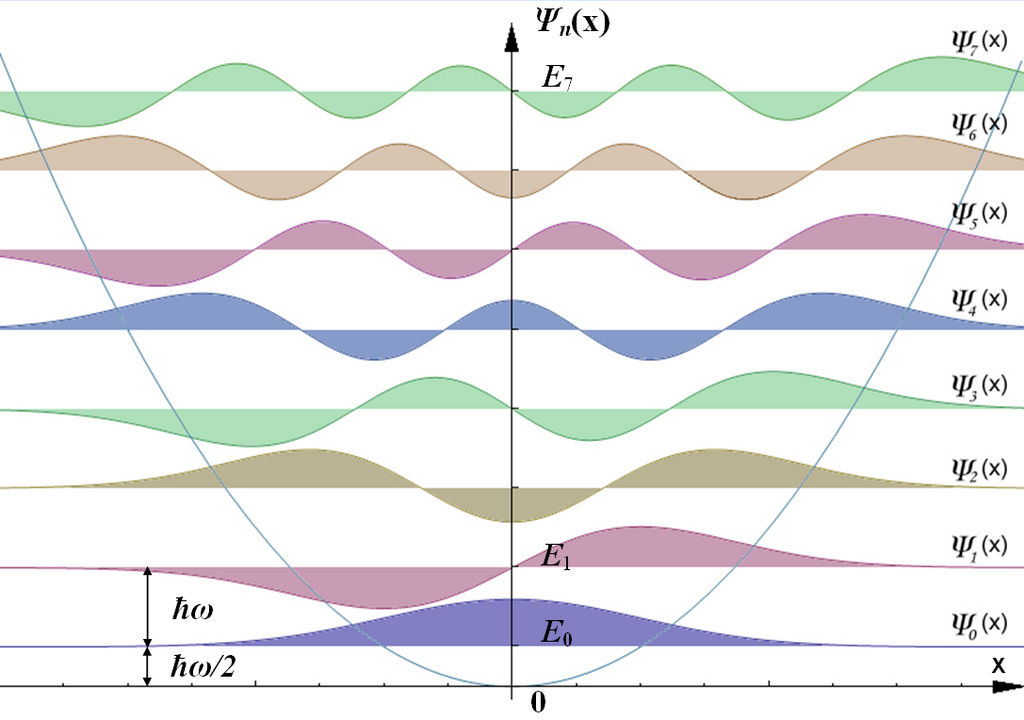
So, an operator asks a question. What does the answer look like? This is where the eigenvalue equation comes in. It's one of the most fundamental concepts in quantum mechanics. It states that for a given operator , there are special states called "eigenstates." When the operator acts on one of its eigenstates, it doesn't change the state's "direction" in Hilbert space; it just multiplies the state by a constant scalar. This scalar is called the eigenvalue.
The crucial insight is this: the only possible result you can ever get from measuring an observable is one of its eigenvalues. A particle in a superposition of many energy states will, upon measurement, collapse into a single energy eigenstate, and the measured energy will be the corresponding eigenvalue. This is how quantum mechanics enforces that energy levels in atoms, for example, are discrete rather than continuous.
Probabilities and Time Evolution
A general quantum state is usually not a single eigenstate but a superposition of many different eigenstates. We can write it as a linear combination of the eigenstates of an operator :
The coefficient is the for finding the system in the eigenstate . To find the actual probability, we take the square of its absolute value, . This value, , is the probability that a measurement of the observable A will yield the eigenvalue . The sum of all these probabilities must, of course, equal 1. The coefficients themselves are found by taking the inner product of the state with each basis vector: .
Finally, the state of an undisturbed quantum system evolves in time according to the Schrödinger equation. In the language of state vectors, this evolution is described by applying a time evolution operator, which is built from the system's Hamiltonian operator .
This formalism provides a complete and powerful framework for predicting the behavior of quantum systems. By representing states as vectors and observables as operators, we can use the tools of linear algebra to unlock the secrets of the quantum world.
In quantum mechanics, what does a state vector, denoted as a 'ket' like , represent?
When a quantum system is measured for a specific observable (like energy), the result of the measurement will always be one of the operator's eigenvalues.